
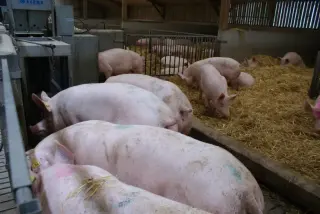
How innovation is transforming Breton pig farming
Changing societal expectations, new regulations and health crises have helped transform the Breton pig sector over the past thirty years. Read also: Nine award-winning pig farming…
Results for “Vaccination” · All content · Newest first
Changing societal expectations, new regulations and health crises have helped transform the Breton pig sector over the past thirty years. Read also: Nine award-winning pig farming…
Fowlpox, also called avian pox, is a slowly spreading viral disease of chickens. It is characterized by proliferative nodular lesions or scabs on the head, comb, eyelids, and watt…
Introduction: Many factors can cause abnormal egg production in laying hens, including physiological, nutritional, stress-related, and pathological factors. This article briefly d…
Assays available: Gross pathology Visual inspection of lung lesions Figure 1. Picture demonstrating the classical cranial ventral consolidation associated with Mycoplasma hyopneum…
Building Disease Resilience in Pigs: Why Genetics Is Changing the Game Pig production is facing a rapidly evolving disease landscape. Pathogens such as PRRS continue to emerge, sp…
Fowlpox is a highly contagious viral disease. It tends to spread in autumn and winter, especially in damp environments where mosquitoes are abundant, as they can accelerate transm…
Fowlpox is an acute, highly contagious infectious disease caused by the fowlpox virus. It mainly affects the skin and oral mucosa of chickens, and occasionally affects both at the…
Vaccination is an important barrier to ensuring the health of a flock and one of the most important aspects of production management. The following principles must be observed: “F…
Vaccination is the most effective way to prevent infectious diseases. A vaccination is considered successful when it produces good antibody levels. However, after comparing antibo…
In the previous post, we discussed booster vaccination: giving an extra shot does not automatically mean more reliable protection; every booster should have a clear protective goa…
Infectious bronchitis (IB) is an immunologically controlled disease affected by the environment. In autumn, large temperature fluctuations and sudden changes in temperature can ex…
Influenza A virus (IAV) causes respiratory disease with systemic complications in a variety of avian and mammalian hosts, including humans and pigs. Infection with IAV in newborns…
Farm description The farm is a conventional farm with external replacements located in Piedmont, Italy in an area with a high pig density. The nearest farm is about 500 meters awa…
I. Newcastle disease in chickens Caused by Newcastle disease virus, this disease can occur throughout the year. It has an acute onset, spreads rapidly, and has a high mortality ra…
Respiratory diseases are one of the problems that have the greatest impact during the finishing period because: They are typically recurrent pathologies. They tend to have a signi…
The role hatcheries play in modern poultry production is significant, laying the foundation for flock health and business performance. As hatcheries utilize more automation and te…
Uniformity refers to how consistent the body weights of all birds in a flock are. It is an important indicator for evaluating a replacement pullet flock. Uniformity not only refle…
[Excerpts from two presentations during the 2026 annual meeting of the American Association of Avian Pathologists] David Swayne, Birdflu Veterinarian LLC, USA, noted that the expa…
Infectious bursal disease (IBD) remains a significant challenge for poultry producers because early infection in a bird’s life can compromise immune function and create opportunit…
Key takeaways Current ILT outbreaks in the U.S. are predominantly associated with field strains in the cases studied.1 Proper application protocols are important for optimal ILT v…