Changing societal expectations, new regulations and health crises have helped transform the Breton pig sector over the past thirty years.
Read also: Nine award-winning pig farming innovations at Innov’Space
To assess these changes objectively, the Brittany Chamber of Agriculture conducted an evaluation of the impact of research, innovation and development activities. The selected topic was animal health and welfare. This case study, focusing on the livestock farming link in the chain, analyses how the knowledge generated, the tools developed and the support systems have had an impact on animal welfare, health, farm economics, and the working conditions of farmers and their employees. It shows that three broad categories of stakeholders with interdependent roles enable innovations to spread when they interact coherently:
The main stakeholders (technical institutes, INRAE, chambers of agriculture) produce reference materials, test solutions and support their dissemination.
Influential stakeholders (public authorities, interprofessional organizations, agricultural unions) shape the regulatory framework, guide investment, and support transitions.
Affected stakeholders (livestock farmers, groups, supply chain operators) implement transformative solutions.
This structure highlights the central role of experimental stations, training programs, public policy development, and supply chain stakeholders in moving from research results to widely adopted practices.
Stay up to date in real time!
Follow topics, legislative projects, companies, and public figures to be notified as soon as we publish an article.
Animal welfare: gradual evolution
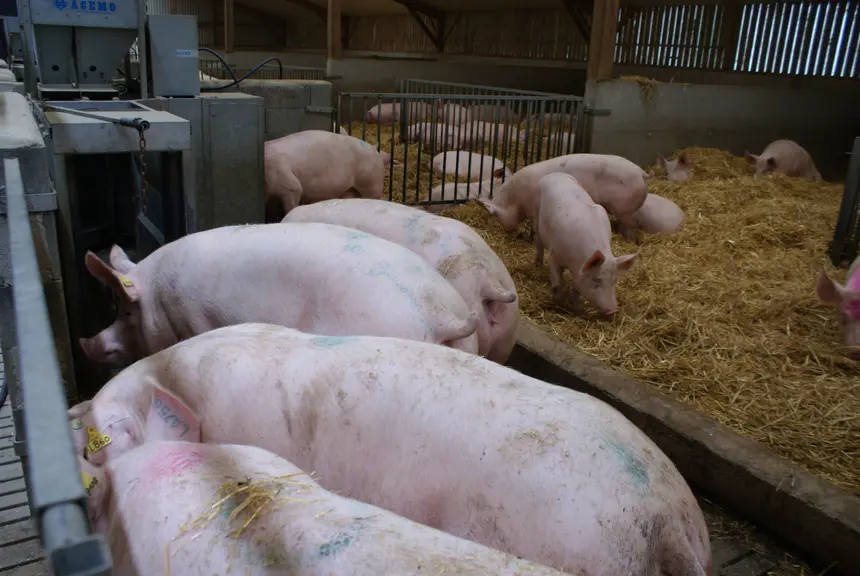
The most visible changes concern animal housing. The move to group housing for pregnant sows, which began in the 2000s, rose from 10% of farms in 2003 to 100% over a decade. To achieve this, findings from projects conducted at experimental stations as early as the nineteen-eighties helped calibrate equipment and farming practices, and then support farmers. At the same time, pen enrichment has become widespread, and diagnostic tools such as BEEP (well-being in pig farming) from Ifip make it possible to assess welfare on farms objectively. The production of entire or immunocastrated males, as well as the discontinuation of tail docking, demonstrates the sector’s ability to progressively adopt alternatives to painful practices. The accounts collected show that these changes benefit animals just as much as they benefitfor breeders, who mention brighter, more ergonomic buildings that are better suited to daily work. They also help improve the image of the sector among the general public and local stakeholders.
Animal health: prevention and biosecurity
Health prevention strategies have led to a decrease in antibiotic use of 67% between 2011 and 2022. Spending on curative treatments fell by 9% between 2006 and 2016. Livestock farmers have adopted biosecurity, targeted vaccination, and livestock monitoring tools. This momentum strengthens the health resilience of livestock farms and their ability to respond to crises, particularly in the face of emerging risks such as African swine fever. These developments have also enabled the growth of differentiated segments such as “antibiotic-free” supply chains, which accounted for 15% of production in 2020.
Economic and social: structuring investments
The changes required significant investment: bringing housing for pregnant sows up to standard represents nearly 300 million euros in Brittany. Beyond the economic aspects, increased technical expertise is one of the most notable outcomes. Professionals have strengthened their skills in biosecurity, managing farrowing units with free-farrowing systems, health management, and data analysis. These skill gains and the associated improvements in livestock-rearing conditions make the profession more attractive to farmers and employees, facilitate the transfer of farms, and strengthen alignment with the principles of One Welfare, which link animal welfare, human well-being, and overall performance.
A gradual and collective transition
The timeline of actions shows that innovations spread sustainably only when they are supported by a foundation of proven references, technical assistance, and a coherent regulatory framework. However, overcoming the social, technical, and economic barriers to adopting new practices takes time. Combining the generation of knowledge and operational tools with their deployment and the development of new public policies is a lengthy process, but one that can lead to real changes in livestock farming and generate impacts. For example, group housing for sows was able to be widely adopted quickly, whereas other changes, such as ending tail docking or transitioning to free-farrowing systems, require more gradual adjustments and stronger support. This study also illustrates the importance of an evaluation rRegular and multi-criteria assessment of research and development activities to maximize their societal impact and enable them to engage in new research programs to address tomorrow’s challenges.
Mathieu Merlhe, [email protected]
Brittany Chamber of Agriculture
Analyze the impacts of applied research
The study is based on a method developed by Inrae and adapted by technical institutes and the Ministry of Agriculture to assess the societal impacts of applied research across five dimensions: economic, health, political, environmental, and social. This approach combines a scientific, technical, and regulatory literature review with twenty-two in-depth interviews with livestock farmers, advisers, engineers, researchers, and industry representatives.