In the previous installment, we discussed different routes of administration. But the route of administration answers the question, “How does the vaccine enter the body?” There is another, more fundamental question: What exactly is entering the body?
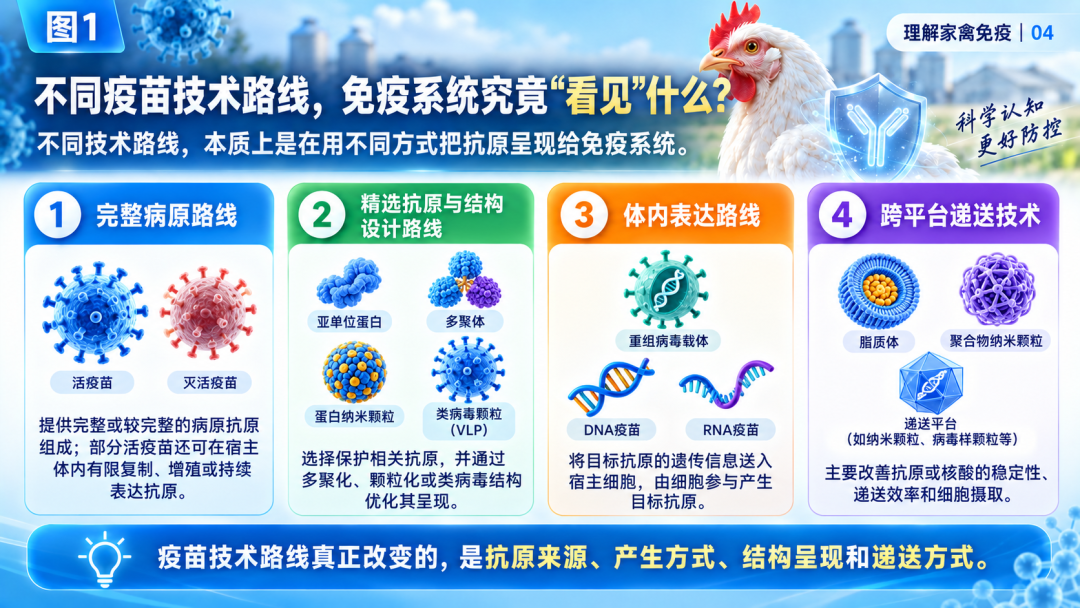
Although they are all called “vaccines,” live vaccines may provide intact pathogens with some biological activity; inactivated vaccines provide intact or relatively intact pathogen antigens that can no longer replicate; subunit vaccines select the antigen components associated with immune protection. Further approaches include viral vectors, DNA, RNA, VLPs, protein nanoparticles, and various delivery technologies [ 1–3 ].
How exactly do vaccines provide target antigens to the immune system?
01, different vaccine technology platforms: what exactly does the immune system “see”?
The complete pathogen route: live vaccines retain a certain degree of biological activity. Many live vaccines can replicate, proliferate, or continuously express antigens to a limited extent at specific sites in the host; inactivated vaccines lose the ability to replicate but usually retain a complete or relatively complete composition of pathogen antigens[1,2].
The selected-antigen and structural-design route: subunit vaccines no longer use the complete pathogen, but instead select one or more protective antigens. Antigens can also be designed as multimers or protein nanoparticles, or further assembled into structures such as virus-like particles (VLPs)[1,4,5].
The in vivo expression route: recombinant viral vectors, DNA, and RNA deliver the corresponding genetic information to host cells, enabling the cells to participate in producing the target antigen[1-3]. In addition, delivery technologies such as lipid or polymeric nanocarriers span multiple platforms.
02, what exactly changes from whole pathogen to selected antigen?
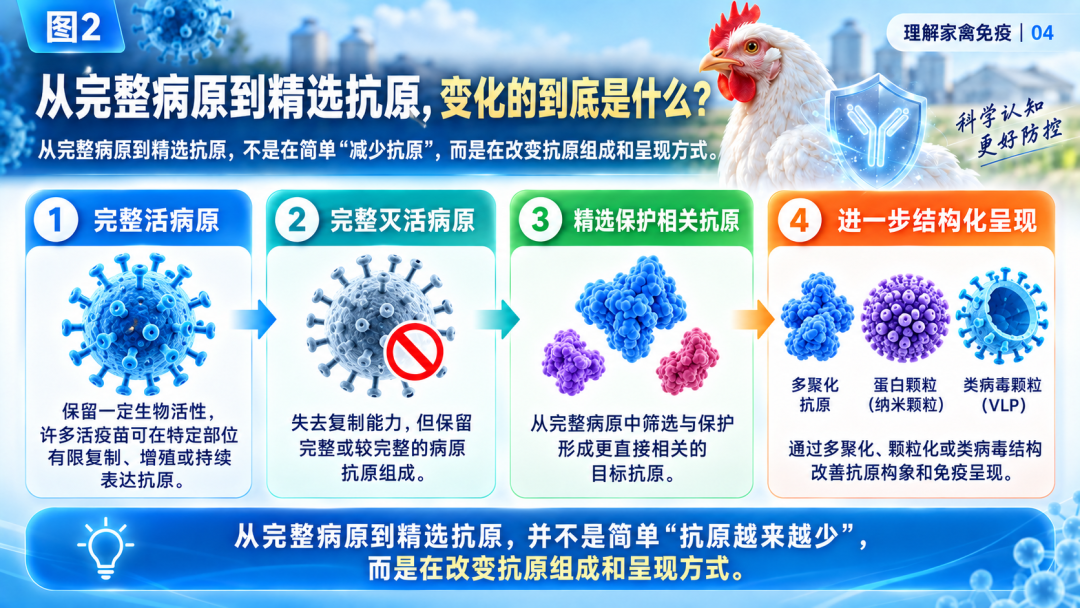
Whole pathogen vaccines provide a broad antigen spectrum in a single dose. The approach of subunit vaccines is different: selecting antigens with genuine protective value from complex pathogens, then presenting them anew through expression, purification, and structural design.
For example, research on novel variant infectious bursal disease virus has been able to use VP2 to construct VLP candidate vaccines; avian influenza research has also shown that HA can be presented in a structured form through VLPs and induce an immune response in chickens[4,5].
What truly changes is that the antigen composition is more selective, while the antigen’s spatial structure, repeated arrangement, and presentation format can also be redesigned.
But this does not mean that “the fewer antigens, the more advanced,” nor that any subunit platform will inherently be superior to a whole-pathogen vaccine.
03, viral vectors, DNA, and RNA: why do they all belong to the “in vivo expression” approach?
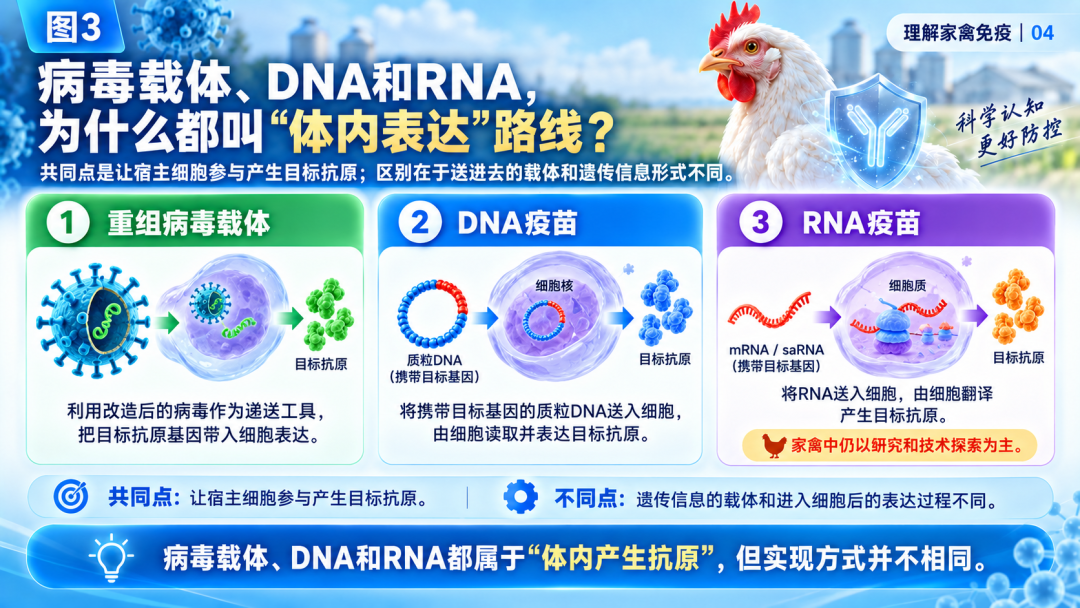
First deliver the genetic information for the target antigen, then host cells participate in producing the antigen.
Recombinant viral vectors use modified viruses as delivery vehicles to carry the target antigen gene into cells. Several relatively mature viral vector technologies are already used in poultry, such as recombinant vectors based on herpesvirus of turkeys, fowlpox virus, or Newcastle disease virus [ 3 ].
DNA vaccines typically deliver plasmid DNA encoding the target antigen into cells, where it is then transcribed and translated to produce the antigen. RNA vaccines, by contrast, deliver RNA directly into the cytoplasm, where cells translate it to form the target antigen. In recent years, related research has indicated that this technology has research potential in the poultry field 6,7.
RNA vaccines are currently still mainly at the research and technology exploration stage in poultry, and are not a mainstream vaccine platform in routine production.
Are 04, particulate antigens, and nanocarriers the same thing?
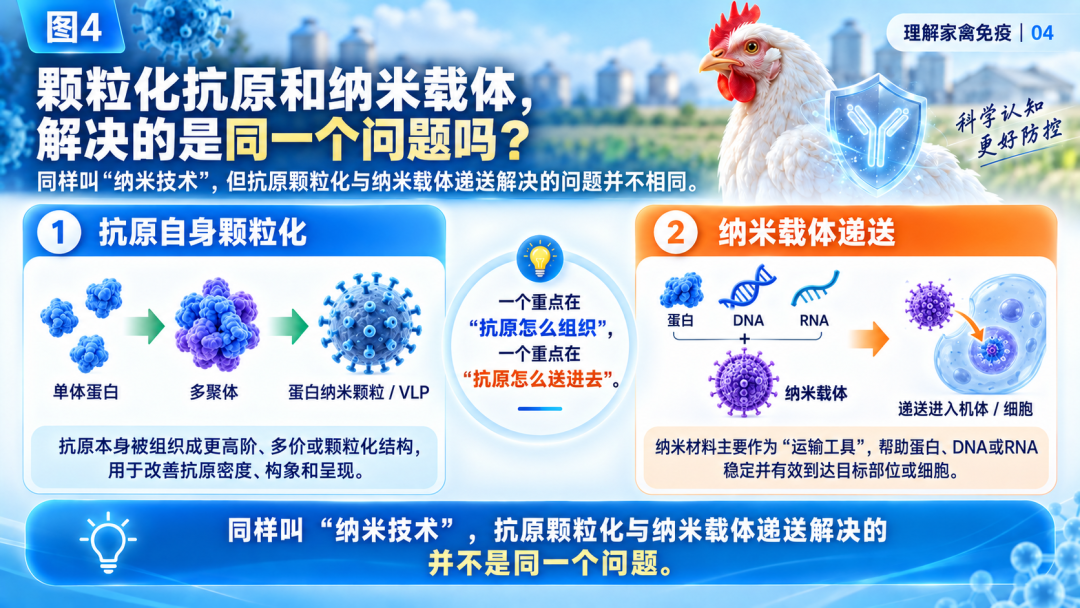
One situation is when the antigen itself is organized into particles—for example, multiple proteins form an ordered multimeric structure and self-assemble into nanoparticles. VLPs further mimic the overall geometry of a virus, but usually do not contain a complete viral genome capable of replication 4,5.
Another situation is the use of nanomaterials to deliver antigens. Materials such as lipids and polymers can encapsulate or carry proteins, DNA, RNA, and other components, with a focus on addressing stability, transport, and cellular uptake.
Protein nanoparticles are not the same as nanodelivery carriers, and VLPs cannot simply be equated with all protein nanoparticles.
References
[1] ABDELAZIZ K, HELMY Y A, YITBAREK A, et al. Advances in poultry vaccines: leveraging biotechnology for improving vaccine development, stability, and delivery[J]. Vaccines, 2024, 12(2): 134.
[2] BODMAN-HARRIS O, ROLLIER C S, IQBAL M. Approaches to enhance the potency of vaccines in chickens[J]. Vaccines, 2024, 12(12): 1337.
[3] HEIN R, KOOPMAN R, GARCÍA M, et al. Review of poultry recombinant vector vaccines[J]. Avian Diseases, 2021, 65: 438-452.
[4] WANG Y, JIANG N, FAN L, et al. Development of a virus-like particle candidate vaccine against novel variant infectious bursal disease virus[J]. Vaccines, 2021, 9(2): 142.
[5] ABOLNIK C, SMITH T, WANDRAG D B R, et al. Dose immunogenicity study of a plant-produced influenza virus-like particle vaccine in layer hens[J]. Heliyon, 2022, 8: e09804.
[6] XU S, ZHANG B, YAO J, et al. A new H9 influenza virus mRNA vaccine elicits robust protective immunity against infection[J]. Vaccine, 2023, 41: 2905-2913.
[7] SNOECK J, CHIERS K, TAM Y, et al. Evaluation of a self-amplifying mRNA reporter vaccine in explant models of broiler chickens[J]. Poultry Science, 2023, 102: 103078.