

In the previous installment, we discussed why flocks need vaccines. Chickens already have an immune defense system, and one benefit of vaccines is to prepare the immune system as early as possible to target pathogens. But when a pathogen actually strikes, where does protection come from?
In production, antibody levels are often the most commonly used evaluation metric, so it is easy to develop the intuition that the higher the antibody levels, the better the protection; as long as antibodies are present, the vaccine is working. Antibodies are certainly important, but actual immune protection is not provided by a single metric [ 1-4 ].
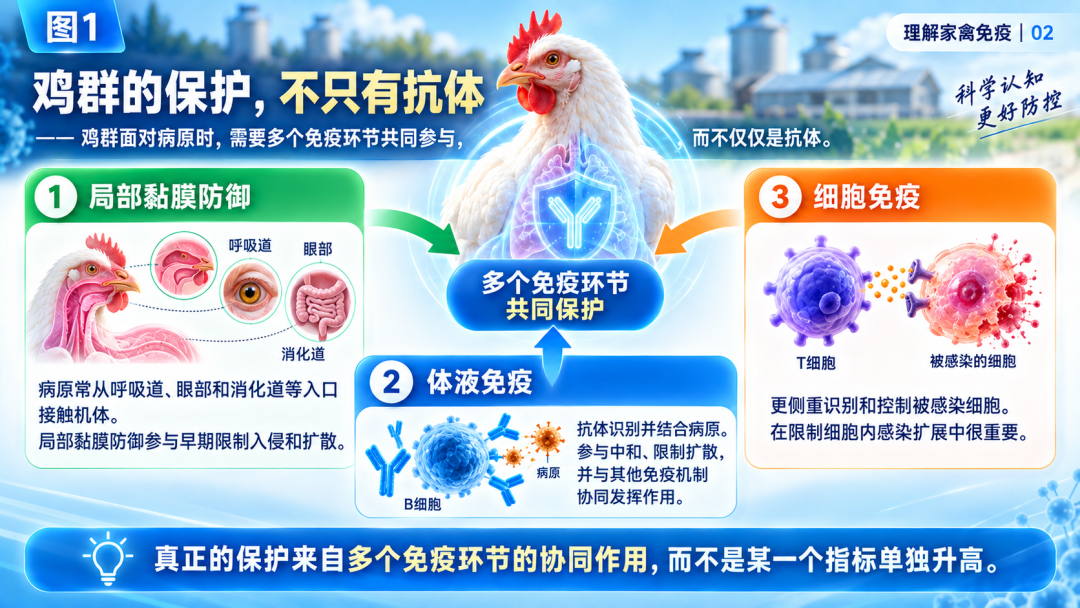
01Protection for the flock is not just about antibodies
Strictly speaking, mucosal immunity, humoral immunity, and cellular immunity are not three entirely parallel and independent systems. Mucosal immunity primarily emphasizes where the immune response occurs and the local environment; mucosal tissues also have innate defenses, antibody responses, and cellular immunity.
Humoral immunity primarily emphasizes specific immune responses involving B cells and the antibodies they produce; cellular immunity places greater emphasis on immune cells such as T cells participating in the recognition and control of infection[1-3].
True protection is closer to the result of coordination across multiple stages than to an increase in any single immune indicator.
What is the local defense doing when 02 pathogens enter through the mucosa?
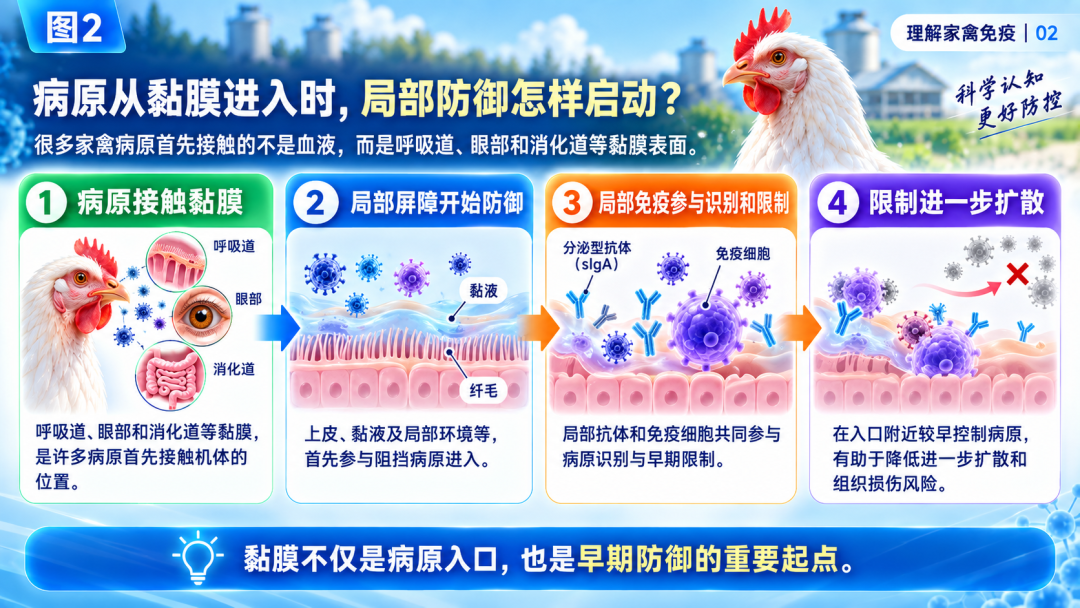
The mucous membranes of chickens’ respiratory tract, eyes, and digestive tract remain in contact with the external environment over long periods and are also important sites where many pathogens first come into contact with the body.
Mucus, epithelial cells, cilia, and local immune cells together form a barrier and defensive environment; once adaptive immunity is established, locally secreted antibodies and other factors can also participate in pathogen recognition and neutralization, as well as limit contact between pathogens and epithelial cells [ 2,3 ].
Mucosal defense does not mean only IgA.
Mucosal tissues also contain various immune cells, including macrophages, dendritic cells, B cells, and T cells. “Mucosal immunity” is better understood as an integrated immune response occurring in the special frontline environment of the mucosa[2].
What problems do 03 antibodies and cellular immunity address, respectively?
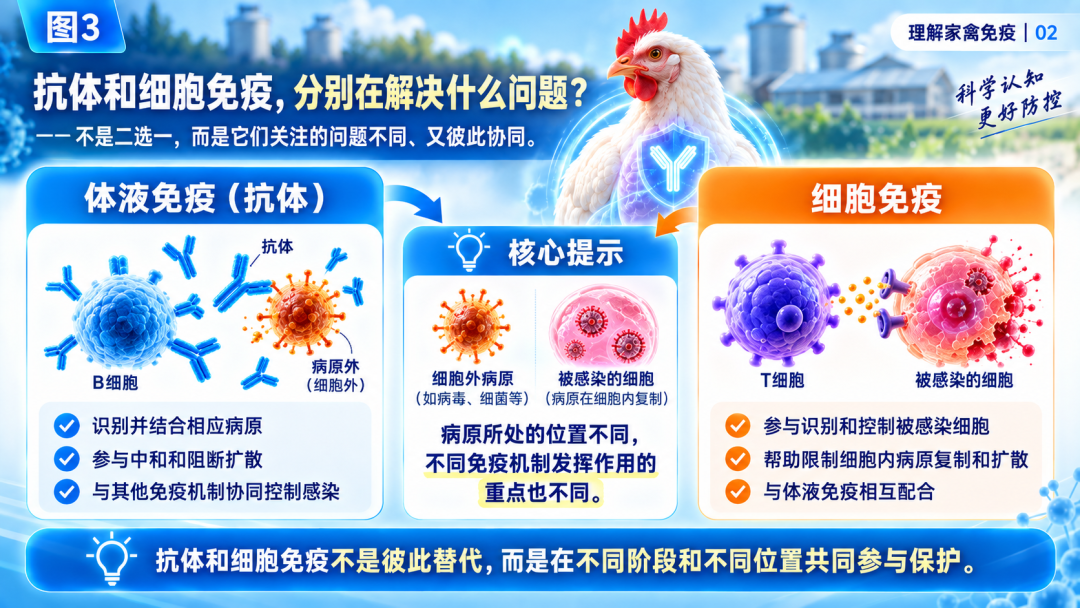
After B cells are activated by the corresponding antigen, they can further differentiate and produce specific antibodies. Antibodies can recognize the corresponding antigen and, in different diseases, participate in neutralizing pathogens, blocking pathogens from binding to target cells, limiting their spread, or helping other immune mechanisms further clear pathogens[1,3,4].
However, antibodies cannot explain all protection. After some pathogens, such as viruses, enter cells, extracellular antibodies alone are not enough to fully control them. At this point, cellular immunity involving T cells and other components becomes more important[1,3]。
Nor should the two be absolutely separated in the opposite way, as if “antibodies only deal with what is outside cells, while cellular immunity only deals with what is inside cells.” During real infections, humoral immunity and cellular immunity often work together extensively.
04True protection comes from the coordinated action of multiple immune mechanisms
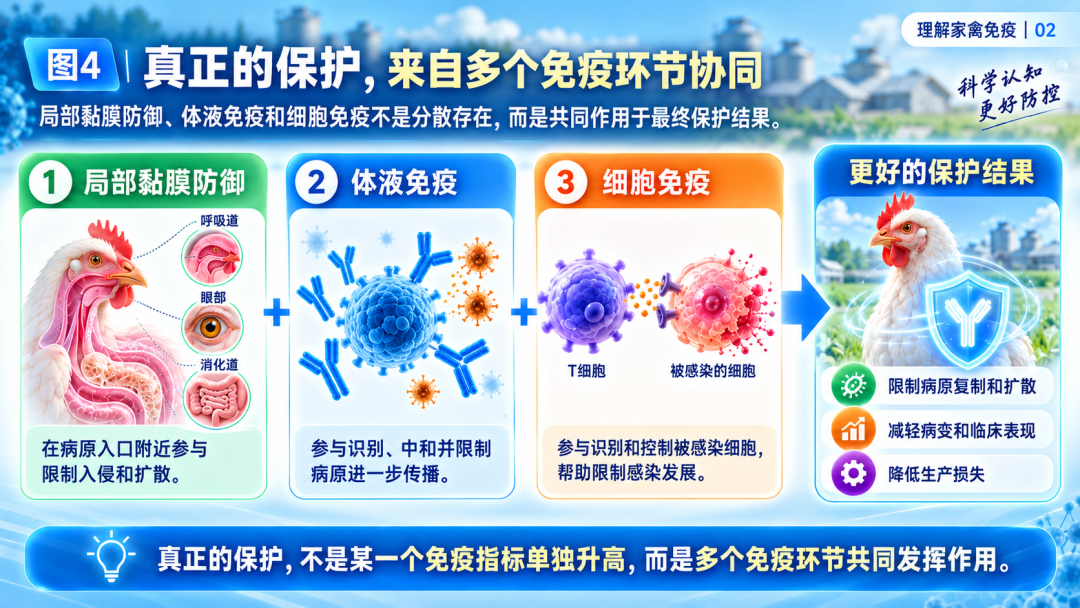
When a pathogen first comes into contact with the body, local barriers and innate immunity help limit it at an early stage; established local specific immunity can further help control the pathogen; antibodies participate in recognition, neutralization and limiting its spread; cellular immunity participates in regulating the immune response and controlling infected cells [ 1-4].
This also explains why, in production, looking at a single antibody number alone often cannot fully answer the question, “Is the flock actually protected?” Antibody testing can help us understand the humoral immune response, but true vaccine protection is ultimately reflected in whether the pathogen is controlled, tissue damage is reduced, clinical signs decline, and production performance is maintained [[4]].
True protection does not come from a single immune indicator increasing on its own, but from multiple immune mechanisms working together in the right places and at the right times.
References
[1] KAISER P. Advances in avian immunology—prospects for disease control: a review[J]. Avian Pathology, 2010, 39(5): 309-324.
[2] NOCHI T, JANSEN C A, TOYOMIZU M, et al. The well-developed mucosal immune systems of birds and mammals allow for similar approaches to mucosal vaccination in both types of animals[J]. Frontiers in Nutrition, 2018, 5: 60.
[3] SHARMA J M. Introduction to poultry vaccines and immunity[J]. Advances in Veterinary Medicine, 1999, 41: 481-494.
[4] RAUTENSCHLEIN S, SCHAT K A. The immunological basis for vaccination[J]. Avian Diseases, 2023, 67(4): 366-379.