
Report Overview
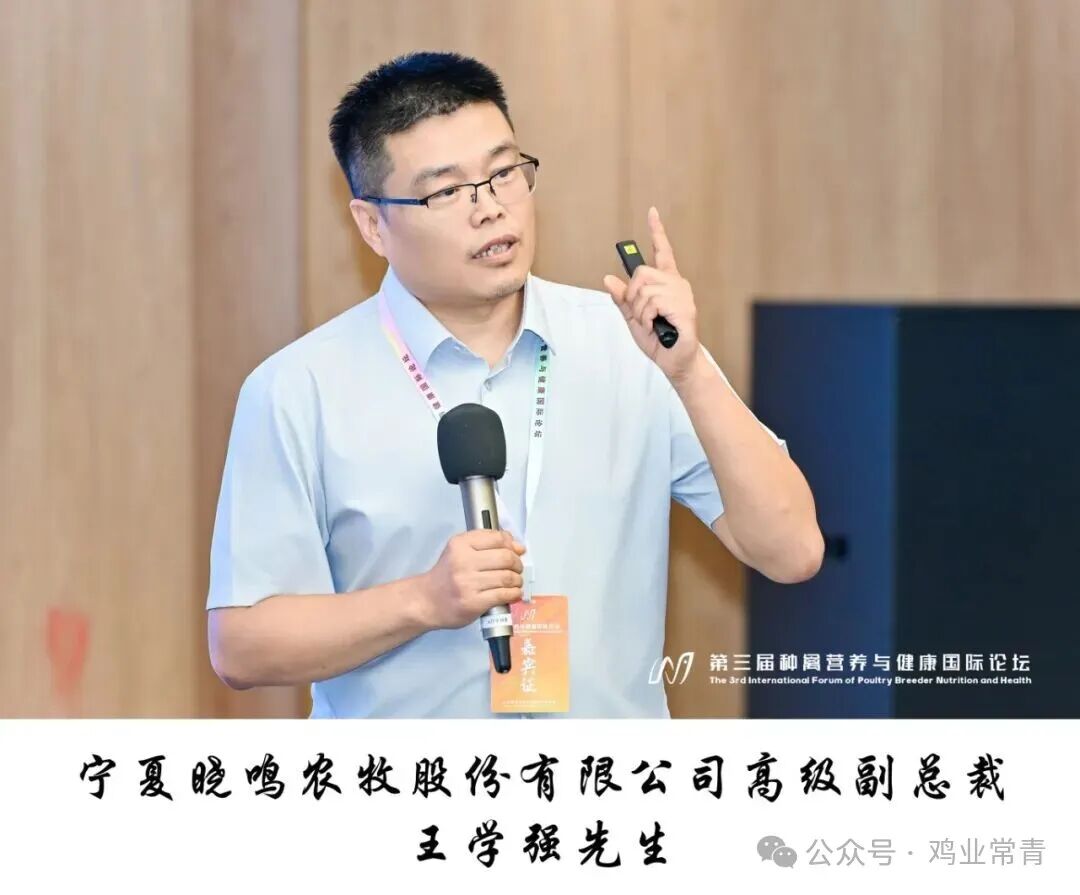
Mr. Wang Xueqiang, Senior Vice President of Ningxia Xiaoming Agriculture and Animal Husbandry Co., Ltd., holds an EMBA from Renmin University of China. He has extensive hands-on experience in the feeding and management of breeding chickens, technical management, biosecurity, and technical guidance for major customers, and is widely recognized in the industry as an “expert in laying hens.”
Chicken farming is a systematic undertaking, and any weak link can undermine returns. Starting from the “ten essential conditions for raising chickens well,” Wang Xueqiang brought together good chicks, good feed, good water, a good environment, good housing, good stock, good disease prevention, good practices, good plans, and a good team to form a “wooden barrel,” and focused on breaking down practical approaches to gut health.
Ten Conditions, One Wooden Barrel
Good chicks, good feed, good water, a good environment, good housing, good stock, good disease prevention, good practices, good plans, and a good team. Weak links determine the water level; strengths determine the advantage. 5A chicks: clean, healthy, resilient, happy, and comfortable; 5A feed: safe, comprehensive, balanced, precise, and reliable; 5star drinking water: harmless, non-toxic, fresh, pure, and clean; six aspects of a good environment: good ventilation, clean air with little dust, controllable stress, suitable temperature, humidity meeting standards, and appropriate lighting; 5good poultry houses: suitable width, height, and roof pitch to facilitate ventilation and heat retention. Wang Xueqiang particularly emphasized: “There is no such thing as a free lunch, and the same is true for chickens!” Nutrition must follow the conservation of matter and energy. Good feed is not necessarily better the more expensive it is; rather, it must be precisely matched.
Gut health: poultry’s largest digestive and immune organ
The four key factors affecting gut health are husbandry management, nutritional supply, pathogenic microorganisms, and genetics and breed. The corresponding solutions follow four tracks: optimizing husbandry management, scientifically configuring nutrition, implementing systematic disease prevention and control, and improving breeds and optimizing the microbiota. The principles are clear; the key is how to put them into practice. The practical experience shared by Wang Xueqiang is the truly valuable part.
Practical lesson one: Read the limestone clues in chicken manure and put calcium where it counts
There’s no need to guess whether there’s enough stone powder; check the chicken manure. If you can see obvious small particles of stone powder in the droppings, the amount added may be insufficient, or the particle size may be too large, resulting in poor digestion and absorption.
Practical case two: Controlling water quality is more cost-effective than expensive additives.
Rather than spending a lot on additives to protect the gut, start by keeping the water lines in good condition. Xiaoming5 Star’s drinking water standards: harmless, non-toxic, fresh, pure, and clean. Water quality testing standards: total bacterial count <100 CFU/ml; total coliform count <10 CFU/100 ml. Water treatment methods each have their advantages and disadvantages: RO reverse osmosis offers the best results but has high operating costs; silver ions + hydrogen peroxide provide long-lasting antibacterial action; electrolyzed water kills bacteria promptly; sodium dichloroisocyanurate effervescent tablets provide stable operation and are suitable for high flow rates. Bacterial levels in the water lines inside the chicken house continue to decline. Clean water lines provide the first line of protection for gut health.
Practical Lesson Three: Environment and Weight—Details Determine Later Performance
A six-good environment is not a slogan: ventilation, dust, stress, temperature, humidity, and lighting must each be quantified. 5-good poultry houses emphasize suitable width, height, and roof pitch. The roof is sprayed with polyurethane insulation, and intelligent environmental control is used to stabilize the microclimate inside the poultry house. Body weight management is equally important: if body weight at 6 weeks of age is 50 grams lower, additional feed costs will be needed later. A case involving a customer in Hebei shows that deviations between actual body weight and standard body weight directly affect production performance. Before and after vaccination, when vaccinating at around 10 weeks of age, producers can switch back to high-nutrient-density starter feed to compensate for reduced feed intake.
Practical Case Four: Precision Nutrition and Antibiotic-Free Solutions
The formulation stages cover the brooding period, rearing period, pre-laying period, peak laying period, mid-laying period, late laying period, and extended production period. Standard specifications are set for metabolizable energy, crude protein, digestible lysine, and the energy-to-protein ratio for Hy-Line Brown, Hy-Line Pink, and Hy-Line W-36. The standards for a good program are that it be quantifiable, actionable, effective, economical, and systematic. Regarding antibiotic reduction, the EU’s 12 points on reducing antibiotic use are worth reading repeatedly: no single additive can replace antibiotics, and combination programs must be considered. Nutritional approaches include low-protein technology, enzyme preparations, amino acid balancing, fatty acid nutrition, dietary fiber, probiotics, prebiotics, acidifiers, and plant essential oils. Under heat stress, supplementing vitamins C and E at 150mg/kg can improve laying rate and eggshell strength; manganese, zinc, and copper are essential for eggshell strength and eggshell membrane integrity.
Gut health is not something a single additive can “rescue”; it requires a systematic approach combining “management + nutrition + biosecurity + monitoring.” The core of antibiotic-free farming is to manage the poultry house environment, drinking water hygiene, feed quality, immunization program, and gut microbiota together. For large-scale layer farms, gut health is the first line of defense in cost control. Managing the water source, keeping a close eye on limestone powder, and understanding the manure are more effective than blindly adding additives.
There are no shortcuts to raising healthy chickens. Only by turning the ten key conditions into a system and treating gut health as the “key lever” can you help the flock get sick less often, lay more eggs, and maintain stable profitability.