The Program Director and Congress Chair was Dr. Rebecca Robbins, together with her team of 20 people, who formed the organizing committee along with the directors of the 11 districts. The event consisted of 9 seminars spread over the weekend, including student seminars, seminars on research topics, and four on topics related to the industry, as well as the presentation of 70 student posters. These were followed on Monday and Tuesday by joint plenary and thematic sessions, with over 300 presentations and more than 80 sponsors.
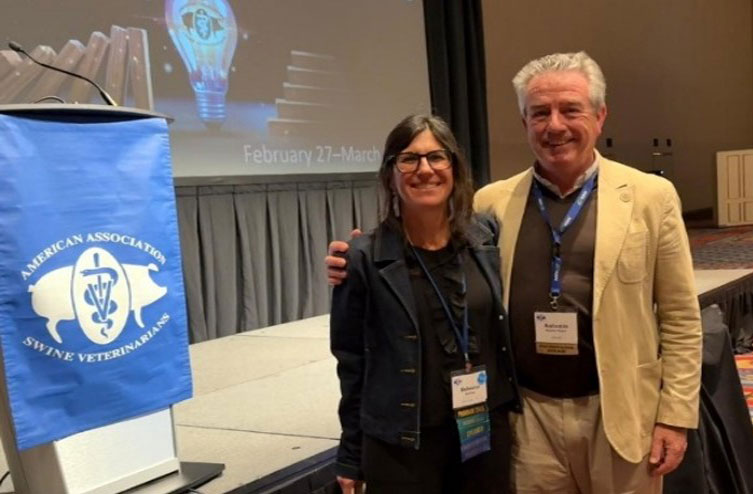 Antonio Palomo with Rebecca Robbins
Diagnostic airballs: Reserve the right to learn. D. Madson. ISU
When the puzzle pieces start to fit together, we must focus our efforts on recognizing and organizing them. The art of diagnosis is defined as the act of identifying a disease based on its signs and symptoms. Diagnosis is a process, not an isolated act, involving the gathering of information, performing tests, reflection, analysis, investigation, and verifying its consistency and relationship with what is observed on the farm (refine and repite). Diagnosis is often uncertain due to a lack of information, insufficient observations, or inadequate tests. Not all signs are constant, and we must learn from them while remaining open to variations from what is already known. It is essential to have a good diagnostic team and a reference laboratory with appropriate techniques that is safe, reliable, and operates within the required time frame. Diagnosis involves and is interconnected with the professionals working in farming, companies, consultants, laboratories, and slaughterhouses...
At Iowa State University, 130.000 analyses are performed annually, taking into account both active and passive stakeholders (users, collaborators). Integrating all the analyses, while considering their chronology, provides the laboratory with relevant information on the main temporal etiologies. The type of samples and their quality at the time of submission are essential for an accurate diagnosis. When submitting samples, it is mandatory to indicate the purpose of the analysis and the previous clinical history. Submitting appropriate samples and animals is essential for diagnosis. The main errors arise from assuming that diseases are uniform across populations, ignoring biological differences, failing to distinguish between acute and chronic conditions, sample selection problems, collecting an insufficient number of samples, and failing to distinguish between the type of diagnosis and the type of sample.between the type of diagnosis and the type of sample.
Time must be devoted to defining both the diagnostic process and its interpretation. Another critical point is to consider the reasons for accuracy or error in the diagnosis. In humans, it is estimated that 30% of diagnoses are not entirely accurate, and it is estimated that the error rate in veterinary medicine is very similar (between 30% and 40% or higher). Most errors are associated with pig selection, sample type, sampling context, inadequate information, and sample shipping and storage procedures. Many errors are not due to a lack of knowledge, but rather to cognitive aspects related to the decision-making process. It is equally important to recognize that a significant proportion of problems on farms are not infectious in origin, but rather metabolic and nutritional. We must focus on the process, not just the final result. A preconceived diagnosis is often reached without any basis. Sending samples and expecting the laboratory to do the rest is not an effective strategy. At every stage of the process, from the farm to the final diagnosis, sufficient time must be allowed for each function to be performed correctly. If we do the job halfway, we will have to repeat it,resulting in a loss of time and money.
Interpreting results is complex and not without flaws, so continuous learning and humility are essential. Identifying an infectious agent does not necessarily mean that it is the cause (“Don´t be a PCR Princess”).
When interpreting a diagnosis, we must seek the intersection of host, pathogen, environment and disease, and distinguish between commensal and pathogenic, endemic and epidemic. It is not always PRRS. We must consider that pathology is dynamic and that things change over time, as demonstrated by the evolution of problems related to Circovirus. To this end, we must maintain diagnostic curiosity to integrate all the variables involved, combining knowledge and experience, data and variables with optimism, while optimizing time and financial resources. In recent years, the cost of diagnosis has decreased by approximately 41%.
Practice-based evidence has its myths and applications, which we must verify against scientific evidence (convergence, consistency and context). It is not uncommon for some diseases to manifest differently than in the past, and not only in the distant past, as in the case of PRRS, PCV, Streptococcus suis and numerous enteric diseases. We must not underestimate the importance of exchanging views and communicating among farmers, veterinarians and laboratories. Communication has different styles and expectations, from which we can all learn. Words speak louder than a thousand words. Let us devote time to learning effectively and with passion.
PRRS: Continuous learning and improvement by turning obstacles (and evidence) into opportunity. R. Philips
PRRS, with more than 30 years of history, is at the center of research in the global swine industry, in search of applications and solutions in biosecurity and diagnostic techniques. The study of immunity, reducing exposure, mitigating the consequences of infection and reducing viral spread, as well as management and control protocols, have evolved and continue to change due to the high diversity of viral strains, which have a significant impact on swine health and welfare. New variants continue to emerge, causing substantial economic losses due to coinfections, with a 278% increase in spending on injectable drugs and 1,2 billion dollars in annual losses in the United States, of which more than 50% is due to mortality among weaned piglets.
Progress in diagnosis and survival has been considerable: ORF5 sequencing, dendrograms, RFLP, PCR, ELISA, gene sequencing in processed fluids (PF), oral fluids (FOF-OF), tongues (TTF), and blood. Understanding PRRSV status and virus circulation patterns among farms and production stages is essential for validating protocols, implementing monitoring and sampling, aggregating populations, and designing intervention programs. Classifying farms as acutely infected, low-prevalence, stable, or negative is essential for this purpose. At this stage, PCR results associated with production parameters for 16-22 weeks are needed, providing insight into viral activity. Over the last 20 years, transmission mechanisms and biosecurity guidelines have evolved, moving from theAerosol transmission via sows and semen (1990-2000) led to the discovery of mechanical routes (transport, personnel, materials), followed by airborne transmission (2004-2010), validation of filtration systems and, finally, feed transmission (2014-2020). The next generation of biosecurity implemented between 2014 and 2020 by Scott Dee evolved into Next Generation Biosecurity, which reduces the risk of outbreaks by 8% in large-scale production systems (evidence-based biosecurity is effective). Research into the cost-effectiveness of biosecurity protocols focused on bioexclusion, biocontainment and transport biosecurity is progressing.
PRRSV immunity management has been extensively documented with numerous vaccines aimed at heterologous protection, but with highly variable results in practice. Maximizing immunity and reducing exposure (circulation - transmission) through diagnostic measures can have both direct and indirect benefits. Routine vaccination of breeding animals will depend on the specific needs and risks of each farm. Working on herd stability is important, as is maintaining it and, even more so, eliminating it. This progressive PRRS management model also includes prevention. To maintain stability, we must prevent both horizontal and vertical transmission and wean negative piglets. Chronically infected farms have three animal subpopulations.
Vaccination of piglets and grower-finisher pigs in large production systems, 3-4 weeks before infection, improves average daily weight gain and reduces mortality, according to numerous studies conducted in the United States. However, we are still facing difficulties due to high losses caused by different virus variants in vaccinated herds. Regional control programs (Morrison) launched years ago have had inconsistent results and follow-up due to a lack of contingency plans, deficiencies in monitoring (sensitivity and sampling intervals), their non-mandatory nature, and unclear objectives (elimination, reduction of prevalence, clinical control), resulting in considerable frustration and repeated attempts. It is proposed that regional plans be classified according to the prevalence of wild-type strains, together with evidence-based biosecurity measures for better control of regional spread, focusing on biocontainment to prevent the introduction of new viral strains, as stated by Bob Morrison in 2012.
The future of PRRSV control is based on our understanding of the virus, national-level elimination techniques, genetic editing, and National Control Plan strategies to improve pig health and welfare, as well as farmers’ profitability. This commitment requires leadership, patience, perseverance, collaboration, coordination, and communication, with veterinarians playing a fundamental role alongside the entire industry and all stakeholders.

The impaired animal on-farm: A vision for turning an animal welfare challenge into an animal welfare opportunity. E. Sundman. ISU
Angela Basinger was a leading figure in advancing animal welfare in the United States, laying the groundwork for collaboration between veterinarians and industry. The Five Freedoms (nutrition, environment, health, behavior, and mental state) serve as a model for the vision of pig welfare. WOAH defines animal welfare as the animal’s physical and mental state in its living conditions, encompassing natural, health, and behavioral conditions. Inadequate welfare refers to an imperfect state of the animal (sick, injured, in poor condition, or disabled). Animals that suffer injuries have compromised welfare. Health is integrated into all welfare parameters.
Opportunities to improve animal welfare focus on minimizing negative impacts, supporting positive experiences, and allowing euthanasia, if necessary, to prevent suffering/pain when no improvement is observed after two days of intensive care and treatment. Suffering animals show altered behavior, which affects their immune response and makes them more susceptible to pathogens. At the same time, animals reorganize their group behavior and hierarchies, displaying stereotypical behaviors and reduced motivation to feed, with negative consequences for production parameters (lower feed intake due to competition, increased waste, and altered thermoregulation). They adapt their consumption patterns according to the degree of impairment of their welfare.
Animal welfare can be effectively measured through audits (PAACO – Professional Animal Auditor Certification Organization), which assess minimum standards for facilities and production conditions rather than focusing on the animals themselves. A critical point of failure is the euthanasia technique and its application. Direct and indirect indicators (KWI – key welfare indicators) focus on morbidity and mortality rates, recognizing that these cannot be zero due to health problems, accidental injuries, and other associated factors. The number of animals in the infirmary serves as a benchmark for welfare. Other parameters include sows culled due to locomotor problems. Individual-level measurements focus on behavior, changes in body condition, reproductiveefficiency, physical appearance, negative pig-human interaction, restricted movement, and nervousness.
Within the five domains, three are essential for survival: nutrition, health, and environmental conditions. These, combined with the domain relating to their natural behavior, converge in the fifth domain: their mental state. Some groups, such as JBS and Tyson Foods, are integrating these welfare protocols into their production systems. Further research to identify and validate additional measures of affective state is needed to translate them into real-time integrated technologies (PLF) for on-farm decision-making (application, integration, and innovation).
Thinking forward, looking back: Redefining value in basic research for swine health. A. Moeser. Michigan State University
Looking to the future while reflecting on the past can help us add value to our work to improve animal health. Basic science is not a technology. The ability to ask biological questions is part of our curiosity. Many practical issues related to swine health from 20 years ago are no longer relevant. Under the same production conditions, two pigs can show very different behaviors and outcomes, so we must never stop questioning the fundamental principles. Disease is not just a pathogen; it also includes host conditions, environmental stressors, nutritional factors, management practices, and more.
Recognizing pig biology and its resilience should prompt us to reflect and make the best decisions. Faced with the same question, we can approach it from different angles and develop parallel solutions that complement one another. We must base our questions on pig biology, using multiple models to maintain the conditions pigs need, depending on the different disciplines.
Long-term work programs and the opportunity to make room for new ideas, together with maintaining curiosity, are the pillars of our professional experience. Integrating different medical sciences supports long-term biological research, requiring collaboration across models and disciplines. Basic science builds the future, with the understanding that the solutions we will need in the future will stem from the questions we ask today, distinguishing what is real and feasible from what is fictitious.
Keeping pork safe: FARAD’s extra-label guidance and industry engagement. R. Baynes. NC State University
FARAD was established in 1986 and authorized by Congress in 1998. Founded in 1982 with the aim of ensuring food safety and preventing the presence of residues, it conducts research, provides services, and publishes materials. Its headquarters are located at five American universities (Davis, California, Kansas, Virginia, Florida, and North Carolina). The information flow involves farmers, veterinarians, and researchers who, together with the administration, aim to define withdrawal times for all products administered to animals.
Many of the requirements for the off-label use of drugs are well known to industry professionals, although questions and incidents are not uncommon. FARAD is committed to responding to them diligently. These include the use of veterinary drugs prohibited in animal feed (chloramphenicol) or permitted but prohibited for off-label use (cephalosporins, fluoroquinolones), products not approved by the FDA, or drugs that have not demonstrated specific efficacy against a particular pathogen.
15% of consultations concern swine, 32% small ruminants, 28% poultry, and 20% cattle. In swine, the most frequently consulted medications are, in order, meloxicam, dexamethasone, flunixin, omeprazole, tulathromycin, florfenicol, xylazine, amoxicillin, ceftiofur, enrofloxacin, and oxytetracycline. It is important to remember that the withdrawal period is an estimate, since it differs in plasma compared with tissues (tissue elimination half-life). Many prescriptions based on mg per kilogram of body weight and days of treatment, when analyzed against withdrawal periods and tolerance limits, often reveal that some are obsolete and others ineffective, requiring adjustments to different routes of administration and dosages depending on the production phase. This also presents some difficulties in defining the withdrawal period for products intended for exportaction. To this end, a collaboration program between FARAD and AASV has been launched, focusing primarily on the scenario involving 17 drugs.
Veterinary diagnostic laboratory trends. G. Trevisan. Iowa State University
The most recent positive TGE cases date back to 2021, and between 2024 and 2025, diagnoses of Mycoplasma hyopneumoniae in the United States decreased by 50%. The main problem is PRRSV, whose number of unstable and positive farms has increased year over year by 15-36%. The increase in cases occurred during the weaning and finishing phase, preceded by changes in detection methods on sow farms. Genomic sequences have changed over time, with strain L1C.5 now accounting for more than 60% of all field-isolated strains. This surge began in 2024 and saw a significant increase in 2025. Strain 1C.2 is the second most frequently isolated across all states. Strain 1C.5.32 causes the highest number of piglet deaths, averaging 5,7 per sow, compared with 2-3 for other, less virulent strains.
The incidence of PED increased again in 2026, after a decline in 2024 and 2025, with higher rates in some states than in others. Detection of influenza virus decreased significantly since 2021. Detection of Senecavirus A was highly irregular, with peaks in 2016, 2018, 2022 and 2023, but low incidence between 2024 and today. Among the circoviruses, the predominant genotype is PCV2d, followed by PCV a at a considerable distance. The dynamics of Escherichia coli continued to show an increase in F18 since 2017 and a decrease in K88. Among the highly pathogenic isolates, only 12,22% are positive for Stx2e and negative for F18.
These data compile the disease index, which assesses the activity of endemic pathogens in the United States. PRRSV ranks first, with a rate of 0,9, followed by Streptococcus suis at 0,7. Among respiratory pathogens, influenza virus is the most prevalent, followed by Glasserella parasuis and Streptococcus suis. Escherichia coli and rotavirus are the most common enteric pathogens. Most diagnoses of urogenital problems are nonspecific. Antibiotic sensitivity varies considerably between farms and even within the same farm. Their conclusion is that disease dynamics in the United States are gradually changing.
Endemic disease diagnostic approach and interpretation. P. Gauger. ISU
An endemic disease is a disease that is present for a long period of time without reintroduction and affects susceptible animals and populations, with prevalence that varies but only slightly. Pathogens with high genetic diversity and a high mutation rate are associated with high genetic variability and tend to persist. Diagnostic techniques for detecting them must be adapted according to their sensitivity and cost. Disease diagnosis is based on identifying clinical signs and production losses, focusing on pathogen detection. Surveillance and monitoring differ from diagnosis in terms of sampling, and knowledge of the population is necessary to maximize detection. Choosing the correct sample type to determine survival is essential: fluids processed forVertical and horizontal transmission should be interpreted with caution; oral fluids from stillborn piglets are more suitable for vertical transmission, while fluids from piglets that die after weaning are more suitable for horizontal transmission.
Low prevalence is considered to be below 10%. A negative PRRSV PCR test in a pig’s serum does not mean that it is negative for the virus, but rather that there is no prolonged viremia. The persistence of the virus in other tissues (lymphoid tissue, tonsils, and lungs) must be analyzed. Analyzing pools of more than 5 samples reduces detection capability. Ct values equal to or greater than 35 lose 50% of their repeatability, making reanalysis necessary, taking into account the correlation between clinical and subclinical disease in these cases. Ct values below 25 are typical after a recent infection. Genetic sequencing is necessary to understand farm-level epidemiology, genetic evolution and strain diversity, possible lateral introductions or reinfections, to differentiate between field and vaccine viruses, and to avoid misinterpretations ecExcessive. Coinfections involving multiple pathogens simultaneously are common (two strains, vaccine and field viruses, or different associated infectious agents such as influenza viruses), and priority should be given to detecting wild-type strains. The use of live attenuated vaccines complicates interpretation and should be taken into account for a considerable period after vaccination. The first step in controlling endemic agents is biosecurity, biocontainment, and bioexclusion. Inadequate biosecurity (a primary bottleneck) affects all processes.
Antonio Palomo Yagüe