
I. Common Intestinal Diseases in Chicken Flocks During Summer and Autumn
(I) Enteritis-type Escherichia coli Disease
An infectious disease caused by pathogenic Escherichia coli, characterized by rapid spread and a high mortality rate.
1, Predisposing factors: In summer and autumn, high temperatures and humidity in the early period, followed by weather that alternates between cold and hot in the later period; imbalances in farm feeding and management; poor sanitation; various stress factors; and reduced resistance of the body.
2, Clinical manifestations of avian Escherichia coli disease: Depending on the bird’s age and resistance, as well as the pathogenicity of the Escherichia coli and the route of infection, it may present as septicemia, airsacculitis, yolk peritonitis, salpingitis, panophthalmitis, Escherichia coli granuloma, omphalitis, or enteritis.
① Acute septicemic form: pericarditis, perihepatitis, and peritonitis; ② airsacculitis; ③ salpingitis; ④ yolk peritonitis; ⑤ omphalitis in newly hatched chicks; ⑥ panophthalmitis; ⑦ Escherichia coli granuloma; ⑧ enteritis: ruffled feathers, drooping wings, lethargy, diarrhea, and damp, soiled, matted feathers below the vent.
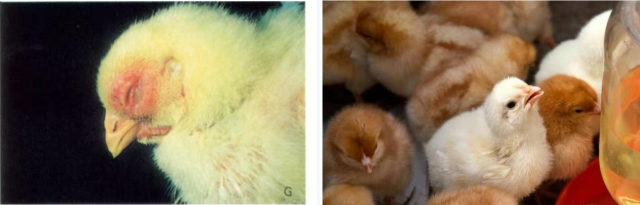
3, Pathological changes: The intestinal mucosa from 1/3 to 1/2 along the intestinal tract is congested and thickened, with catarrhal or hemorrhagic enteritis
(II) Necrotic enteritis
An infectious intestinal disease caused by Clostridium perfringens type A or type C and characterized by necrosis of intestinal mucosal epithelial cells. Clostridium perfringens is also known as Welch bacillus. It is widely distributed in nature and can be isolated from soil, feed, sewage, feces, and the human intestinal tract. It can occur in all seasons, with a higher incidence in the hot, humid summer and autumn.
1, Epidemiological features
Susceptibility: Under natural conditions, the disease is seen only in chickens. It can occur in both broilers and layers, especially in floor-raised chickens, and is more common in chicks and growing chickens. In meat chickens, the disease is commonly seen at 2 to 8 weeks of age.
Seasonality: It can occur in all seasons, but is more common in hot, humid summer weather.
Predisposing factors: High flock density, poor ventilation, sudden feed changes, and low protein content in the feed; adding high-energy or high-protein ingredients such as fish meal, soybeans, wheat, and animal fats to a complete ration; irrational use of medicated feed additives; occurrence of coccidiosis; and Clostridium perfringens levels in the environment exceeding the normal range.
2, Clinical signs
Onset is sudden; affected chickens often die suddenly without showing symptoms;
Depression, ruffled feathers, drooping wings, reduced feed intake, weight loss, a dazed look in both eyes, lack of response to external stimuli, severe diarrhea, and foul-smelling feces that are dark red or black, sometimes containing blood and mucus.
3, postmortem signs
The lesions are characterized by mucosal necrosis in the middle and posterior sections of the small intestine, most notably in parts of the ileum and jejunum.
The intestinal surface is dirty grayish-black or dirty blackish-green, and the intestinal lumen is distended with gas, measuring 2–3 times the size of a normal intestinal tract. The intestinal wall is thickened, and the intestinal contents are liquid, blood-like or blackish-green, and fishy-smelling. There are hemorrhagic spots on the intestinal wall, and the mucosa is necrotic, with necrotic lesions resembling bran flakes that vary in size and shape.
(Three) Coccidiosis
1, disease characteristics:
Seasonality: Generally occurs during the months of 6–10 each year.
Susceptibility: Chicks aged 3–5 weeks are most susceptible; adult chickens have milder symptoms.
Source of infection and route of transmission: Sick chickens are the source of infection. Feed, drinking water, and equipment contaminated by sick chickens may contain oocysts. Ingestion of infective oocysts by chickens is the main route of transmission. Flies and rodents are mechanical vectors.
Predisposing factors: A decline in the chickens’ resistance, vitamin A or vitamin K deficiency in the feed, and malnutrition can all trigger this disease.
2, Clinical signs:
Cecal coccidiosis: The comb becomes pale; the chicken appears lethargic, its wings droop, and its feathers become loose and erect. It passes watery droppings containing blood or passes whole blood. Deaths may occur within 2–3 days. If treatment is delayed, the mortality rate in chicks can reach over 50%.
Small intestinal coccidiosis: There may be no obvious signs. Signs include anorexia, reduced activity, weight loss, slow growth, partial paralysis of the toes, diarrhea, meat-like, carrot-like, tomato-like, or soy-sauce-colored droppings, reduced feed intake, closed eyes and a tucked-in head, and loose, ruffled feathers.
3, Necropsy:
Cecal coccidiosis: There are obvious signs of anemia throughout the body, and the muscles or internal organs appear pale. The ceca are enlarged, several times thicker than normal, and dark red, with thickened walls. Their contents consist of blood and blood clots.
Small intestinal coccidiosis: The small intestine is dark red. The jejunal and ileal mucosae have pinpoint hemorrhages or white nodules about the size of a grain of rice, and the intestinal lumen contains carrot-colored, jelly-like material.
(Four) Enterotoxemia syndrome
An intestinal disease caused by multiple factors (Escherichia coli, Clostridium, coccidia, and electrolyte imbalance), characterized by diarrhea, feed passage, and blood-streak-like, tomato-like material in the feces.
1, Clinical symptoms
It can affect laying hens and broilers of all ages. In laying hens, it most commonly occurs at 40-90 days of age, and can also occur in laying hens in production.
Laying hens: They pass yellow feces containing undigested feed (feces are mostly dry in pullets and loose in laying hens in production). The feces contain tomato-like material and carrot-string-like debris. Feathers are disheveled, growth and development are poor, egg production rate declines in laying hens, and the birds gradually become thin.
Broilers
In the early stage, the flock shows no obvious clinical symptoms. A few birds have loose, unformed feces containing undigested feed;
In the middle stage, most of the flock has diarrhea with watery droppings, which are light yellow or light yellow-green;
Later, droppings resemble tomatoes or fish intestines, and feed intake declines markedly by 10%-20%; in severe cases, it declines by more than 30%;
Restlessness and agitation, screaming, and head tremors; paralysis, exhaustion, and death, with a mortality rate of 1%~1.5%.
2, pathological examination by necropsy:
Early stage: The duodenal and jejunal mucosa is thickened, resembling a layer of thick bran, and is very easy to peel away. The intestinal lumen is empty, with undigested feed visible.
Mid-to-late stage: The intestinal wall becomes thinner, the mucosa sloughs off, and the middle and rear sections of the small intestine are filled with orange-yellow droppings resembling persimmons, fish intestines, or carrots.
3, differential diagnosis:
Intestinal toxemia syndrome---droppings are lean-meat-like or tomato-like, with symptoms of feed passage.
Necrotic enteritis---does not present with symptoms of feed passage; the droppings are black, with sloughed intestinal mucosa.
Intestinal coccidiosis---meat-like or carrot-like, tomato-like feces, or sauce-colored feces
4, lesions:
Intestinal toxicosis syndrome---generalized thinning of the intestines; intestinal contents resemble orange-yellow persimmons, fish intestines, or carrots, and the feces have these appearances; no gas is produced in the intestines.
Necrotic enteritis---the intestinal lumen is dilated and filled with gas, measuring 2~3 times the normal intestinal diameter; the intestinal surface is dirty gray-black or dirty black-green, and the intestinal contents are black.
Intestinal coccidiosis---large-grain-sized hemorrhagic spots and rice-grain-sized white nodules in the jejunum and ileum, containing tomato-paste-like material.
(Five) Mycotoxin poisoning
1, predisposing factors:
There is abundant rainfall and high air humidity in summer and autumn, and temperatures are high in summer. During storage, mold and its toxins proliferate in feed and its raw materials.
Aflatoxin damages the liver. Harmful bacteria in the intestines rapidly proliferate due to abnormal bile salt secretion by the liver, causing enteritis in the flock.
T-2 toxin can cause ulcers in the digestive system (oral cavity, glandular stomach, intestines), resulting in widespread inflammation of the digestive system.
2, Clinical symptoms:
May occur at any stage of broiler or layer rearing;
Large amounts of red and black droppings, mixed with yellow or watery droppings;
The flock's average body weight and uniformity are low;
Flocks at the onset of laying fail to reach peak production (around 85%), while the laying rate of flocks at peak production drops by 1%~3%; in severe cases, it drops by more than 5%.
3, Necropsy lesions
The glandular stomach is mildly swollen, and the glandular stomach papillae are swollen to varying degrees and vary in size. The intestinal wall is swollen, with a large number of bubbles in the intestinal lumen. Parts of the intestinal mucosa are blackened and sloughed off, and the mesentery is blackened.
4, distinguishing fungal enteritis from intestinal infections caused by other diseases:
In fungal enteritis, the feces are red, gray, or grayish-black;
Treatment with antibiotic drugs is ineffective;
The entire intestinal tract is blackened (the jejunum and ileum are blackened in necrotic enteritis), the mesentery is blackened, and there are fungal nodules in the lungs.
II. Prevention and control measures for intestinal diseases in summer and autumn
(I) Prevention
1, strengthen management of the rearing environment: improve ventilation and air exchange, lower the temperature in the chicken house, maintain appropriate temperature and humidity in the chicken house, reduce the impact of various stress factors, and prevent complications.
2, Keep the chicken coop clean and sanitary, and attach importance to disinfection. Disinfect the chickens regularly, and keep the water lines and feed troughs clean.
3, Prevent feed from becoming moldy; do not use moldy feed. Store feed in a dry, well-ventilated place. Watch for leaking drinkers that can cause feed to become moldy and sour. Use a mold-control product (霉毒净).
4, Routinely prevent various parasites (such as tapeworms and coccidia), and periodically add deworming medication to the feed.
5, Add appropriate amounts of nutritional products such as multivitamins, electrolytes, VA, VE, and cod liver oil to promote the chickens’ growth and development, strengthen disease resistance, and reduce the occurrence of heat stress.
(二)Treatment
Eliminate pathogens (bacteria and parasites): quinolones, polymyxins, aminoglycosides, and traditional Chinese medicine preparations.