
The harm caused by heat stress has become a widespread problem in poultry production today!
Heat stress is the result of combined environmental factors, including air temperature, humidity, and wind speed, with temperature playing an important role. When the ambient temperature exceeds the optimal growth temperature for commercial broiler chickens, it may trigger a heat stress response, leading to increased body temperature, faster breathing, reduced feed intake and body weight gain, lower breast muscle yield, and decreased meat quality.
Lin et al. summarized several common strategies for alleviating heat stress, including genetic, nutritional, husbandry, and environmental strategies. Among these, providing good ventilation in poultry houses is very important in broiler production, especially in tropical and subtropical regions. Research into the effects of ventilation on poultry dates back to the 20s of the 60th century. Drury et al. were the first to propose that “broiler production benefits from the wind-chill effect produced by air speed,” and concluded that air speed can improve broiler production performance. In the following decades, related research was conducted in the United States, Israel, Brazil, and other countries. By the end of the 20th century, ventilation management was already widely used in poultry production. Although summer ventilation can alleviate heat stress and reduce mortality, very little data systematically explains this, and the mechanisms are not yet fully understood.
According to statistics, only a handful of research teams outside China have conducted experimental studies specifically on the effects of wind speed on poultry, and they have published just over 20 papers. In China, Tao Xiuping was among the first to conduct preliminary research on temperature, humidity, and wind, developing a temperature-humidity-wind index model for broilers and investigating the effects of wind speed on broiler physiology and biochemistry. Therefore, this article briefly summarizes poultry heat balance and its regulation, the contributions of wind speed to sensible and latent heat loss, and, in conjunction with a discussion of production performance, explains the role of wind speed in regulating poultry heat balance.
Poultry heat balance and its regulation
1, the heat balance of poultry
Thermal balance refers to a state in which heat production and heat dissipation reach a dynamic equilibrium. Maintaining thermal balance in poultry requires the body to make corresponding adjustments at all times, mainly through physical and chemical regulation. Physical regulation includes physiological and behavioral 2 aspects. When broilers are in a high- or low-temperature environment, the skin blood vessels first dilate or constrict, thereby increasing or decreasing skin blood flow and skin temperature, and increasing or decreasing the temperature difference with the external environment to help maintain thermal balance.
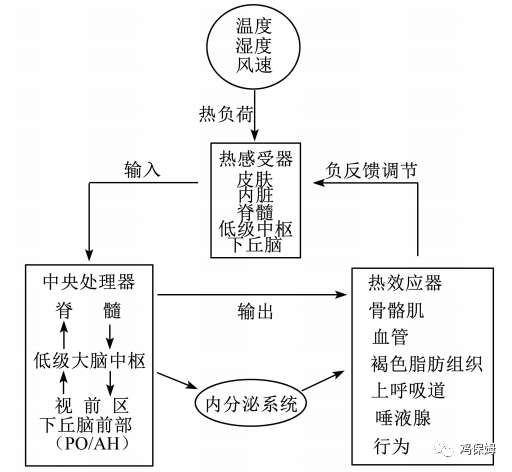
Poultry behavior plays a very important role in maintaining heat balance. Chemical regulation mainly increases or decreases heat production by adjusting the metabolic rate when physical regulation cannot maintain heat balance. Poultry have a complete mechanism (Figure 1) for maintaining heat balance. Temperature, humidity, and wind speed collectively characterize the environmental heat load and act on the poultry’s thermoreceptors, including peripheral and central thermoreceptors. These organs transmit the thermal information they sense to the central processor. The central structures that regulate body temperature are located throughout the nervous system, from the spinal cord to the cerebral cortex, but the primary center for thermoregulation is located in the hypothalamus. The preoptic/anterior hypothalamus (PO/AH) is a key part of the thermoregulatory center. After the thermal information is processed by the central processor, it acts through neural and/or endocrine pathways on effectors to produce a response and regulate heat dissipation, completing the regulation of heat balance and achieving a state of thermal balance in the body. Figure 1 Schematic diagram of poultry sensing environmental stimuli and responding to regulate heat balance l
2, poultry heat dissipation methods and their distribution patterns
Heat dissipation in poultry is divided into 2 categories: sensible heat loss (SHL) and latent heat loss (LHL). SHL is also known as “non-evaporative heat loss” or “sensible heat loss” and includes radiation, conduction, and convection, all of which are physical methods of heat dissipation.
LHL is also known as “insensible heat loss” or “evaporative heat loss” and includes the evaporation of moisture from the skin and respiratory tract. Since most of a bird’s body is covered with feathers and it has no sweat glands, it cannot dissipate heat directly by sweating through its body surface. Conduction also requires contact between materials at different temperatures, so it contributes little to heat dissipation in poultry.
In fact, poultry dissipate heat in the following 2 ways:
1) SHL, primarily based on radiation and convection;
2) LHL, primarily based on respiratory evaporation and skin evaporation mechanisms.
The temperature difference between the poultry’s body surface and the surroundings drives SHL. As long as this temperature difference is positive, SHL continues, and the process is entirely physical, consuming no additional energy. LHL, which relies on panting as a major means of heat dissipation, is the opposite: this process consumes a large amount of energy. However, as the ambient temperature rises, the proportion of heat dissipated through SHL gradually decreases. At low and moderate temperatures (13~25℃), broilers dissipate heat mainly through radiation and convection. When the temperature rises to 30℃, the proportion accounted for by LHL gradually increases; when the ambient temperature reaches 35℃, LHL accounts for 90% of total heat dissipation. The distribution of heat dissipation in broilers at different ambient temperatures is shown in Table 1.
