
Proventriculitis and gizzard erosion are environmentally conditional diseases. Environmentally conditional diseases occur when unsuitable conditions during rearing disrupt the balance of the chickens’ respiratory, digestive, and reproductive systems, weakening the flock and triggering disease.
一、Risks of proventriculitis and gizzard erosion
Proventriculitis and gizzard erosion generally do not cause flock mortality, but they seriously affect feed conversion in chicks, resulting in substandard body weight and body development, poor uniformity, and large numbers of non-conforming chickens. This increases the culling rate, which can reach as high as 10%—20% in severe cases.
Body condition deteriorates severely, reducing resistance to stress and making chickens susceptible to secondary diseases that can cause death.
Mycotoxins cause immunosuppression, leading to infectious bronchitis vaccination failure. In many flocks, the peak in egg production is delayed or does not occur; in severe cases, the laying rate may even be below eight tenths, seriously affecting economic benefits.
二、Age at Onset and Pattern of Disease Progression
1, age at onset: concentrated between 3-6 weeks.
2, Disease pattern: After immunization at 12 days of age, the overall flock condition was poor. Clinical inspections found chicks standing with their necks retracted and appearing lethargic. Necropsies showed no obvious lesions in the proventriculus or gizzard. From 15 to 16 days of age, lethargic chicks continued to appear throughout the flock, and necropsies showed gizzard inflammation with signs of proventriculitis and gizzard inflammation. Treatment with traditional Chinese medicine was not notably effective, and the gizzard inflammation continued to worsen. Necropsies showed gizzard erosion, followed later by pinpoint hemorrhages in the duodenum; the proventricular papillae were flat and indistinct. The flock also showed a severe decline in production performance. After a mold binder was added to the feed, house humidity was reduced, and a stomachic was used as an adjunct, the flock began to recover in week 5. Necropsies showed that the gizzard koilin layer had recovered a smooth surface and the proventricular papillae were clear and distinct. The flock’s general condition and body weight gradually recovered.
III. Necropsy findings
The main necropsy findings are an enlarged proventriculus, or flattened or even absent proventricular papillae; hemorrhage, ulceration, and sloughing of the proventricular mucosa; crater-like ulcers on the gizzard koilin and mucosal surfaces; and gizzard erosion.
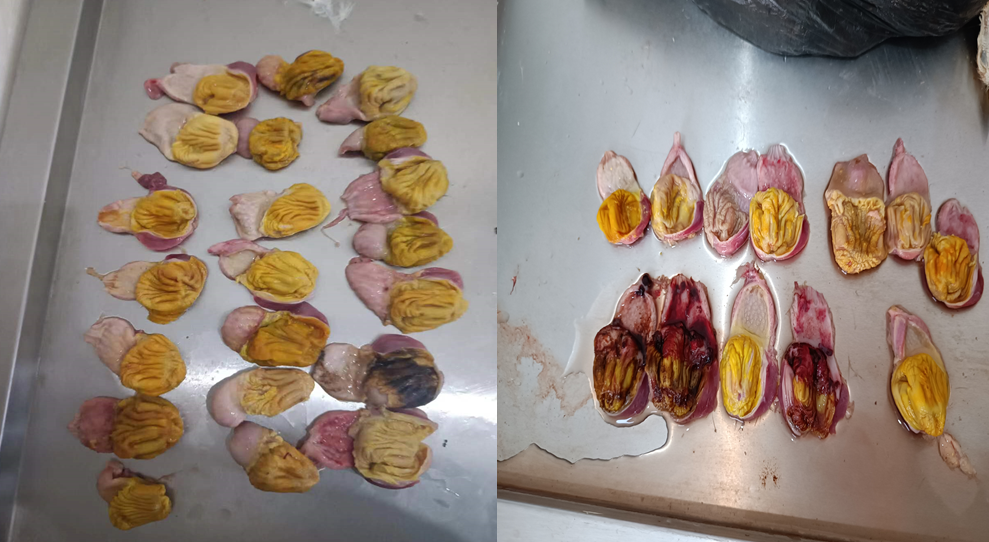
IV. Changes in production performance
1, Body weight: Body weight was normal at week 3, but weight gain did not meet the target. At weeks 4–5, body weight was more than 60 grams below the standard.
2, Uniformity: Uniformity declined markedly at week 3. At weeks 4–5, uniformity fell to between 50% and 70%. After the flock’s condition recovered at 6W, uniformity improved.
3, Percentage meeting the standard: The percentage meeting the body-weight standard was around 50%, and the flock as a whole was in a subclinical state.
4, Rearing rate: In houses with more severe disease, the mortality and culling rate was 5%–7%, and the rearing rate was around 93%.
V. Cause analysis
After the chicks arrived at the farm, prolonged feed storage and excessively high temperature and humidity caused mold growth and mycotoxin accumulation. The flock was in a suboptimal health state, and ongoing stress triggered severe glandular and muscular stomach inflammation.
1, Feed storage: Feed stored for more than 12 days can develop mold.
2, Feed hardness: The feed pellets are too hard, aggravating gizzard keratin-layer ulcers when gizzard inflammation is present.
3, Environmental factors
(1) High temperatures and humidity in the poultry house during the early stage are favorable for mold growth and reproduction.
(2) After the flock becomes ill, it is sensitive to cold. When the temperature is controlled according to the target temperature, the flock huddles together and appears cold. Therefore, temperature and humidity remain high after the flock becomes ill, reducing the flock’s physical condition and stress resistance.
4, Immunization stress
During the 7-20-day age period, vaccination against infectious bronchitis, Newcastle disease, and avian influenza H5+H7 is carried out. Vaccinations are relatively concentrated during this period, which also aggravates the condition to some extent.
Six. Measures to Take After Disease Onset
For medication choices, consider using traditional Chinese medicine to prevent adenomyogastritis before disease onset; it is less effective after onset. For more severe symptoms, add a mycotoxin binder to the feed to prevent continued toxin accumulation from prolonging or recurring the disease course, and reduce the humidity inside the poultry house. Medications may include cimetidine (10 mg/bird) for 4—7 days + penicillin (or amoxicillin) for 3—5 days as combination treatment for adenomyogastritis, while also preventing secondary bacterial infections. Select the more severely affected chicks for an additional 4 days of treatment after 1 treatment course(s).
Mycotoxins from molds that cause adenomyogastritis can lead to immunosuppression. After the flock recovers, test antibody levels; if they are low, vaccinate as appropriate to the specific circumstances.
Seven. Prevention and Control Measures
1. Environmental control is key
Feed:
(1) Pay attention to feed storage and avoid storing it for too long. In summer, feed stored in the feed silo should not exceed 3 days. In winter, storage should not exceed 5 days.
(2) Before using feed for chicks, test its nutritional composition, mold, and mycotoxins.
(3) When using new corn, a mold inhibitor must be added to the feed.
(4) Feed properties such as particle size and hardness can also have a significant impact on the flock and aggravate proventriculitis and gizzard inflammation. Assess the physical properties, communicate with the feed mill in a timely manner, and minimize adverse effects as much as possible.
(5) In the early stage, use as little wet-mixed feed as possible to avoid feed contamination caused by uneaten feed remaining in the trough.
(6) Clean the feed silos, feed carts, and feed troughs every week to ensure the feeding environment is sanitary and tidy.
Temperature and humidity: Maintain suitable temperature and humidity, with humidity controlled at 50%—60%, and avoid prolonged high-temperature, high-humidity conditions that can promote mold growth inside the poultry house.
2, reducing stress is key
(1) Reduce immune stress
Immunity assessment: Assess the flock's immune status.
Combining vaccines for immunization reduces the number of injections. For vaccines that cause substantial immune stress, use anti-stress medication 2 days before and 2 days after immunization. Use a water bath to pre-warm the vaccines.
(2) Control heat and cold stress
Ensure adequate ventilation as the basis. At night, focus on perceived temperature; during the day, focus on perceived temperature under different humidity conditions.
(3) Feed change stress
Monitor changes in feed intake. Feed changes cause substantial intestinal stress. Promptly use water drenching and feed leveling to stimulate feed intake. Also use Yixin Aike to relieve feed-change stress and repair the intestinal mucosa.
(4) Flock grouping stress
Flock grouping preparation: Except during hot seasons, appropriately set the temperature 0.5℃ higher on the day of grouping.
Assess respiratory conditions and adjust ventilation accordingly.
3, the flock’s physical condition is the foundation
Physical condition is the foundation of the body’s resistance to disease. Ensure the flock meets weekly targets for body weight and uniformity, with no disease occurring in the flock. In daily management, carry out the flock’s three health-care measures to maintain good physical condition.