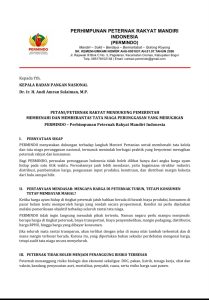
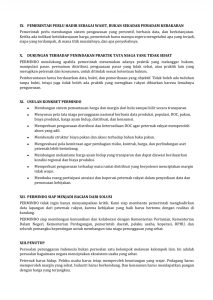
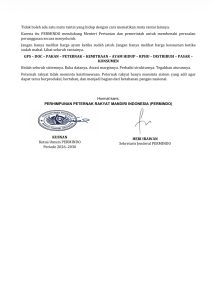
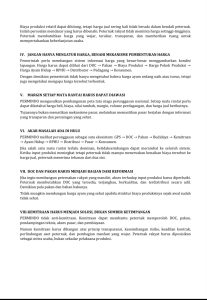
Bogor (TROBOSLIVESTOCK.COM). The Indonesian Independent Smallholder Farmers Association (Permindo) stated its support for the government in reforming and eradicating harmful practices in Indonesia’s poultry trade. This is reflected in a letter Permindo sent to the Head of the National Food Agency (Bapanas) and Minister of Agriculture (Mentan), Andi Amran Sulaiman.
In its letter, Permindo expressed support for the Minister of Agriculture’s efforts to reform the governance and trade of the national poultry sector, including taking action against various practices that could harm smallholder farmers and consumers. For PERMINDO, Indonesia’s poultry issues should not be viewed solely through the price of live birds (live bird) at a single point in time. The issues are much more fundamental: how industry structure, distribution, price formation, control of production inputs, partnerships, and margin distribution operate from upstream to downstream.
In a substantive statement, Permindo said that when live bird prices at the farm level fall, even below production costs, consumers in the market do not necessarily receive proportionally lower prices. This situation needs to be explained through an objective examination of the entire trade chain.
Permindo does not want to immediately accuse any particular party. However, the state needs to be able to answer these questions: What is the price at the farm level, the transportation cost, the slaughter cost, traders’ and distributors’ margins, the price at the RPHU (poultry slaughterhouse), and the price paid by consumers? If the entire chain is transparent, it will be clear where value is added and where the largest margins lie. Therefore, what is needed is not merely a debate about prices, but a comprehensive audit of the trade system.
According to Permindo, farmers should not be the ones bearing the greatest risk. Farmers already bear both biological and economic risks, including DOC (day-old chicks), feed, electricity, labor, medicines and vaccines, housing, asset depreciation, mortality, disease, weather, and price risk at harvest. Production costs can be calculated relatively easily, but selling prices are often outside farmers’ control. This is a fundamental issue that needs to be addressed. Smallholder farmers are not asking for the highest possible prices, but they need prices that are fair, measurable, transparent, and allow them room to sustain their businesses.
Permindo recommends that the government build a price information system that truly reflects conditions on the ground. Prices should be traceable from DOC → Feed → Production Costs → Cost of Production → Live Chicken Price → RPHU → Distributor → Trader → Consumer. This way, the government will know not only whether chicken prices are rising or falling, but also why those prices have formed.
Permindo also proposes developing a national poultry trade map. For every link in the chain, it should be possible to identify purchase prices, costs, value added, margins, trade volumes, and the subsequent selling price. The aim is not to shut down market mechanisms, but to ensure that the market operates with transparent information and fair competition.
Root Causes
Permindo views poultry farming as a single ecosystem: GPS → DOC → Feed → Farming → Partnerships → Live Chickens → RPHU → Distribution → Market → Consumer. If one link becomes too dominant, the imbalance can spread throughout the system. When production inputs become more expensive but farmers cannot pass those cost increases on through selling prices, they come under pressure from both sides.
To build independent smallholder poultry farming, access to production inputs must be improved. Farmers need DOC that is available, affordable, high-quality, and distributed fairly. The same applies to feed and its raw materials. It is impossible to establish healthy chicken prices if the production cost structure is already unhealthy from the outset.
Partnerships Must Be a Solution
Permindo says it is not opposed to partnerships. Partnerships can help farmers obtain DOC, feed, technical assistance, market access, and financing. However, partnerships must be built on the principles of transparency, balanced risk, fair contracts, protection of farmers’ assets, and a reasonable sharing of benefits. Smallholder farmers must be positioned as business partners, not merely as production operators.
On the other hand, the government needs to establish a preventive, data-based, and sustainable monitoring system. When there are indications of unreasonable prices, the government must be able to quickly determine what is happening, who is affected, where the problem lies, and what is causing it.
Cracking Down on Unfair Trade Practices
Permindo stated its support for taking action in accordance with the law if the government finds any unlawful practices, market manipulation, distribution schemes, unhealthy market dominance, or other practices that harm farmers and consumers.
Enforcement must be based on data, evidence, and objective examination. There must be no accusations without evidence, but neither should practices that harm the public be allowed to continue because of weak oversight.
Permindo’s Concrete Proposals
Permindo also offered its recommendations, namely:
- Establish a transparent system for monitoring prices and margins from upstream to downstream.
- Develop a national poultry trade map based on production, population, DOC, feed, production costs, live chicken prices, distribution, and consumption data.
- Strengthen oversight of DOC distribution and availability so that smallholder farmers have fair access.
- Improve the structure of feed costs and access to feed raw materials.
- Evaluate partnership models to ensure a more balanced allocation of risks, contracts, prices, and protection of farmers’ assets.
- Establish a transparent and monitorable live chicken pricing mechanism based on regional conditions and production costs.
- Strengthen oversight of distribution chains that may create unreasonable margins.
- Make room for smallholder farmer associations and cooperatives to participate in data provision and policy formulation.
Ready to Be Part of the Solution
Permindo stated that it does not want merely to voice criticism; Permindo is ready to help the government provide field data from smallholder farmers, because good policy must align with realities on the farm.
Permindo is ready to build communication and collaboration with the Ministry of Agriculture, the Ministry of Home Affairs, the Ministry of Trade, local governments, businesses, cooperatives, RPHU, and all stakeholders to build a healthy poultry trade system.
Indonesia’s poultry issues are not a matter of one group against another. This is a matter of how the state creates a healthy business ecosystem. Farmers must be able to make a living. Businesses must continue to earn a reasonable profit. Traders must earn a healthy margin. The industry must develop, and consumers must have access to affordable food.
No link in the chain should thrive by putting another link out of business. Therefore, Permindo supports the Minister of Agriculture and the government in addressing poultry issues comprehensively. Do not look only at chicken prices after they have fallen. Do not look only at consumer prices after they have become high. Look at the entire chain.
GPS – DOC – Feed – Farmers – Partnerships – Live Chickens – RPHU – Distribution – Market – CONSUMERS. Examine the entire system. Make the data public. Monitor the margins. Improve the structure. Enforce the rules. Smallholder farmers are not asking for special treatment. They are only asking for a fair system so they can continue producing, remain in business, and contribute to national food security. This letter was signed by Permindo Chairperson Kusnan and Permindo Secretary General Heri Irawan.bella