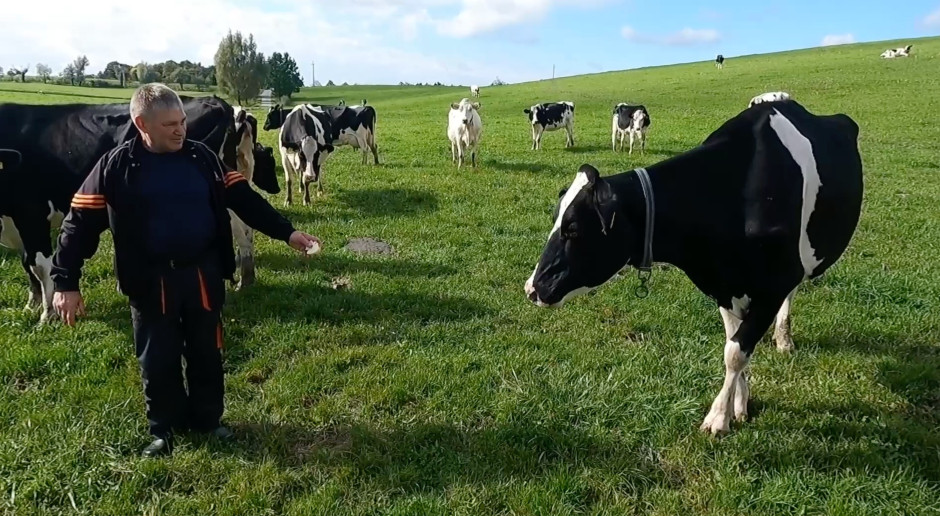
- The Romanowskis run a small family dairy farm where grassland and grazing cows are the basis of production.
- The most important innovation was taking part in the Zielone Mleko project and producing raw material with an increased content of certain health-promoting components.
- The farmers show that innovation does not have to mean buying another machine—it can involve changing the production method, reducing costs and focusing on quality.
- Watch the other reports from farms taking part in this year’s edition of the Innowacyjny Farmer competition.
A small farm, a different idea for production
Jolanta and Grzegorz Romanowski’s farm is located in Warmia, in the village of Kobyliny. It is a family farm run by two people. It covers approximately 30 ha, and practically the entire area consists of grassland. Its production focus is dairy cattle. The herd currently consists of more than 30 head of cattle, including approximately 20 dairy cows. At first glance, this is not a farm that would compete in terms of production scale or an extensive fleet of the latest machinery. And that is precisely what makes it distinctive. The Romanowskis have not opted for maximum intensification, but for keeping cattle in the most natural system possible and making use of what the farm has at its disposal—above all, meadows and pastures. The meadows are managed without mineral fertilizers or crop protection products. Grass is the basis of the animals’ diet, and during the grazing season the cows stay outdoors around the clock. Their ration is supplemented with concentrated feed. This system is intended to ensure not only adequate milk production, but also a specific quality of milk.
Green Milk – where the biggest innovation began
The most important initiative the Romanowskis became involved in was the Green Milk project. Its premise was relatively simple: to see how a feeding system based largely on pasture, grasses, and herbs affects the composition of the milk produced.
Green Milk was the biggest innovation we introduced on our farm. We support ecological farming and healthy cattle nutrition, and we have organic meadows and pastures,” said Grzegorz Romanowski.
As part of the project, soil analyses were carried out first. Specially prepared grass mixtures with a high proportion of herbs were used on the grassland, and in the next stage, researchers began testing milk produced by cows using this feeding system. Samples were collected during the grazing season and then analyzed, among other things, for the content of components considered beneficial to health in the project. The goal was ambitious. The milk was to contain from 20 to 30 percent more of selected components than bulk milk.
The results exceeded expectations
According to Grzegorz Romanowski, some of the results were even better than expected. The difference in beta-carotene was said to exceed 39 percent, while the difference in the omega fatty acids analyzed reached around 40 percent compared with bulk milk.
The program aimed to obtain from 20 to 30 percent more health-promoting components in the milk than in bulk milk. The results turned out to be better than expected,” Romanowski said.
The project did not end with laboratory research alone. Milk obtained in this way was also used to begin producing cheese with enhanced health benefits. In this way, changes to grassland management and animal feeding were translated into a specific end product. And this is where the farm’s innovation is most evident. It is not about a single machine or piece of equipment. The starting point is the soil and the composition of the pasture sward, followed by animal feeding, then milk analysis, and finally a product intended for consumers.
8,5 thousand liters without chasing records
The Romanowskis emphasize that their goal was never to achieve the highest possible milk yield from their cows. Under their chosen husbandry system, the herd produces around 8,5 thousand liters of milk per cow per year. For the farmers, production stability, animal health, and the ability to maintain yields while relying primarily on their own grasslands matter more than record-breaking results.
Our yields may not be record-breaking, but given the conditions—we feed them organic grasses—a yield of 8500 liters, which does not bring the national average down, is praised by nutrition advisers from various companies,” said Grzegorz Romanowski.
In practice, this means trying to find a balance between production, costs, and animal husbandry conditions. The farm does not try to copy the model of large-scale milk production, but instead makes use of its own resources.
Not every innovation has to be a new machine
The Romanowskis’ approach to mechanization is also interesting. The farmers do not assume that they have to carry out every task using their own new machines. They keep their existing equipment in working order and contract out some of the more specialized work. Grzegorz Romanowski gave a simple example. If a machine were to cost tens of thousands of złoty and be used for only a short period each year, it might be more cost-effective to pay a neighbor to do the work. For a small farm, this model makes it possible to avoid tying up capital in equipment that would be used to only a limited extent. This, too, can be considered an element of innovative management. Rather than expanding its machinery fleet at any cost, the farm focuses its resources where they can genuinely improve production efficiency or quality.
There are breeding results and awards
The results of the Romanowskis’ many years of work have also been assessed repeatedly outside the farm. They won the Farm of the Year title in the Spomlek competition and were finalists twice in the nationwide Farmer of the Year competition. They also received a special award from the rector of a university in Bydgoszcz. The animals have also achieved success. Romanowskis’ cattle are shown at breeding exhibitions in the Warmian-Masurian region. One heifer was named first vice-champion, and in 2026 a cow from the farm became the champion in its category. For the farmers, this is further confirmation that a more extensive farming system does not have to mean giving up good production or breeding performance.
The next step – an educational farmstead
The Romanowskis also want to show the farm to people who have no everyday contact with agriculture. Agricultural school students have already completed placements at the farm, and groups of children have also visited. The farmers are currently seeking certification as an educational farmstead. In the future, they want to show in a practical way where milk comes from, what keeping cattle on pasture looks like, and how the successive stages of production—from soil and grass to the finished product—are connected.
The Romanowskis’ story fits well with the idea behind the Innovative Farmer 2026 competition. It shows that a farm’s innovativeness does not have to be measured by the number of screens in a tractor, the size of its machinery, or the scale of its investment. In this case, it starts with the pasture. Next come properly managed sward, feeding practices, milk quality testing, animal welfare, and cost control. The aim is to produce a product of the highest possible quality on a small family farm.