
“I wanted a simple feeding system that anyone could use.” Benoît Gayraud is a breeder of 500 Lacaune sheep dairy cows at Montals, in Aveyron, in a Gaec with his father Yves. He equipped himself a year ago with a feedingsystem fully automated. Time-saving, simplicity of work, well-mixed and calibrated rations: the farmer benefits in many ways. A state-of-the-art system, yet very easy to use, which allows it to be easily replaced by its employee : « You just have to press a button to activate the system. It’s something anyone can do ,” he says with delight. This automation solution is marketed by the Aveyron-based company T2A. The Gaec paid a total of 150 000 euros excluding tax, to equip themselves with a mixer, conveyor belts and to automate distribution.
From the mixer wagon to the feeding belt
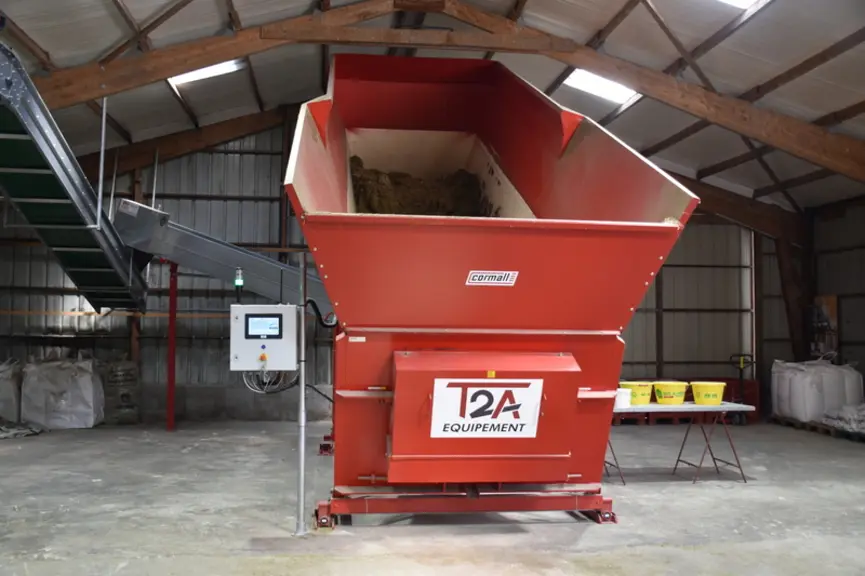
It all starts with a mixer fixed and inclined Cormall of 30 m3. It is loaded by tractor, once a day, with forage, whether square-baled hay or wrapped forage. “This is my kitchen ,” Benoît sums up. The mixer weighs the ingredients.
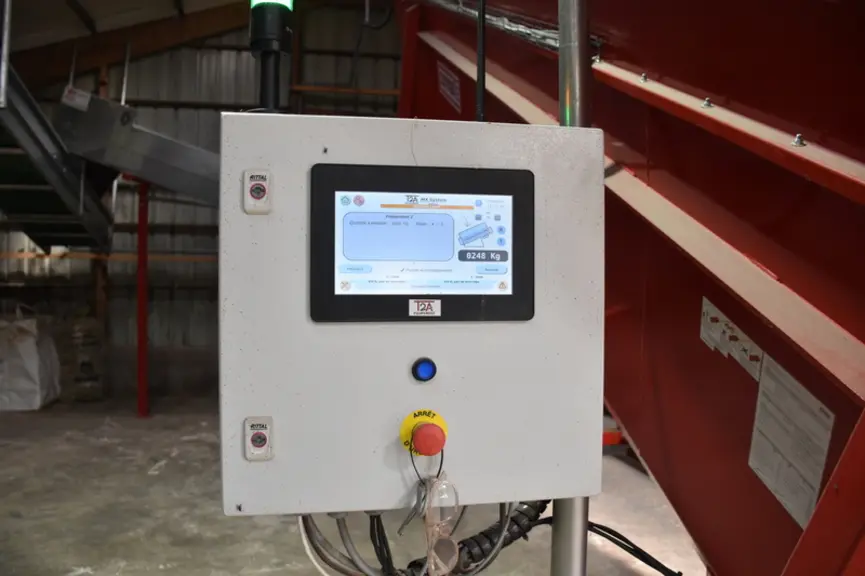
A touchscreen allows it to be controlled in real time: you can enter the ration composition, as well as the quantities to distribute per feeding mat.
Stay up to date in real time!
Follow topics, legislative projects, companies, and public figures to be notified as soon as we publish an article.
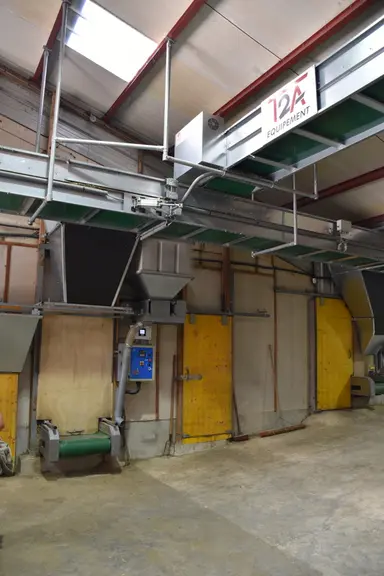
Once the forage has been mixed, it is weighed and transported on an Albouy conveyor belt to the four feed mats from the sheepfold. The amount of forage distributed can be adjusted for each mat. The conveyor belt speed is automatically modulated. At each belt entry, hoppers distribute cereals. The amount of concentrate distributed may vary from one mat to another and is therefore adapted to the different batches of ewes. The rations for the different batches are formulated with a nutritionist. Rejected items are sucked up by the conveyor return. “ The daily operating cost, including mixing and distribution, is only four to five euros”, estimates Benoît.
Time and production gains
The work of distributing the ration is thus simplified as much as possible. Distribution takes place automatically twice a day during the milking period. Result: “We have gained one hour of work per day. » Even though the farmer does not yet have several years’ experience with the system, they considerthe first year of operation satisfactory. The ration is more uniform and better mixed, and refusals have decreased. “We benefit from it », concludes Benoît. Ultimately, the food cost went from 36% in 2024 to 23% in 2026. The average milk production at the beginning of milking has gone from 2,8 to 3,5 liters per day and per ewe. It remains to be seen whether this upward trend will continue over the years.