
The answer goes far beyond technology. Experiences from North American producers show that automation requires changes in management, animal selection, and farm routines—and that results vary according to the size and characteristics of each operation.
In a report published by Dairy Herd, two producers shared their experiences with robotic milking, while Courtney Halbach, an extension specialist with the Dairyland Initiative at the University of Wisconsin, raised questions about the challenges and limitations of this model.
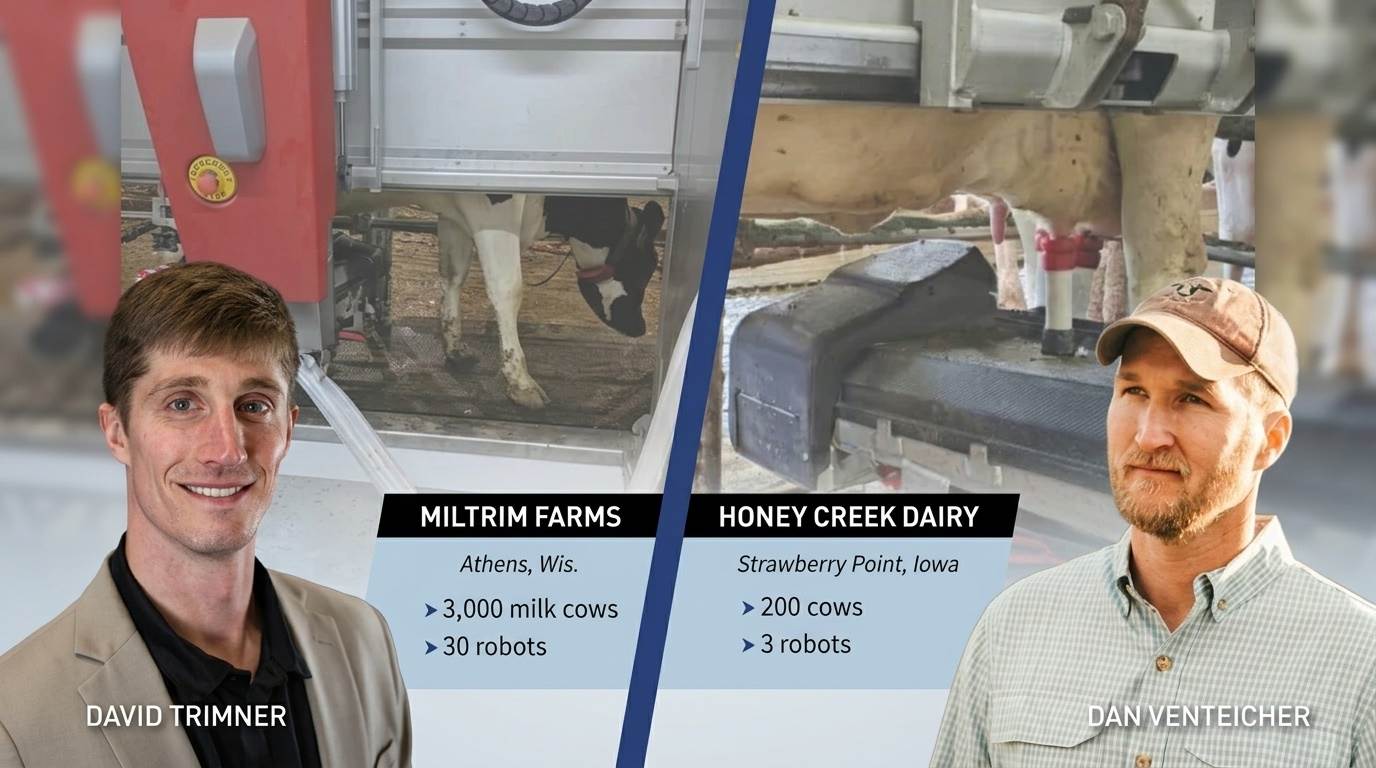
On one hand, David Trimner manages an operation with 3 thousand cows in Athens, in the state of Wisconsin. On the other hand, Dan Venteicher works with his brother on a farm with 200 cows in Strawberry Point, Iowa. Although they operate on very different scales, both say they are satisfied with the decision to invest in the technology.
From 200 to 3 thousand cows: how automation changes the daily routine
On Venteicher's farm, three robots serve 200 cows. He and his brother are responsible for the operation, which ships approximately 6 million pounds of milk per year, or the equivalent of close to 2,72 million kilos. The producer highlights that the increase in milk production after adopting the system helped offset the investment payments. In addition to the production returns, automation brought flexibility to the family’s routine, reducing dependence on fixed milking schedules.
At Trimner’s operation, the strategy is different. Of the 3 thousand cows, approximately 1.800 are milked by 30 robots, while the other 1.200 remain in a conventional milking parlor. The robotized facility operates with six people dedicated to activities related to the robots and animal management in this barn. This represents approximately 300 cows per employee, not including tasks such as feeding and manure management, which would also be necessary in the conventional system.
Continues after the advertisement
The figures show the potential of automation to expand operational capacity, but they do not mean that the work disappears. As Halbach notes, the roles change: instead of focusing on milking at set times, the team moves on to perform more specialized tasks, monitor the equipment, and intervene when necessary.
Does the investment pay off?
Cost is one of the main points of concern. The two producers installed their systems in 2019, when financing conditions were more favorable. Trimner reports that the total investment in his facility, including installations and equipment, came to approximately US$ 9.500 per cow. According to the report, similar projects can currently cost from US$ 15 thousand to more than US$ 20 thousand per animal, depending on the location and the conditions involved in building or adapting the facilities.
The difference underscores the importance of assessing the timing of the investment, credit conditions, and the project's total cost. It is not enough to compare the price of the robots with an employee's salary: facilities, maintenance, financing, production, herd size, and work organization must also be considered.
For Venteicher, the decision was also influenced by the prospect of personnel costs increasing over time. The producer says the additional milk volume obtained after the change exceeded the financing installments. Both producers say the systems paid for themselves. Even so, these are individual experiences that do not guarantee the same return for other farms.
More milk does not always mean greater efficiency
One of the points raised by Halbach concerns production per cow. According to the researcher, some farms that were producing more than 100 pounds of milk per cow per day before installing robotic systems began having difficulty exceeding 90 pounds after the change.
The figures correspond to approximately 45,4 and 40,8 kilograms of milk per cow per day, respectively. This observation does not mean that robotic milking necessarily reduces production, but it does highlight the need to evaluate results carefully, including in new, well-planned facilities.
Trimner, in turn, reports production of 112 to 113 pounds of energy-corrected milk per cow per day, both in the robotic barn and in the conventional milking parlor. This is equivalent to approximately 50,8 to 51,3 kilograms of energy-corrected milk per day — a measure that should not be directly confused with the volume of milk produced. The comparison illustrates how performance depends on the combination of facilities, management, animal profile, and milking frequency.
In robotic milking, each cow’s time matters
Another lesson from the Venteicher farm is in animal selection. The farmer evaluates not only the amount of milk produced, but also how long each cow stays in the robot during milking. He cites two cows as examples. One of them, called Marshmallow, produced an average of 155 pounds of milk per day over three consecutive lactations and stayed in the equipment for about 5,5 minutes per milking. Another, Franny, produced 130 pounds per milking, but occupied the equipment for approximately 15 minutes. Faced with this difference, the farmer concluded that the first allowed more efficient use of the system’s capacity.
Continues after the advertisement
The logic is simple: in a system with limited milking capacity, it is not enough to look at individual production. The amount of time the equipment is occupied also affects how many milkings can be performed and how much milk can be obtained throughout the day. Automation therefore even changes the criteria for selecting and culling the herd. Efficiency comes to involve both production and each animal’s ability to adapt to the system’s routine.
Management remains decisive
Heifer adaptation is another relevant factor. Venteicher reports that he keeps the animals in an area near the robots during training, until they learn to use them independently. Some heifers adapt quickly; others may take up to two weeks.
The producer attributes some of his results to calm management and genetic selection. The researcher also mentions studies indicating that calves raised in pairs or groupsmay find it easier to deal with new situations, although this should not be interpreted as a guarantee of adaptation to robotic milking.
A hoof health also requires attention. At Venteicher’s farm, the combination of sand bedding, automatic scrapers operating continuously, relatively short corridors, and hoof trimming every 40 days is part of the management strategy.
He says he does not use footbaths, but stresses that this is a decision based on the specific conditions of his farm, not a universal recommendation. Halbach recalls that lameness problems have been observed in robotic herds, especially when decisions about facilities and housing do not promote animal comfort. In addition, failures in teat preparation can compromise milking hygiene and increase the risk of mastitis. Equipment precision remains a challenge, despite technological advances.
Robots or conventional systems? It depends on the size of the farm
For Halbach, farms with fewer than 500 cows may find that robotic milking offers advantages related to routine flexibility and work organization. In larger herds, the economic analysis becomes more complex, with high capital costs and a need to compare the technology with conventional high-capacity systems as well, such as rotary parlors.
Trimner’s experience shows that combining the models can be an alternative. By keeping cows with health problems, less favorable udder characteristics, or adaptation difficulties in the conventional system, the farmer can direct the animals best suited to the robots. This strategy helps show that the choice does not have to be a contest between technology and conventional methods. Under certain conditions, the systems can complement each other.
Ultimately, the main lesson from the two farms is that robotic milking does not replace farm management. It changes the way of working, requires new indicators, and calls for planning so that the investment generates a return. Rather than asking how many cows a robot can milk, the farmer needs to assess whether the system makes sense for their herd, facilities, team, and economic objectives.
The information is from Dairy Herd, adapted by the MilkPoint Team.