
Cniel is preparing to publish a brochure on lipolysis. Why focus on this criterion?
Nadine Ballot, Cniel: “We are not seeing any deterioration in the results for lipolysis in bulk tank milk apart from the usual seasonal variations. In general, lipolysis increases on farms between June and August. Although the national average is well below the penalty threshold set at 0,89 mEQ/100 g MG, some farms regularly show deteriorating results, and it is not uncommon for a farm to exceed this threshold at least once a year.
Moreover, lipolysis is a real challenge for all stakeholders in the dairy sector leading to products that cannot be marketed, a loss of value among consumers, and penalties in milk payment. Since lipolysis cannot be corrected during milk processing, it should be limited at the production stage. In response to this challenge, which affects the entire sector, Cniel is preparing to publish a brochure to help farmers better understand and control fluctuations in milk lipolysis results.
Does an increase in lipolysis indicate a problem on the farm?
Lipolysis is first and foremost a matter of good practices. A balanced and sufficient diet, good hygiene, appropriate milking practices that promote proper teat stimulation, and well-designed milking and storage equipment that allows the milk to flow properly all help limit it.
In terms of feeding, vigilance is essential during the start of lactation and before drying off. It is essential to meet cows’ needs to limit the energy deficit and to adjust feed intake during dietary transitions and periods of high heat.
In terms of equipment, the milking installation must be well designed, correctly sized, assembled and adjusted. In addition to regular maintenance and inspections, it must allow milk to flow smoothly and limit air ingress. It is preferable to have the milk enter tangentially along the wall of the tank. Cooling, agitation and storage must be adapted to the volume of milk to reach 4°C in 2 to 3 hours.
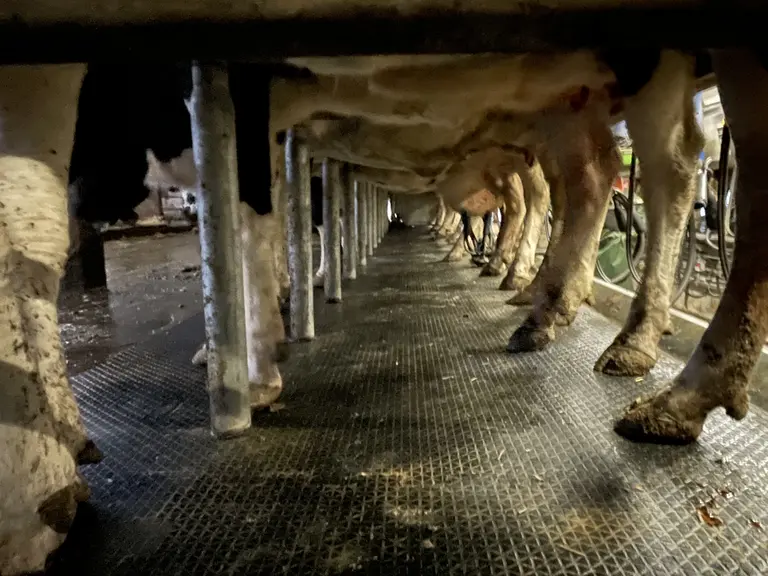
Do all cows face the same risk of lipolysis?
Recent research conducted by the teams Inrae have taught us that there is animal variability in lipolysis. Cows differ in their sensitivity to this risk: some cows produce milk with high lipolysis regardless of circumstances, with fluctuations linked to farming factors, while other cows maintain consistently low lipolysis values, whatever their environment.
The differences are partly linked to genetics. The trait is heritable (0,2-0,3) and repeatable from one lactation to another, but is only weakly genetically correlated with milk production and TB. We also know that some breeds are more prone to lipolysis. Montbéliarde is more prone than Prim’Holstein, which itself has higher values than Normande. Physiological stage also has an impact. Lipolysis is lower in primiparous cows.
Stay up to date in real time!
Follow topics, legislative projects, companies, and public figures to be notified as soon as we publish an article.
Milking robots promote lipolysis. Is it inevitable?
Depending on the milking setup, the risk of lipolysis appears to be higher or lower. It gradually becomes more significant with a robot than with a traditional high-line or low-line milking installation. The higher the milking frequency, the more it tends to increase.
In robot system, the more complex milk circuit and increased air intake also promote lipolysis. But this risk remains manageable by ensuring appropriate settings, good equipment maintenance, and careful management of permissions to enter the milking area, etc.
Definition
Lipolysis is the enzymatic breakdown of milk fat by lipases, resulting in the release of free fatty acids into the milk. Lipolysis is responsible for defects in most dairy products, causing rancid tastes and odors, changes in texture, and reduced shelf life.
Did you know?
There are three types of lipolysis:
- The spontaneous lipolysis is due to the natural fragility of fat globules. It is promoted by a cow effect and certain farming factors. It develops after the milk has cooled in the tank and can occur even in the absence of any mechanical or microbial alteration.
- The induced lipolysis is due to thermal and mechanical shocks that weaken the fat globule membrane. It occurs during milking, storage, transport, and processing of the milk.
- The microbial lipolysis is linked to the presence of psychrotrophic bacteria capable of surviving and multiplying at low temperatures, close to 0 (for example, pseudomonas), or to inadequate refrigeration of the milk. It appears 72 hours after milking and can occur in heat-treated milk.