
Recurring difficulties finding enough qualified catchers prompted Christophe Gall to invest in mechanized catching so he could be more self-sufficient.
Read also: Watch a video of catching with the Chicken Cat machine at Christophe Gall’s farm
Based in Plounévez-Moëdec in the Côtes d’Armor, the producer of sexed heavy chickens operates two poultry houses totaling 3 100 m2 in partnership with Le Gouessant, and is currently building a third measuring 1 370 m2, with his son Donovan expected to join the farm as an employee.
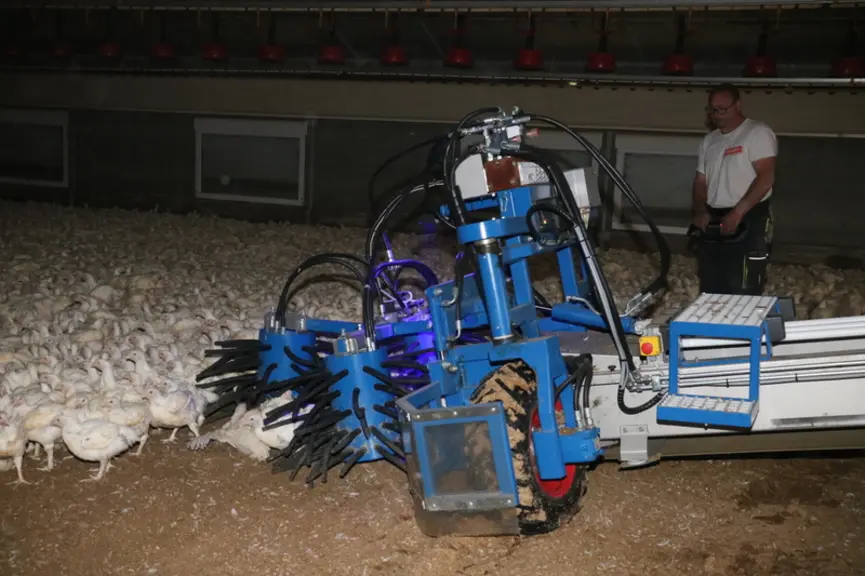
Catching involves three people: Christophe Gall, who operates the machine, and two operators who monitor the filling of the container crates and guide the exit of the conveyor belt. © A. Puybasset
In the summer of 2025, he invested in a Chicken Cat machine. This is an uncommon approach for a farm of this size, but the producer sees only benefits, both economically and in terms of peace of mind, despite the substantial investment. Purchased new, the machine cost him 264 500 euros, including the poultry-weighing option, plus 20 000 euros for the trailer used to transport the machine for contract work.
Greater autonomy in poultry catching
“Catching is a key step in the profitability of the flock. On catching nights, I was always worried that I would be left without catchers, with the trucks waiting in the yard. I can now be confident that catching will take place on time and under better-controlled conditions. I feel more at ease,” explains the farmer. Whereas 7 to 8 people were needed for manual catching, mechanized catching in his poultry houses now requires only three people: Christophe operating the machine and two workers at the end of the conveyor: Bernard and Yannick, employees on Tesa contracts. The machine is used to catch birds in his two poultry houses and is also hired out to two farmers located less than 10 km away, representing 5 300 m2 of poultry-house space. The machine therefore handles a total of 8 400 m2 of sexed heavy-broiler floor space, with two catches per flock (females then males).
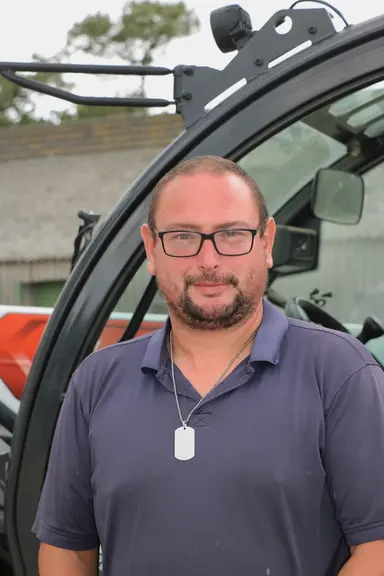
Christophe Gall: “The machine therefore handles a total of 8 400 m2 of sexed heavy-broiler floor space, with two catches per flock.” © A. Puybasset
Payback over ten years
Christophe Gall estimated his return on investment based on a ten-year depreciation period. “The machine’s annual payment costs me 6 000 euros less than the annual cost of mechanical catching in my two poultry houses, if it were carried out by a catching company, he calculated. My collection services practically cover the cost of this annual payment. I only have to cover the labor costs. That’s almost 30 000 euros less in operating costs per year.” Christophe is not looking to expand his service business further, partly because of the workload (he carries out a total of 12 collections every two-month cycle), and partly to avoid wearing out the machine too soon. “I’m planning to use it over the long term. The machine runs for 350 hours a year, including service work. By taking care of my machine and using it moderately, I’m aiming for a lifespan of nearly twenty years”, he hopes.
Very consistent filling of the containers
The machine’s settings and familiarization with the control unit were handled by the farmer during the first batch, and he admits that he had a few cold sweats that day. Since then, the collection process has been perfectly fine-tuned and runs at the machine’s steady pace. Loading each truck takes an hour, sometimes less, “which is a little longer than with manual collection, but we’re not trying to go fast.”» Christophe Gall advises growers who also wish to equip themselves to choose the automatic weighing option. «The weighing is very precise. This makes it possible to achieve a very even number of chickens across the five levels of the container.» With the switch to mechanized catching, the grower observed a decrease in the rate of condemnations.
Eco side
8 400 m2 of sexed heavy chicken buildings with mechanical catching (6 poultry houses), including 5 300 m2 under contract
Disinfection after each collection
To avoid any risk of pathogen transmission between his farm and the two farms where he works, Christophe Gall follows a strict cleaning and disinfection protocol for the Chicken Cat machine and the trailer.
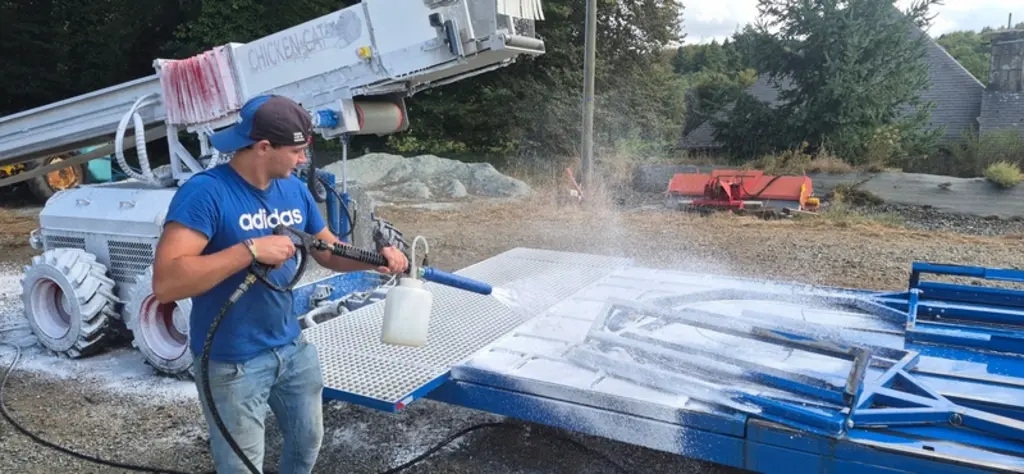
The Chicken Cat is cleaned and disinfected after each use. © Donovan Gall
It is carried out after each use, requiring 1 hours and 30 of one person’s working time, including dust removal, running the foam cannon, disinfection, cleaning the air filter… The machine is greased after each batch and has a maintenance contract with a nearby garage.
The collection process in pictures
Designed nearly 25 years ago by the Danish company JTT Conveying, the Chicken Cat machine with a hydraulic collection system consists of a remotely controlled collection head that sweeps the entire width of the building. Using rubber fingers on rotating drums, it picks up the chickens, which are placed on a telescopic conveyor belt leading to an articulated arm for filling the containers.
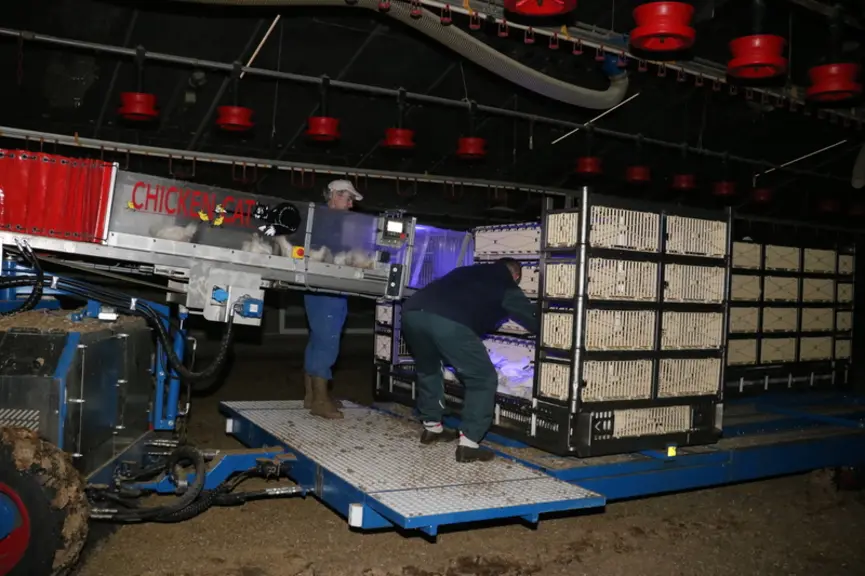
Filling stops automatically as soon as the total weight is reached, crate by crate, thanks to the weighing device, which enables even filling. © A. Puybasset
The latter is controlled by two people. The full containers placed on the rotating loading platform are collected by the truck driver. It can hold up to three (Marel-type containers). “The advantage of the Chicken Cat is that it can sweep the entire width of the poultry house (up to 24 metres), while the rest of the machine remains stationary inside the building,” says Christophe Gall.
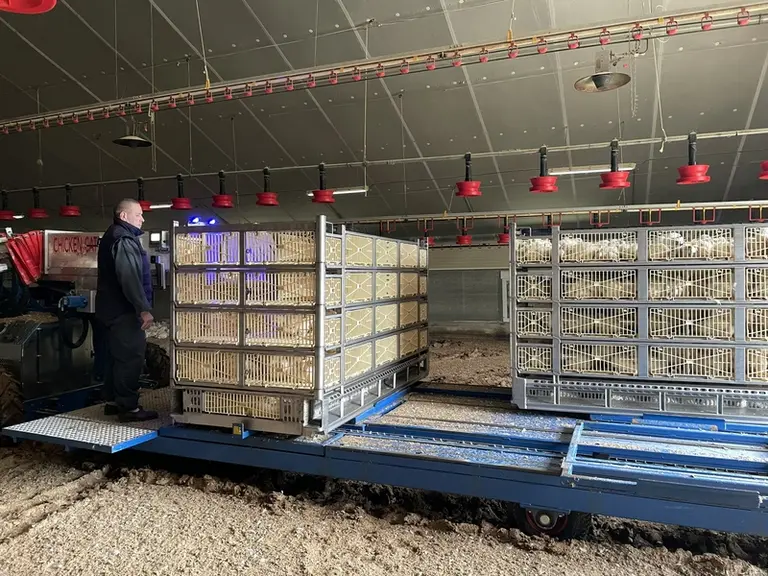
The rotating loading platform can hold up to three Marel-type containers. © A. Puybasset
«It is also suitable for uneven or damp dirt floors. The machine is controlled from the ground, as close as possible to the animals. This requires a great deal of concentration.» Thanks to the weighing system, filling each level of the container stops as soon as the target number of chickens is reached, with the average weight of the batch having been set in advance.