News
Animal husbandry drives European agriculture: animal production rises to 238 billion euros in 2025
In 2025, Eurostat records a record for EU agricultural production at 558,7 billion euros, driven by a 9,2% increase in the livestock sector. The balance between selling prices and costs strengthens value added in Europe and Italy, the Union’s third-largest agricultural power

Analysis of macroeconomic data is the essential starting point for understanding the financial health of European agricultural and livestock businesses. The official data from the Economic Accounts for Agriculture published by Eurostat trace for 2025 a picture of solid growth for the European Union’s primary sector. The total value of European agricultural production reached a record 558,7 billion euros at basic prices, an increase of 4,8% compared with the 532,9 billion euros recorded in 2024. In the overall Community economy, agriculture contributed 244,6 billion euros to Gross Domestic Product of the European Union, equal to about 1,3% of total GDP.
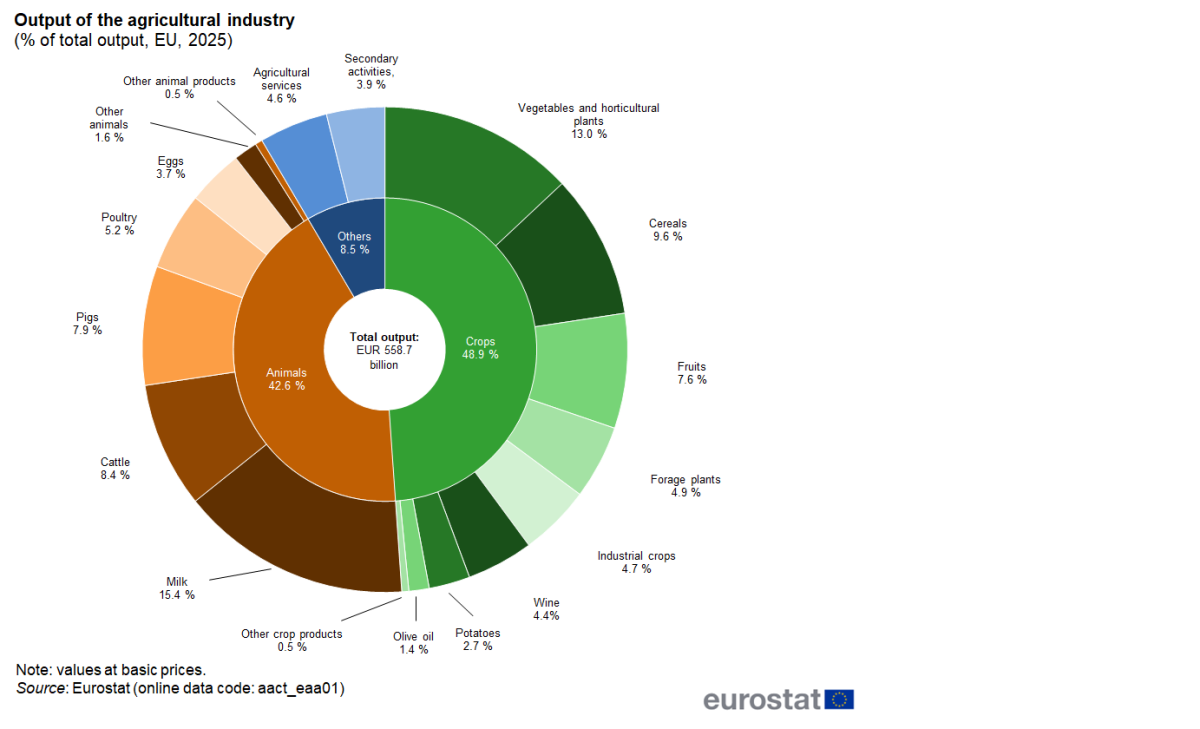
Within this business volume, the livestock sector played a particularly prominent role in sustaining the industry. The production of animals and livestock products generated an estimated value of 238,2 billion euros, equal to 42,6% of the European agricultural industry's total. Compared with the previous year, the livestock sector recorded growth of 9,2% in value, driven in particular by the recovery and resilience of the dairy, of beef cattle and pigs. Crop production provided 273,2 billion euros, equal to 48,9% of total production, with more moderate growth of 1,6%. Agricultural services and non-agricultural secondary activities that cannot be separated completed the picture, providing 47,3 billion euros, equal to 8,5% of the overall value.
The value added by livestock farming
During 2025, the consumption costs intermediate, borne by farmers for the purchase of goods and services necessary for the production cycle, amounted to 309,1 billion euros at the European Union level, with a moderate increase of 1,8% compared with 2024. For livestock farmers, the main expenditure item is feed and animal nutrition, which alone absorb 36,4% of total intermediate costs, with a further 2,4% allocated to veterinary services and healthcare for livestock.
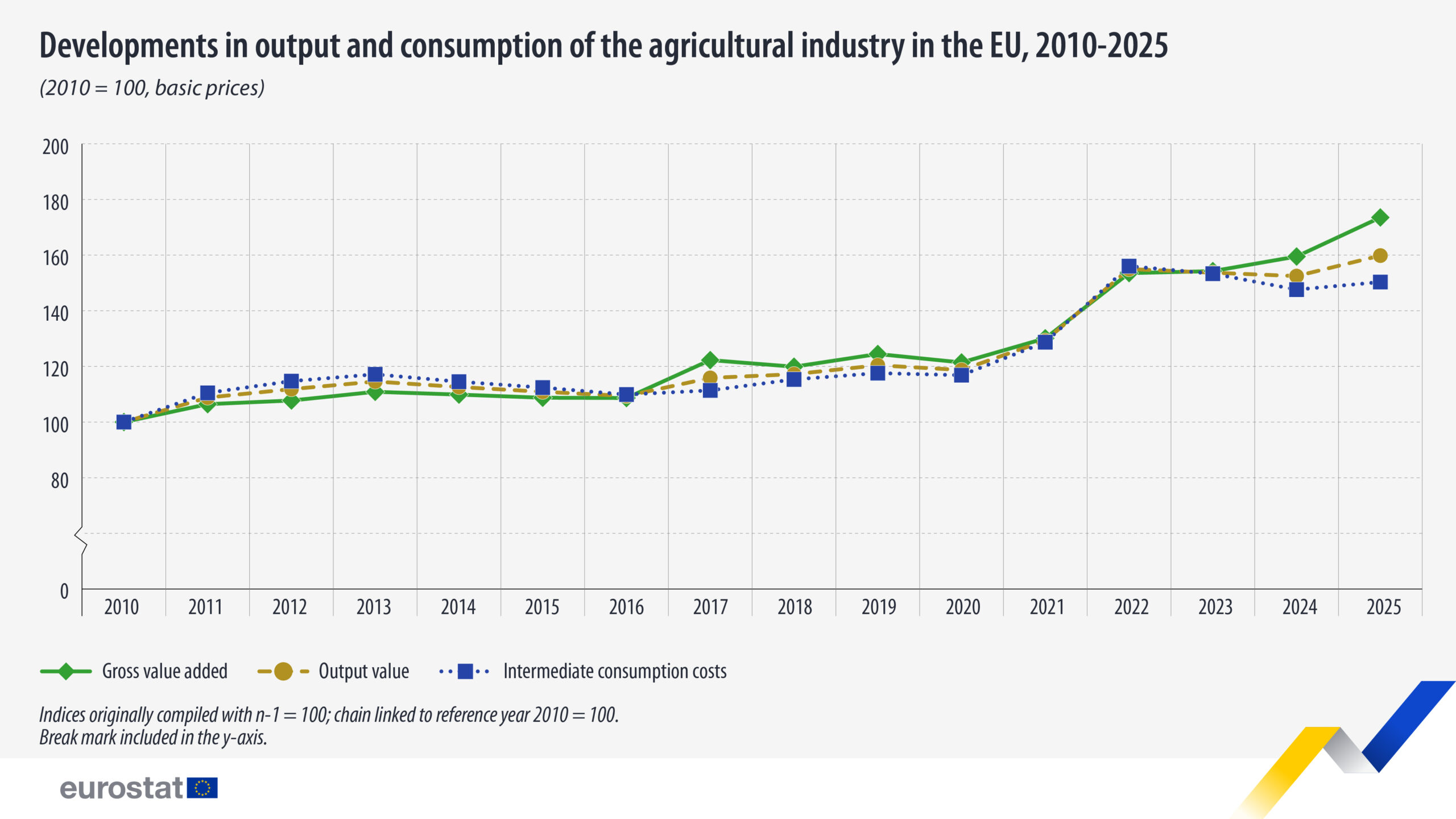
Since the value of production grew at a significantly faster pace than costs, the gross value added of European agriculture rose by 8,8%, reaching 249,5 billion euros. In analytical terms, for every euro spent on purchasing intermediate goods and services, the agricultural sector generated 0,81 euros of added value. This is the highest level of relative profitability ever recorded in the European Union since 2005. This increase in profitability supported the indicator of agricultural labor productivity per annual work unit, which in the EU recorded an increase of 8,2% in real terms in 2025, reaching levels more than 64,9% higher than those recorded in 2010.
The Eurostat model
The data come from the Economic Accounts for Agriculture, a satellite accounting system that integrates production volumes, farm-gate or bulk prices, and the prices of inputs purchased by farmers. Agricultural income per work unit is calculated through theIndicator A, which expresses real net value added at factor cost divided by labour input expressed in Annual Work Units, corresponding to full-time workers.
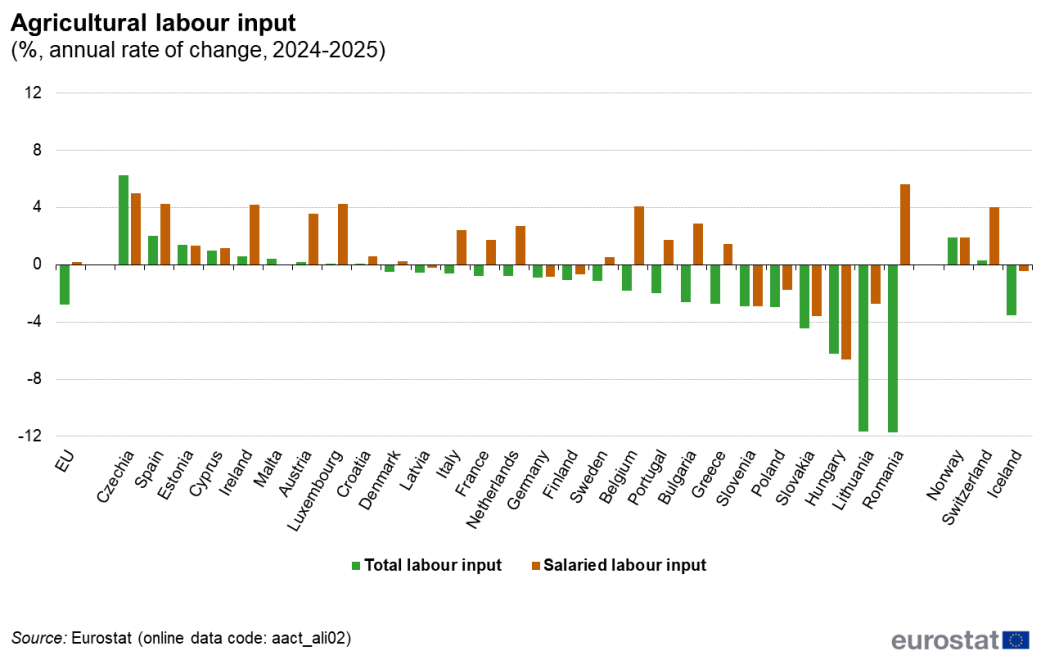
The analysis of labour employment, however, highlights a structural long-term downward trend. In 2025 total agricultural labour input in the European Union amounted to 7,5 million full-time workers equivalent, of which 5,1 million consisted of unpaid family work and 2,4 million of paid employed work. In the last year, the total workforce decreased by 2,8%, accelerating a reduction process that between 2010 and 2025 led to the loss of 2,9 million full-time equivalent work units, equivalent to a cumulative decrease of 27,8%. This trend reflects ongoing progress in the mechanization and management efficiency of farms, combined with the attraction of other economic sectors, but raises considerable questions about the future of the agricultural sector.
The Italian case
Over 56,8% of the total value of agricultural production in the European Union is concentrated in the four leading producing countries, namely France with 93,0 billion euros, Germany with 78,5 billion, Italy with 74,3 billion and Spain with 71,8 billion euros. Italy thus remains firmly the third-largest agricultural power in the European Union in terms of value generated. The second tier of countries includes Poland and the Netherlands, each with 41,6 billion euros, and Romania with 23,0 billion euros; together, these seven countries generate over 75,8% of the EU’s agricultural production.
We are good at…
In the Italian landscape, livestock farming stands out for the high added value of its high-quality supply chains, particularly in the dairy sector and in the processing of beef and pig. The ability of domestic livestock farms to enhance the value of their products on the market has enabled Italy to maintain a leading position in its contribution to European agriculture, despite production input and animal feed costs that call for increasingly efficient and targeted management of farm resources.
In summary
The overall interpretation of the statistical picture 2025 indicates a strong recovery in the value of animal production and resilience in operating margins, providing a solid foundation for addressing investments in the green and digital transition. However, the share of animal feed in total costs and the gradual decline in the availability of agricultural labor are risk factors that require careful planning by livestock farmers.
From this perspective, much of agriculture will depend on the European Commission’s guidelines, which are aimed at ensuring business competitiveness, fair remuneration along the food supply chain and strengthening resilience in the face of changing market conditions.
Source: Eurostat
For further information: Eurostat database
Ruminantia and AI: editorial transparency

To read - November 2026
Share this news!
Articles that may interest you
Soil health, what incentives are available for farmers?
The extraordinary inspection plan for PDO and PGI products is underway
Alfalfa, 2026 campaign: production and quality are growing