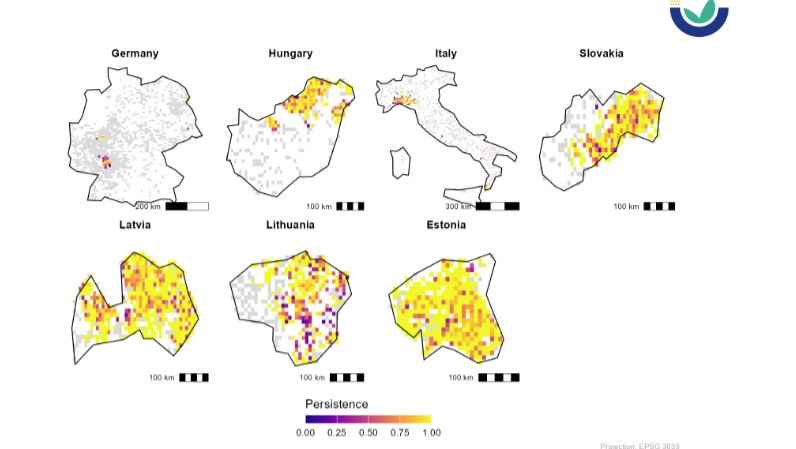
To study the determinants of the emergence, persistence, and spread of African swine fever in European wild boar populations, with particular attention to available estimates of wild boar density, we drew on previous modeling analyses conducted as part of EFSA activities.
Materials and Methods: First, we developed spatially explicit statistical models to identify the determinants of the proportion of wild boar carcasses positive for ASF detected in grid cells measuring 10 × 10 km in 7 European countries (Estonia, Germany, Hungary, Italy, Latvia, Lithuania, and Slovakia), using this metric as a proxy for ASF presence. We then applied a similar framework to study ASF persistence, defined as the percentage of positive months over two- and five-year periods. These analyses provided very limited evidence that available estimates of wild boar density were associated with ASF presence or persistence in the study area. However, several weather variables, including annual temperature and precipitation, as well as ecological variables related to wild boar habitat suitability, including forest cover, forest fragmentation, and the human footprint index, were associated with ASF presence and/or persistence, although not consistently across countries. We also extended an existing spatially explicit mechanistic model of the spread ofPSA operating on a grid of cells measuring 2 × 2 km, parameterized using the available estimates of wild boar density. The model was fitted to four sequential epidemic waves in northern Italy (from January 2022 to November 2025).
Results: The model results provided consistent support for an effect of wild boar density on ASF propagation patterns, with habitats with a higher predicted wild boar density tending to be more susceptible and infectious to nearby habitats.
Conclusions: Taken together, these results suggest that wild boar density may play a particularly important role in the geographic spread of ASF into unaffected areas, while local presence and persistence once ASF has become established may depend more strongly on local epidemiological and environmental conditions.
Delecroix, C., Pedro Mil-Homens, M., Hayes, B., & Vergne, T. (2026). Determinants of African swine fever occurrence, persistence and spread across Europe. EFSA Supporting Publications, 2026, EN-10386. 44 pp. doi: 10.2903/sp.e