
In recent years, Mycoplasma synoviae has been widespread in commercial layer flocks in China, causing huge losses to the egg-laying industry. Clinically, Mycoplasma synoviae (MS) mainly causes joint swelling and synovitis in chickens. Specific signs include lameness, inability to stand, weight loss, and keel swelling in infected chickens. The ages of onset are concentrated at 30-50 days and 60-80 days.
In recent years, Tianjin Zhonglian has detected positive MS nucleic acid in the oviducts of many flocks that did not reach peak egg production; MS ELISA antibody levels were very high (mean greater than 12000). The flocks showed almost no early joint lesions, or only very mild ones, and no MS nucleic acid was detected in joint tissue. It is believed that the MS currently circulating in Chinese layer chickens can be divided by tissue tropism into an arthrotropic form and an oviduct-tropic form, and that the main reason these flocks do not reach peak egg production is infection with oviduct-tropic MS.
There are currently very few domestic studies on oviduct-tropic MS. The author reviewed some relevant international literature and summarized the main findings in the hope of providing further help in controlling MS.
1, Isolation and identification of oviduct-tropic MS
Since 2000, some commercial layer farms in the Netherlands have observed unusual eggs. Their shells differ markedly from those of normal eggs: the shell surface is rough and uneven, thinner, more translucent, fragile, and cracked over an area extending about 2 centimeters down from the pointed end. There is also a distinct boundary line between this area and the lower part of the shell. Some researchers named this condition “eggshell apex abnormalities” (EAA) and called these eggs “EAA eggs,” as shown in the figure.
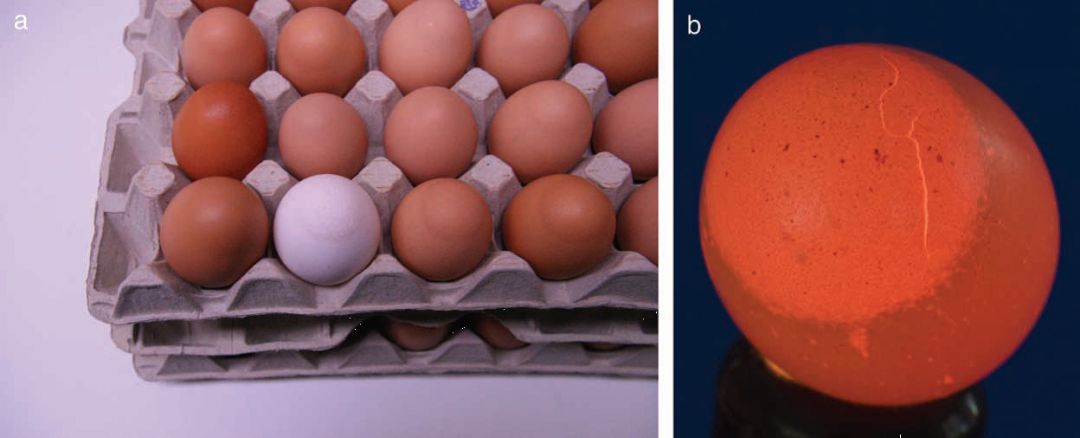
EAA eggs
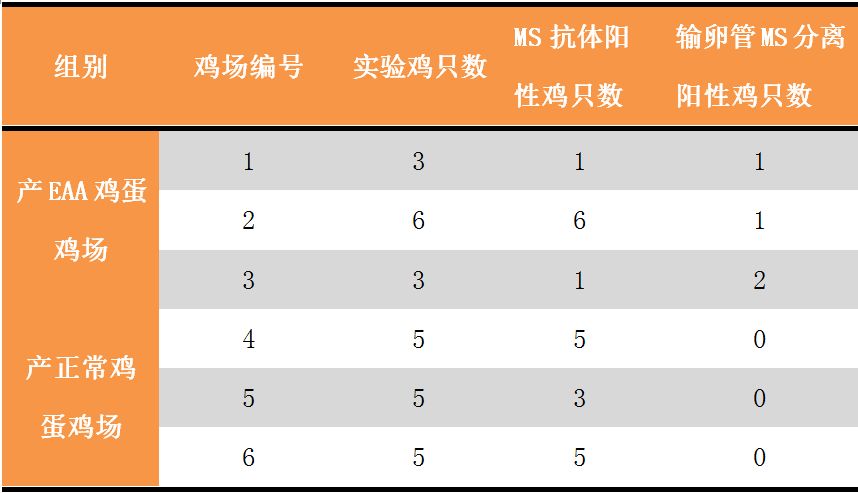
Researchers including A. Feberwee selected 3 white-shell commercial layer farms producing EAA eggs (with EAA egg proportions of 3%, 10%, and 25%, respectively) as the experimental group, and 3 commercial layer farms that tested positive for MS antibodies but did not produce EAA eggs as the control group. They collected serum from chickens producing EAA eggs and chickens producing normal eggs, and tested for MS antibodies using RPA (rapid plate agglutination). The chickens were then necropsied, oviduct swabs were collected for pathogen culture, and the cultures were tested by PCR. The results showed that MS could be isolated from the oviducts only of chickens producing EAA eggs; MS could not be isolated from the oviducts of normal chickens. The MS strain isolated was named EAA-type MS or oviduct-tropic MS, as shown in the table.
MS isolation results from the oviducts of the various flocks
2. Effects of oviduct-tropic MS on the production performance of commercial layer hens
Researchers including A. Feberwee selected 40 white-shell commercial layers, 70 weeks of age, laying EAA eggs, and 10 hens laying normal eggs from a flock of commercial layers laying EAA eggs as the experimental groups. They selected 10 hens, 70 weeks of age, from a flock with normal egg production as the control group. Each hen was housed separately. The experimental hens were divided into 3 groups: 20 hens laying EAA eggs were assigned to experimental group 1, another 20 hens laying EAA eggs were assigned to experimental group 2, and 10 hens in the EAA flock laying normal eggs were assigned to experimental group 3.
At 74 weeks of age, experimental group 2 received a subcutaneous injection of long-acting oxytetracycline at 100 mg per hen. The number of eggs laid by each hen in experimental groups 1 and 2 was recorded in detail over the 71-77-week period, including soft-shelled, shell-less, and damaged eggs. At 74 weeks, 10 hens each from experimental groups 1 and 2 were euthanized for necropsy; at 77 weeks, 10 hens from each group were euthanized for necropsy. Oviduct swabs were collected for pathogen culture, and the cultures were identified by PCR.
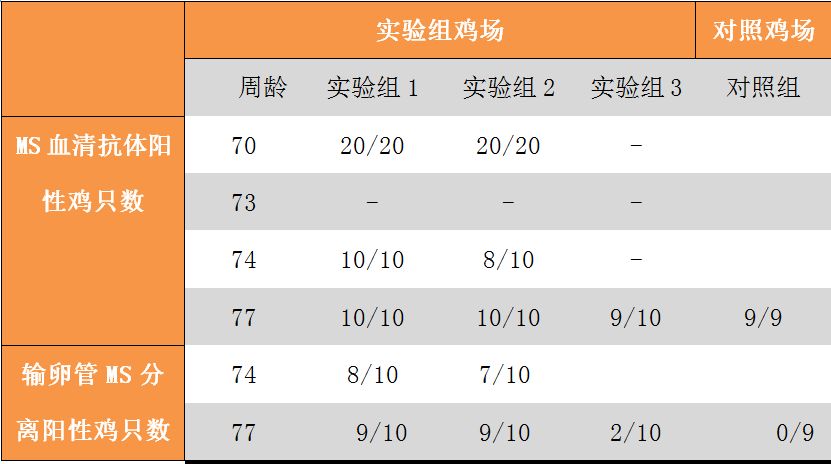
The results showed that at 74 weeks, the MS isolation rates from the oviducts of hens in experimental groups 1 and 2 were 8/10 and 7/10, respectively. At 77 weeks, the MS isolation rates from the oviducts of hens in experimental groups 1, 2, and 3 were 9/10, 9/10, and 2/10, respectively; the rate in the control group was 0/10. This suggests that oviduct-tropic MS was found only in flocks laying EAA eggs, and that the isolation rate from the oviducts of individual hens laying EAA eggs was higher. Use of a susceptible antibiotic had almost no effect on the MS isolation rate in infected hens. In addition, no gross lesions were visible in the oviducts of the hens examined at necropsy, as shown in the table below.
MS isolation results from the oviducts of the experimental groups
3. Study of the reversion of oviduct-tropic MS and its synergistic pathogenicity with IB D1466 strain
Researchers including A. Feberwee selected 7-week-old white-shell commercial layer hens for the study. The flock tested negative serologically for EDS, AI, MG, and MS.
Immunization schedule: at 1 days of age: MA5 spray; at 7 and 28 days of age: ND spray; at 10 days of age: IBD oral drop; at 14 days of age: 793B spray.
At 16 weeks of age, the chickens were ranked by body weight and divided evenly into 5 experimental groups, with large and small birds mixed, and housed separately. The group assignments are shown in the table below.
Challenge inoculation protocol for each experimental group
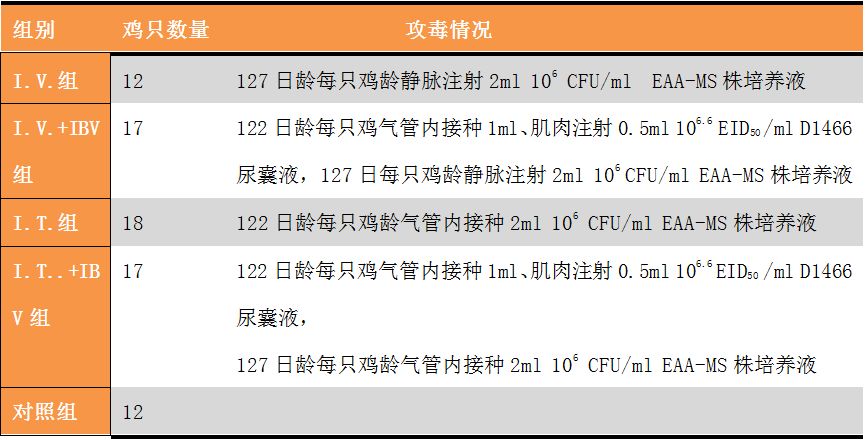
The entire experiment lasted 12 weeks (16-27 weeks). The MS antibody-positive rates in each group were tested using RPA (rapid plate agglutination test) at 16, 20, 24, and 27 weeks. The chickens in each group were weighed at 16 and 27 weeks, and the average weight gain for each group was calculated. The number of eggs laid by each group was recorded in detail during the period from 16 to 27 weeks. At the end of the experiment (the end of week 27), chickens from each group were euthanized, and oviduct swabs were collected for pathogen culture; the cultures were identified by PCR.
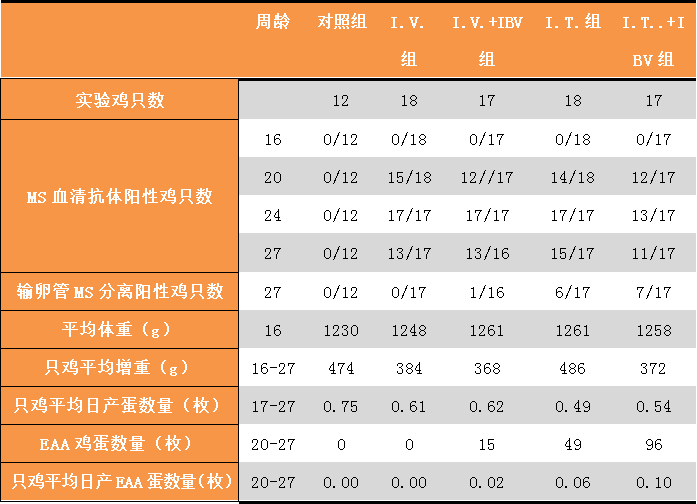
The results showed that no observable clinical signs occurred in any group of chickens throughout the experiment, and no gross lesions were found in the oviducts of the necropsied chickens. The average number of eggs laid per day by chickens in all MS-challenged groups was significantly lower than that of the control group. MS was not isolated from the oviducts of chickens in the blank control group. The isolation rates for the 4 experimental groups were I.V. group 0/17, I.V.+IBV group 1/16, I.T. group 15/17, and I.T..+IBV group 11/17. EAA eggs were produced only by chickens in these 3 groups, in quantities of 15, 49, and 96 eggs, respectively. The chickens began laying EAA eggs 37, 26, and 23 days after MS inoculation. These findings suggest that the MS isolation rate from the oviducts was related to the route of MS infection: MS was rarely isolated from the oviducts after intravenous inoculation, while the isolation rate was high after tracheal inoculation. IB infection increased the number of EAA eggs laid and shortened the time until they appeared. In addition, the effect on weight gain differed by inoculation route, with intravenous injection having a somewhat greater effect than intratracheal inoculation, as shown in the table below.
Statistical results for each experimental group
4, Effects of oviduct-tropic MS on the egg-laying performance of white-feathered broiler breeders
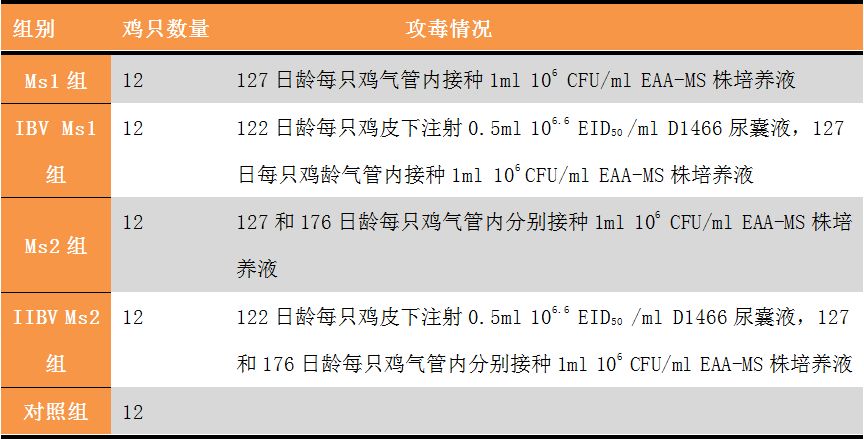
Researchers including A. Feberwee and W. J. M. Landman selected 18-week-old SPF white-feathered broiler breeder hens as the study subjects and divided them into 5 experimental groups, with 12 chickens per group. The group assignments are shown in the table below.
Challenge inoculation protocol for each experimental group
The entire experiment lasted 12 weeks (18-30 weeks). At week 30, the MS antibody-positive rate in each group of chickens was tested using ELISA. Egg production in each group was recorded in detail throughout the experiment. At the end of the experiment (the end of week 30), chickens from each group were necropsied. Tracheal swabs were collected and tested by PCR to determine the MS-positive rate; oviduct swabs were collected for pathogen culture, and the cultures were tested by PCR to determine the MS-positive rate.
Results statistics for each experimental group
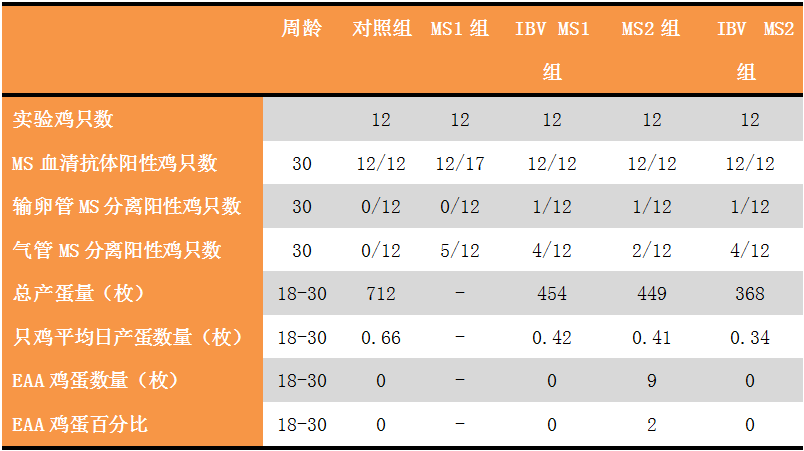
The results showed that no observable clinical symptoms occurred in any group of chickens during the entire experiment, and there was no significant reduction in body weight gain. Due to some issues with the MS1 group, its egg production was not included in the statistics. In terms of MS isolation rates, the tracheal isolation rates were high in all experimental groups, suggesting that the MS strain persisted in the trachea for a relatively long time after challenge. Compared with tracheal tissue, MS was isolated from the oviduct only in the MS2 group (1/12); all other groups were negative. Only the MS2 group also produced 9 EAA eggs. This indicates that, in white-feathered broiler breeders, oviduct-tropic MS strains are not highly tissue-tropic to the oviduct or effective at inducing EAA egg production. However, total egg production in all experimental groups was significantly lower than in the control group, suggesting that oviduct-tropic MS can also substantially reduce egg production in white-feathered broiler breeders.
5, conclusions and discussion
The above study shows that, in addition to the common arthropathic type, MS also has other tissue-tropic types—an oviduct-tropic type.
Oviduct-tropic MS poses a greater threat to commercial laying hens. It can substantially reduce the quantity and quality of eggs produced by a flock, causing laying hens to exhibit “going off lay” and to produce EAA eggs, soft-shelled eggs, and cracked eggs. These effects persist throughout the laying cycle, causing significant losses to the egg-laying industry. Coinfection with IB virus greatly exacerbates these losses.
Early oviduct-tropic MS infection has almost no noticeable clinical symptoms (such as mild respiratory problems or joint swelling). Flocks often show signs only after they begin laying, so the infection is subclinical. Therefore, compared with arthropathic MS, it poses a greater threat. For China's current egg-laying industry, in addition to controlling arthropathic MS, we must not overlook oviduct-tropic MS.