
The rearing-period objective is to raise uniform, healthy, disease-free, qualified chicks whose body weight and body measurements meet standards and whose development is consistent with their breed characteristics, through strict, scientific, and appropriate management of chicks aged 0-6 weeks. During the rearing period, whether the ambient temperature is suitable directly affects the normal growth and development of pullets.
Therefore, according to changes in outdoor temperatures in different seasons, the poultry house ventilation system should be used appropriately to keep the temperature and humidity inside the house within a suitable range, ensuring the healthy and normal growth and development of the chicks.
I. Physiological characteristics of pullets
Chicks’ thermoregulatory function is not fully developed. Newly hatched chicks have a body temperature 2—3℃ lower than that of adult chickens; at around 10 days of age, chicks can reach the body temperature of adult chickens.
Newly hatched chicks’ down provides poor insulation. As their feathers grow and are replaced, chicks’ thermoregulatory function gradually strengthens at around 3 weeks of age. Only after they have completely shed their down and replaced it with feathers at 6~7 w do they have a certain degree of insulation.
II. Effects of temperature on chick growth and development
Temperatures that are too high or too low during brooding can have irreversible effects on chicks’ growth and development. When temperatures are low, yolk absorption is impaired; when temperatures are high, chicks’ feed intake decreases. Large temperature fluctuations can cause cold stress and trigger respiratory diseases, weakening the flock and resulting in slow growth and development, with body weight and uniformity failing to meet standards.
Three. Principles of Poultry House Temperature Management
Poultry house temperature management follows the principles of suitability, uniformity, and stability. Suitable temperature is the foundation, uniform temperature is the key, and stable temperature is the core.
Suitable temperature means physiological suitability—that is, meeting the physiological temperature needs of chickens at different ages;
Uniform temperature means spatial uniformity—that is, meeting the temperature needs of chickens in different areas of the poultry house;
Stable temperature means stability over time—that is, preventing changes in outdoor temperature from making the poultry house temperature unstable, and keeping the day-to-night temperature difference in the poultry house stable within a suitable range.
Four. Setting Temperature Parameters During Brooding
The brooding period is divided into the early brooding stage and the brooding stage. During the early brooding stage (0-14 days of age), chicks rely on the ambient temperature to maintain their body temperature. In the first few days, chicks are extremely susceptible to cold, so the temperature in the chicken house must be regulated by heating. During the brooding stage (15-42 days of age), the insulating capacity increases as feathers grow and are replaced. As body weight increases, the ratio of body weight to body surface area decreases, heat dissipation declines, and the chicks' ability to regulate body temperature gradually strengthens.
(A) Suitable Temperature Parameters During the Brooding Period
1 Temperature Standards During the Brooding Period
In actual production, the temperature in the chicken house is adjusted by observing the chicks. During the first three days of brooding, apply the lower-limit standard when the chicks' birth weight is greater than 34 grams, and the upper-limit standard when it is less than 34 grams. Starting from the second week, reduce the temperature by 2°C each week. By the sixth week, apply the lower-limit standard of 23°C inside the house. This better helps the flock adapt to the continuously falling outdoor temperatures in winter.
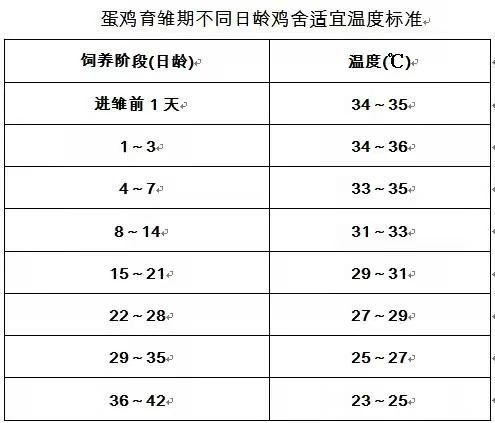
2 Suitable Humidity Standards
The relative humidity in the brooding house should decrease as the flock gets older. The brooding temperature should be adjusted according to the relative humidity inside the house; when humidity is high, apply the lower-limit temperature standard. The ideal relative humidity standard is:
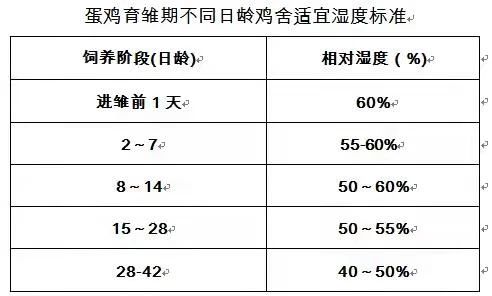
(B) Temperature Stability Parameters During the Brooding Period
A stable temperature in the brooding house means reducing the difference between daytime and nighttime temperatures; this difference should not exceed 2°C. This is especially important during the autumn-to-winter seasonal transition: as outdoor temperatures fall, the temperature in the chicken house must remain stable and must not fluctuate sharply.
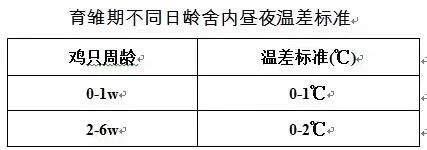
(Three) Brooding-house temperature uniformity parameters
Temperature uniformity inside a chick house refers to consistent temperatures throughout the upper, middle, and lower areas, and the front, middle, and rear areas of an enclosed chicken house. The heating facilities should be laid out appropriately, and the house should be well sealed and insulated, preventing drafts and reducing temperature differences between different areas inside the house.
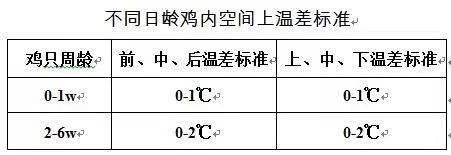
Five. Temperature control measures during the brooding period
1, Temperature control measures for suitable temperatures during the brooding period (physiologically suitable)
During the brooding period, assess whether the temperature in the chicken house meets the flock’s physiological needs based on the chickens’ behavior. Adjust the temperature by observing the chickens:
(1) When the temperature is suitable, chicks are active and lively, their calls are light and cheerful, their feathers are smooth and even, they have a good appetite, drink a moderate amount of water, and their droppings are mostly elongated. When resting, they are evenly distributed across the cage, sleep soundly with their heads and necks extended, show no abnormal behavior or anxious calling, and the chicken house is quiet;
(2) When the temperature is too low, chicks huddle together near the heat source;
(3) When the temperature is too high, the flock pants with open beaks and moves away from the heat source; feed intake decreases and water consumption increases.
2, temperature stability control measures during the brooding period (stability over time)
Temperature stability focuses on maintaining stable boiler temperatures and stable temperatures between day and night. Changes in boiler temperature during the brooding period determine changes in the chicken-house temperature. The boiler return-water temperature should vary by no more than 5℃ per day, and the chicken-house temperature should vary by no more than 1℃ per day. Pay particular attention to keeping the boiler return-water temperature stable at night. Specific measures:
(1) Establish standards for boiler outlet and return-water temperatures: For sites with centralized heating, set boiler temperature standards based on the house containing the youngest chicks, and keep boiler temperature changes within 5 ℃;
(2) Record the boiler water temperature once every hour, including both the return-water and outlet temperatures;
(3) Check whether the temperature is within the required range. It is preferable to use automatic temperature-control equipment that can store daily temperatures for convenient viewing at any time.
3, temperature uniformity control measures during the brooding period (uniformity across space)
During the brooding period, ensure that the chicken house is properly sealed and insulated. Focus on checking the seals around fans, roof insulation panels, manure trenches, chicken-house doors and windows, and air-inlet panels; arrange underfloor heating and side-wall radiators appropriately; and ensure that the temperature difference between the front, middle, and rear of the chicken house, and between the upper, middle, and lower levels of the cage racks, is less than 2℃.
4, measures to maintain suitable, stable, and uniform humidity during the brooding period
The low-temperature, high-humidity and cold conditions in autumn and winter make brooding more challenging. Therefore, humidity during the brooding period must be kept within a reasonable range:
(1) Monitor humidity: Install a hygrometer in the chicken house and monitor the humidity inside every day; do not rely on guesswork. Suitable humidity in the chicken house keeps chicks’ shanks and toes tender and glossy.
(2) Humidity control measures: 1-2 days before the chicks arrive, humidity can be increased to 60% by spraying water on the floor, walls, and cages; during the first 1 weeks after the chicks arrive, the chicken house is well insulated and ventilation is low. As the chickens eat, drink, and excrete more, humidity inside the house rises accordingly, so there is no need to humidify; humidity can also be maintained at 60%. Thereafter, humidity in the brooding house should be gradually reduced as the chicks age. In cold, humid conditions, raise the temperature inside the house and moderately increase ventilation to remove moisture.
In actual production, temperature management during autumn and winter brooding should set suitable temperature and humidity standards according to the chickens’ physiological needs. Adjust the temperature in the chicken house by using its ventilation equipment appropriately to meet the chickens’ temperature requirements and ensure healthy chick growth and development.