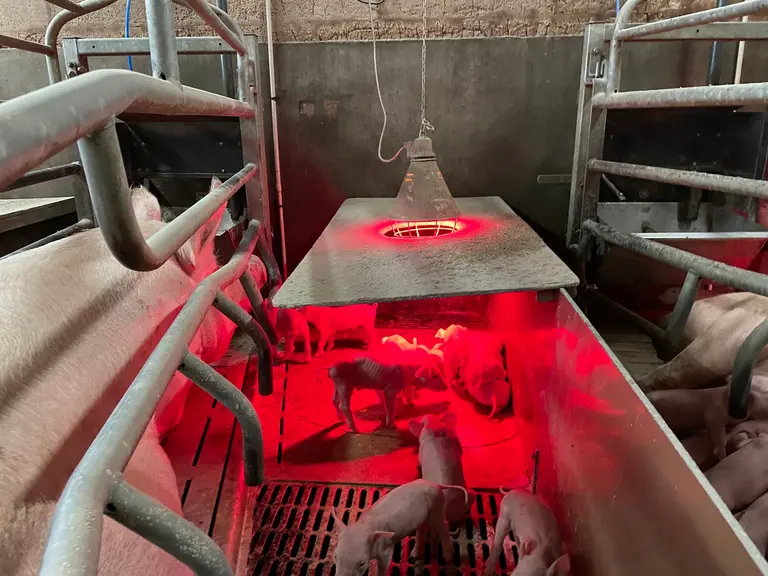
A piglet’s tympanic temperature at 24 hours of life appears to be one of the major determinants of neonatal piglet survival, according to a study presented by Adèle Drouet of Terrena at the Journées de la recherche porcine in February 2026.
Read also: Ifip aims to identify the sounds of sows that save piglets
The study involved individual monitoring of 1 247 piglets from a farrow-to-finish farm equipped with free-farrowing maternity pens. “Each additional degree at birth multiplies the chances of survival until weaning by 2,8.” Piglets that were cold at birth (temperature below 38 °C) had a mortality rate of 14 % before day six, compared with 4 % for warm piglets (above 38 °C). At 24 hours, tympanic temperature had increased by an average of 0,5 °C. More than a third of the piglets did not manage to warm up (<38 °C), and mortality among these piglets reached 24 %. “This clearly shows the importance of warming piglets during the first 24 hours of life to improve their survival (positioning and number of lamps around farrowing, and drying the piglets). » The piglets in this group also weighed 500 g less at weaning at 21 days than all the piglets as a whole. The study shows a significant effect of temperature at 24 hours on piglet survival after the sixth day, showing that it can be a good indicator of viability.
Stay up to date in real time!
Follow topics, legislative projects, companies and public figures to be notified as soon as we publish an article.
No effect of cross-fostering on survival
Cross-fostered piglets (i.e. 18% of the total) had a lower average weight gain during lactation than non-cross-fostered piglets, with a difference of 410 g at weaning (5,07 kg versus 5,5 kg). However, cross-fostering did not adversely affect their survival, provided it was carried out early, that is, between 6 and 48 hours of age. “After this time, the teat hierarchy is established and integrating cross-fostered piglets becomes more difficult.”