Light plays an important role in animals’ behavior, health, and productivity. Although the effects of day length on pigs, particularly in the context of reproduction, have been studied, little is known about how light intensity and color temperature affect their behavior.
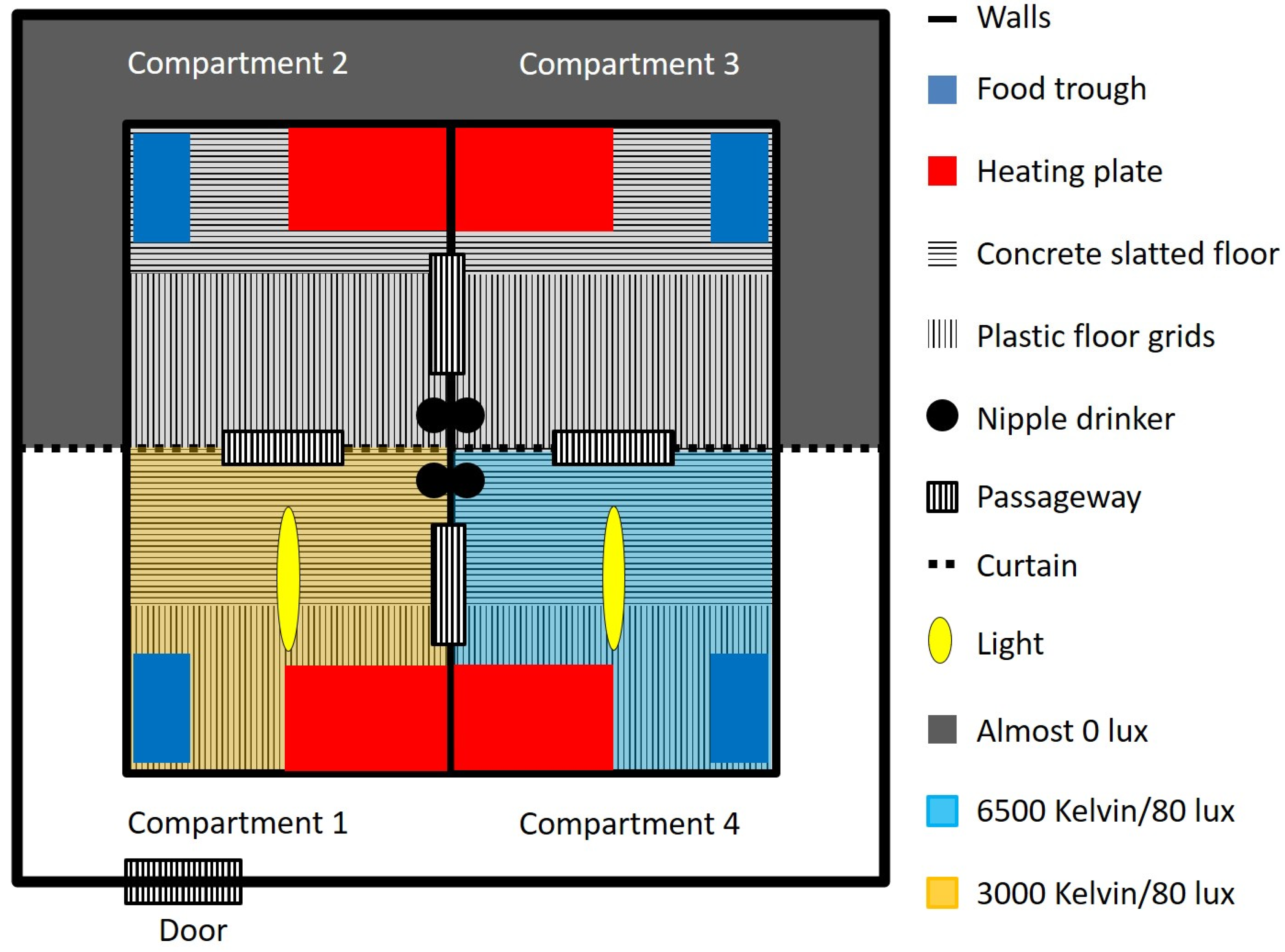
Materials and Methods: This study analyzed the preference behavior of 24 four-week-old weaned piglets under different lighting conditions (0 lux at 0 Kelvin vs. 80 lux at 3000 Kelvin vs. 6500 Kelvin). Two experiments were conducted, each with 12 piglets, over five weeks in a room with four interconnected pens that allowed free movement between pens. Pens A and B were almost dark (~0 lux), while pens C (80 lux, 3000 Kelvin) and D (80 lux, 6500 Kelvin) were illuminated. For three days, in weeks 1, 3, and 5, behavior (lying down, eating, and activity) was recorded by video observation and 5-minute time sampling. Cleanliness was also monitored daily.
Results: In the first week, piglets in the first group preferred the dark pens, while those in the second group preferred the illuminated pens, especially when the color temperature was 3000 Kelvin. By the third week, piglets in the second group had begun to prefer the darker areas. In the fifth week, piglets spent more time in the dark in the morning and evening, but showed no preference for color temperature. The darkened pens remained mostly clean, while pen D, which had a light color temperature of 6500 Kelvin, was the dirtiest.
Conclusions: the results demonstrate that piglets' behavior changes with age and time of day, suggesting that lighting concepts can be adapted to improve both animal welfare and pen hygiene.
Götz, S.; Reiter, K.; Wensch-Dorendorf, M.; von Borell, E.; Raoult, C.M.C. Role of Illumination and Light Colour Temperature in the Preference Behaviour of Weaned Piglets. Animals 2025, 15, 3116. https://doi.org/10.3390/ani15213116