
Introduction: Public and legislative pressure to improve animal welfare has promoted group housing of sows. However, field evidence on welfare and reproductive outcomes when sows are group-housed immediately after weaning remains limited. The first week after weaning is a critical period, characterized by the formation of social hierarchies and the onset of oestrus. This field study describes welfare parameters and conception rate in group-housed sows in two commercial systems, taking into account sow-, group- and environment-related factors.
Materials and Methods: On Farm A (n = 461), sows were housed at 5 m2 per sow throughout the study in structurally enriched pens, including pens and free-access stalls. On Farm B (n = 267), a two-stage mixing approach was applied, with 5 m2 per sow at weaning followed by 3,5 m2 per sow at service. Skin lesions and other welfare parameters (oral stereotypies, faecal soiling, bursitis, lameness and vulvar lesions) were assessed using welfare protocols at weaning, two days and seven days after weaning. Skin lesion dynamics were quantified as the numerical change in the number of skin lesions (ΔLC), while other welfare parameters were analysed as binary outcomes using mixed-effects models. The group-level conception rate was aanalyzed as a reproductive output parameter.
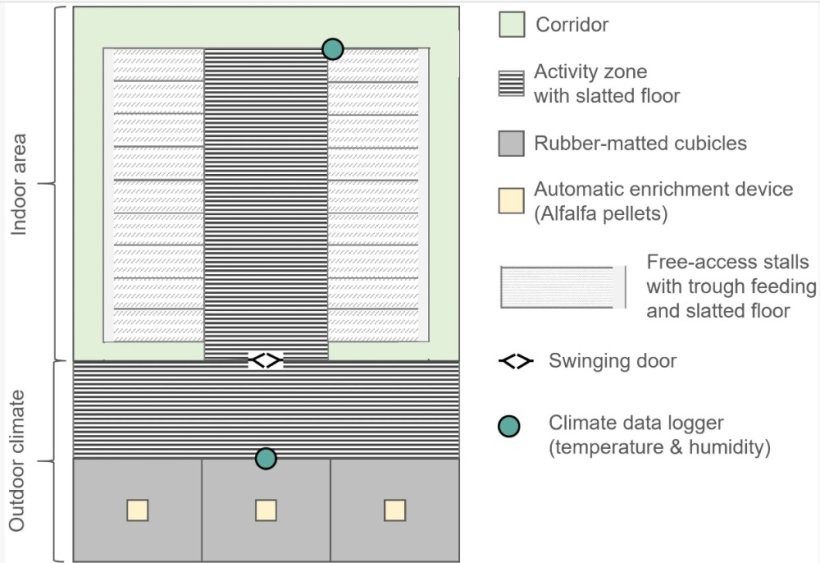 Layout diagram of a group pen (18 sows) in the mating area observed at farm A, illustrating the spatial layout and functional zones. doi: 10.3389/fanim.2026.1892896
Results: In both farms, ΔLC was significantly higher during the first two days after weaning than during the subsequent period (p < 0,05), consistent with early hierarchy formation. ΔLC was higher at farm B (p < 0,001), particularly in less structured mixing pens. Greater susceptibility to skin lesions was observed in sows with low parity (p < 0,01). Other animal welfare parameters occurred at low prevalence but varied between systems: sows at farm B had less fecal contamination (p < 0,05). In addition, fecal contamination was positively correlated with an increase in the temperature-humidity index (p < 0,05). The group-level conception rate was higher at farm A (p < 0,05) and decreased with increasing parityand the heterogeneous composition of the group (both p < 0,05).
Discussion/Conclusions: As this was an observational field study, these results indicate that sow welfare during the first week after weaning is associated with housing and management conditions, as well as the animals’ individual characteristics, providing practical guidance for implementing commercial group-housing systems while maintaining reproductive performance.
Geisler S, Hasler M, van Asten AL, Kemper N and Traulsen I (2026) Welfare parameters and reproductive performance of group-housed sows in two commercial mating area systems: an observational study. Front. Anim. Sci. 7:1892896. doi: 10.3389/fanim.2026.1892896