
Hog production controls have been in place for over a year. Although the number of breeding sows nationwide has declined somewhat, due to the impact of earlier production launches and the overall base, more than half of the A-share listed pork companies that have disclosed data still recorded year-on-year growth in slaughter volume in the first three quarters.
Recently, listed pork companies have successively disclosed their slaughter volumes for the first three quarters. According to statistics compiled by a reporter from CLS, the first 14 A-share listed pork companies slaughtered a total of 1.29 hundred million head in the first three quarters, up approximately 3% year on year.
Most pork companies recorded year-on-year growth in overall slaughter volume. Only New Hope (000876.SZ), Wen’s Foodstuff Group (300498.SZ), Jingji Zhinong (000048.SZ), and Da Bei Nong (002385.SZ) saw year-on-year declines in slaughter volume; Muyuan Foods (002714.SZ) was unchanged from last year. More than half of the listed pork companies still maintained double-digit growth. Among them, the year-on-year increases in slaughter volume for the faster-growing Zhengbang Technology (002157.SZ), Aonong Biotechnology (603363.SH), Keming Food (002661.SZ), Tiankang Bio (002100.SZ), and Jinxinnong (002548.SZ) were 41.48%, 37.4%, 36.25%, 32.18%, and 32.02%, respectively.
Recently, listed pork companies have successively disclosed their slaughter volumes for the first three quarters. According to statistics compiled by a reporter from CLS, the first 14 A-share listed pork companies slaughtered a total of 1.29 hundred million head in the first three quarters, up approximately 3% year on year.
Most pork companies recorded year-on-year growth in overall slaughter volume. Only New Hope (000876.SZ), Wen’s Foodstuff Group (300498.SZ), Jingji Zhinong (000048.SZ), and Da Bei Nong (002385.SZ) saw year-on-year declines in slaughter volume; Muyuan Foods (002714.SZ) was unchanged from last year. More than half of the listed pork companies still maintained double-digit growth. Among them, the year-on-year increases in slaughter volume for the faster-growing Zhengbang Technology (002157.SZ), Aonong Biotechnology (603363.SH), Keming Food (002661.SZ), Tiankang Bio (002100.SZ), and Jinxinnong (002548.SZ) were 41.48%, 37.4%, 36.25%, 32.18%, and 32.02%, respectively.
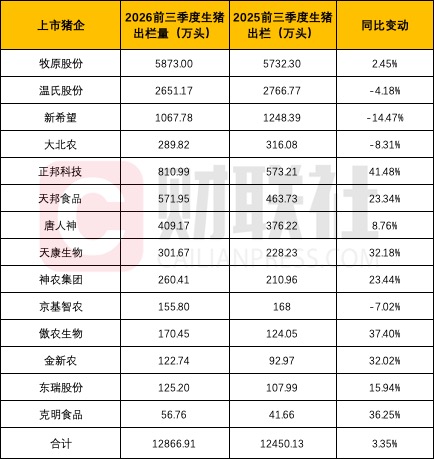
(Source: Company announcements; chart prepared by a CLS reporter)
More than a year has passed since the national capacity controls began. According to monthly reports disclosed by listed pork companies, the average selling price in 9 was approximately 10.5 yuan per kilogram, down about 20% year on year. On 13 10, nationwideThree-way crossbred pigsThe average price of live pigs was about 10.07-10.10 yuan/kg. After a brief rebound before the holiday, prices once again fell below the 10-yuan threshold.
Data from Zhuochuang show that, as of the end of 9, the number of breeding sows at 196 sample companies stood at 841.23 ten thousand head, down 7.18% year on year. Zou Yingji, a live pig analyst at Zhuochuang Information, told a reporter from Cailian Press that capacity reduction was relatively pronounced year on year. However, the theoretical number of live pigs available for market at present is determined by the number of breeding sows 10-11 months earlier. At that time, the number of breeding sows had declined only slightly, while PSY had risen, corresponding to ample live pig supply at this stage.
A relevant executive at a listed pig farming company told a reporter from Cailian Press that, based on breeding sow data, there has been some progress in reducing the number of breeding sows each month from the start of the year to date. However, the impact on current supply remains relatively limited. Over the past few years, the entire industry has been improving production efficiency, which has partly offset the effects of capacity reduction. The industry's absolute numbers remain relatively high, and capacity reduction takes time. Pig prices are still in the bottoming phase.
With pig prices bottoming out over an extended period, listed pig farming companies have further reduced their farming costs, with costs at most companies falling below 13 yuan. Based on costs disclosed by the companies, the first-tier leaders in cost control, including Muyuan Foods, Wens Foodstuff Group, New Hope Liuhe, Shennong Group, and Da Bei Nong, have reduced costs to below 12.0 yuan/kg, while Zhengbang Technology, Tech-bank Food, and Tangrenshen have farming costs below 13 yuan/kg.
It is worth noting that the bottom of this round of thehog cyclehas seen listed pig farming companies further reduce the cost of integrated breeding, while increasing the proportion of self-raised pigs. According to research report data, as of the end of 6 2026, New Hope Liuhe's ratio of pigs raised in its integrated self-farming operation to pigs raised under cooperative arrangements was approximately 40:60, with the self-farming share rising further from the end of 2025. A reporter from Cailian Press learned from New Hope Liuhe that previously, the farming cost for pigs raised under cooperative arrangements was 1 yuan/kg lower than that for pigs bred and raised in-house. With improvements in the company's feed advantages, breeding stock, and disease prevention and control, the farming costs of pigs bred and raised in-house and those raised under cooperative arrangements have been broadly similar since last year.
The fourth quarter will see a peak in consumption. Zou Yingji predicts that demand in the hog market may gradually increase in 11 month. As demand for heavier hogs improves and prices rise, thehog pricesmay receive support. In addition, farmers may hold hogs back to increase their weight, waiting to sell them around the Winter Solstice in 12 month. As a result, supply may tighten briefly in 11 month, and hog prices may rise. Hog demand will reach its second-half peak in 12 month. Meanwhile, heavier hogs will continue to be released, and large producers may push to increase sales at year-end. Supply growth may exceed demand growth, and hog prices may edge down.