
Chick storage
Newly hatched chicks rely on the ambient climate to regulate their body temperature. Good ventilation in the storage room is essential for removing excess heat and carbon dioxide. Remember that humidity and air speed interact with temperature and may cause room temperature fluctuations.
Humidity should be set between 65 - 70%, and room temperature should be adjusted to 23.0 - 28.0°C to keep chick cloacal temperature between 40.0°C and 40.6°C. At higher air speeds, room temperature should be set to the higher end of the range. Precondition the chick storage room before hatching to prevent temperature stress. Ceiling fans draw air toward the ceiling rather than blowing it toward the chicks, creating a wind-chill effect.
在雏鸡盒或手推车之间,以及雏鸡箱与坚实的表面(墙壁、门、设备等)之间,必须有足够的空间,以便空气流通能使小鸡保持舒适和通风良好。如果雏鸡盒子太近,如果间距或通风不利于热量散失,小鸡过热的风险就会增加。一个很好的经验法则是,你应该能够轻松地在一堆雏鸡盒之间走动。如果小鸡舒适,没有热应激,它们应该是平静的休息,并均匀地分布在整个盒子里。
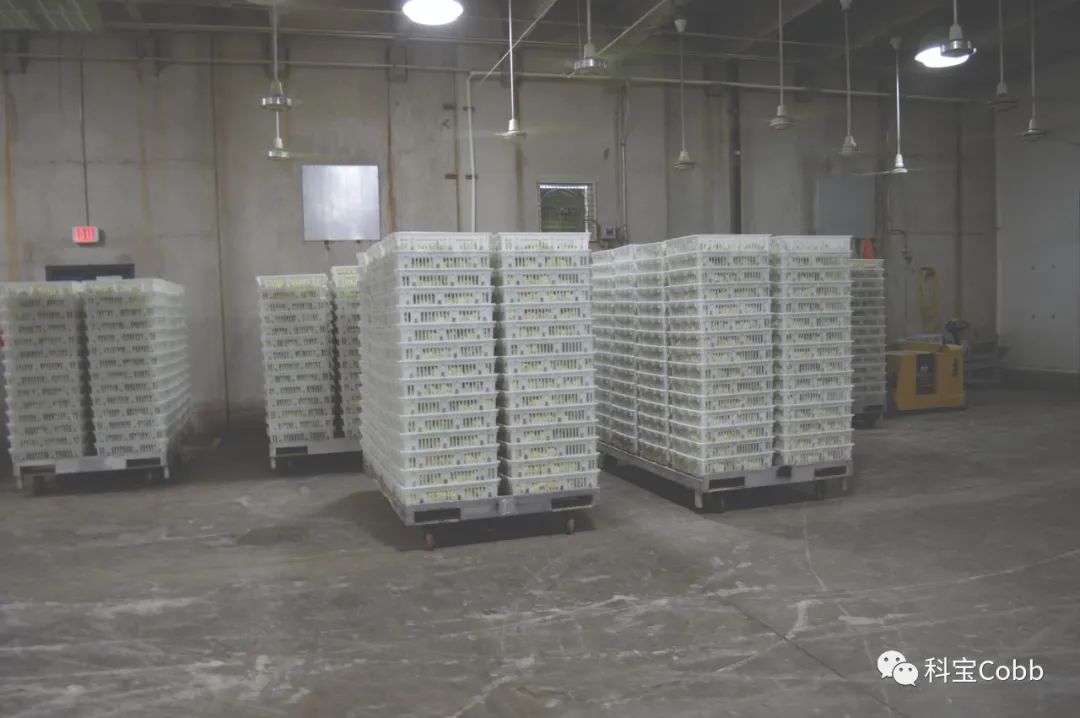
Place lids or empty chick boxes on top of the chick boxes to prevent drafts from blowing onto the chicks. Air speed generated by fans can cause stress and chill the chicks. If you see chicks huddling in the middle or on one side of a box, check the angle, speed, and direction of nearby fans.
Animal Welfare Tips
If the ambient temperature is too high, chicks may open their mouths and pant, which can cause moisture loss from the lungs and air sacs, leading to dehydration and dehydration. If heat stress is not relieved, chicks may become excessively noisy and spread their wings in an attempt to release heat. Please use fans to promote ventilation and air movement.
If the ambient temperature is too low, chicks may huddle together or pile on top of one another, creating a risk of suffocation. Chicks are more likely to become chilled if their bodies are still wet when they leave the hatcher or after spray vaccination. It is especially important to keep chicks in a warm, draft-free place after they become wet during vaccination or immediately after hatching.
If the air is not circulating, the risk of carbon dioxide buildup increases. When carbon dioxide levels rise, chicks may gasp and try to stick their heads out of the box. They may crowd at the edges of the box, reducing the circulation of fresh air and making the problem worse. The carbon dioxide concentration should not exceed 3000 ppm. Fresh air should be exchanged at a rate of 68 cubic meters/hour/1000 chicks.
If spacing and airflow are inadequate, the heat produced by the chicks cannot dissipate from the boxes. This may cause the chicks to overheat. Good spacing and proper air circulation allow heat to dissipate from the boxes and help the chicks regulate their body temperature.
Chick feather sexing
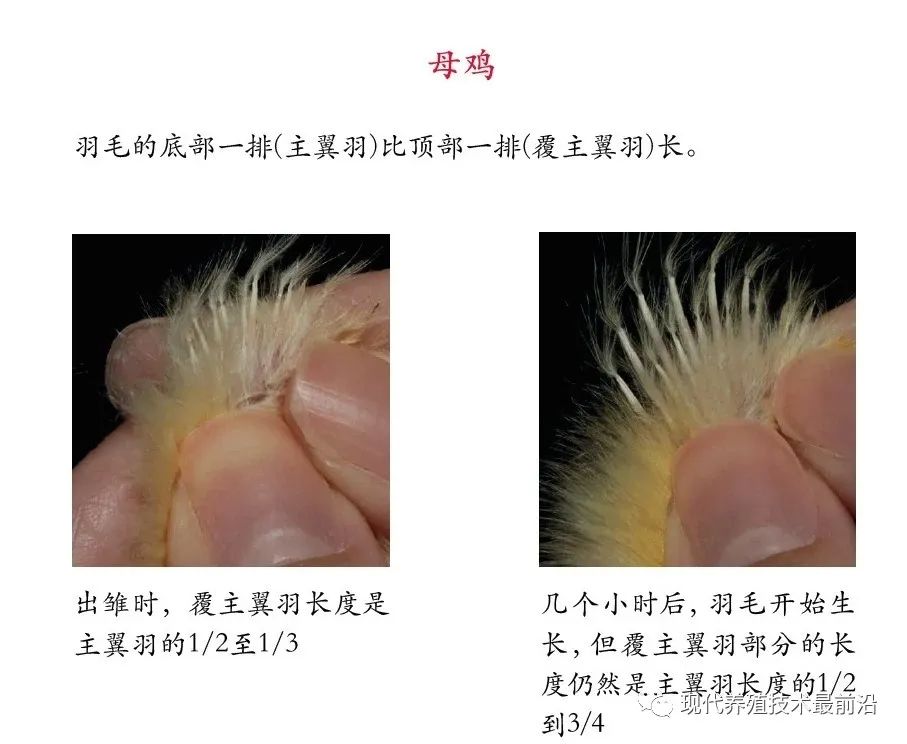
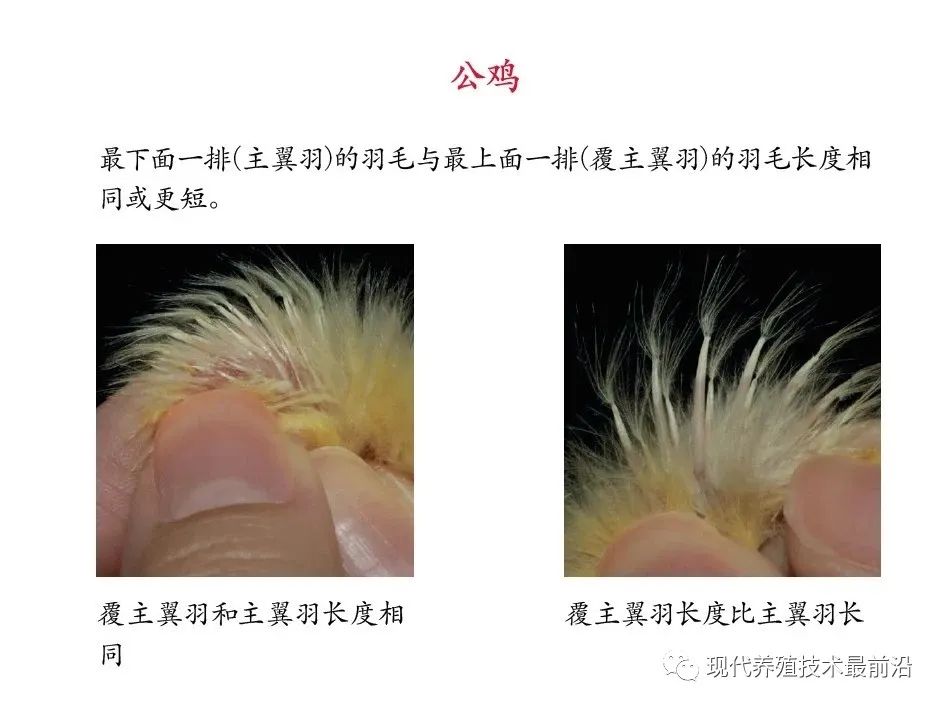
In some cases, chicks are reared separately by sex so that, after placement, males and females can be managed according to their sex-specific requirements. Feather sexing is a quick, non-invasive method of identifying chicks. As shown in the photos, broilers can be sexed at one day of age by feather differences (slow feathering). Where there is no feather difference (fast feathering), both males and females show the same feather development pattern as the male shown in the photos.
Feather sexing should be carried out in a well-lit area. When picking up a chick, place its neck between the index and middle fingers, and support its body with the ring and little fingers. Handle it gently and spread the chick’s wing like a fan. The lower row of feathers consists of the primary flight feathers, and the upper row consists of the primary coverts. If the male/female ratio deviates from normal (48 pairs to 52), investigate the cause of any deviation.
Animal Welfare Tips
The chicks should be positioned so that the sexer can identify their sex more accurately and easily. Chicks must be handled gently, with their wings spread in a slow, controlled movement. The sexing box must be close enough to the sexer so that chicks can be placed in it easily rather than thrown. When picking up a chick, place its neck between the index and middle fingers, and support its body with the ring and little fingers. Never lift a chick by its wings.