
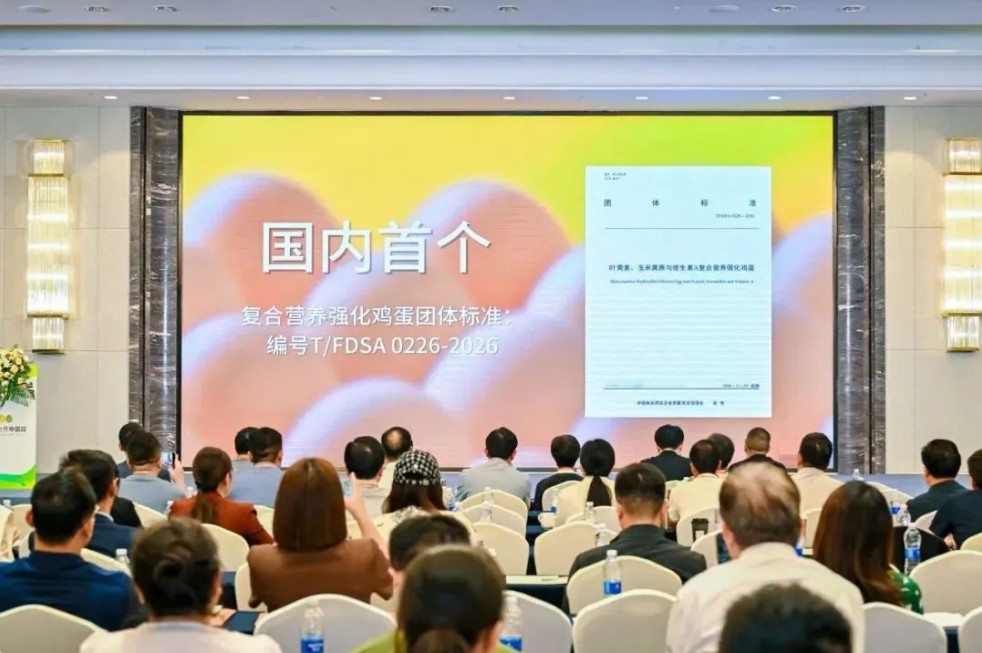
On the 10th of 10, at the 2026 (Seventh) 10·10 Egg Products Day Conference, the group standard “Eggs Fortified with Lutein, Zeaxanthin and Vitamin A” was officially released. It is China’s first group standard for eggs fortified with multiple nutrients, filling a gap in standards in this field. It also marks the egg industry’s first exploration of a multiple-nutrient design approach guided by specific health needs.
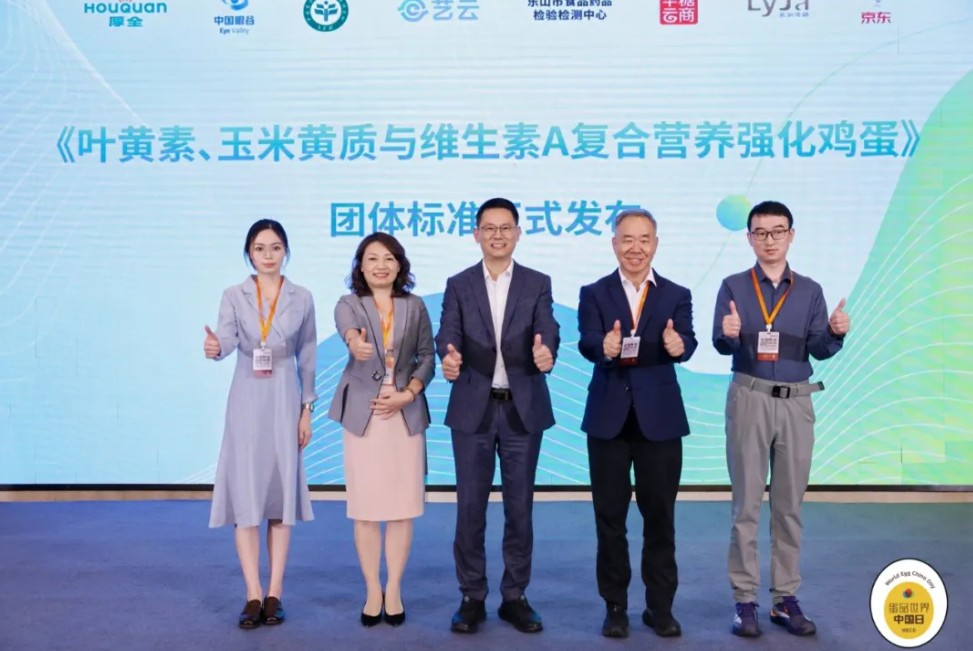
The standard was jointly proposed by Sichuan Houquan Ecological Food Co., Ltd. and Wenzhou International Eye-Optics Innovation Center (China Eye Valley). It was jointly drafted by 8 organizations, including the Feed Research Institute of the Chinese Academy of Agricultural Sciences, Oriental Yiyun Technology Group, Leshan Food and Drug Inspection and Testing Center, Hebei Huatang Yunshang, Shanghai Laijia Culture, and JD.com. The China Association for the Promotion of Quality and Safety of Food and Drug Enterprises serves as the standard’s coordinating organization. The standard was released after following formal procedures, including project approval, public consultation, and technical review.
Focusing on eye healthThree indicators
Meeting the standard together; synthetic pigments are prohibited
In recent years, consumer interest in eggs has expanded from safety and freshness to nutritional value and suitability for specific groups. Nutritionally enriched eggs are moving beyond single nutrients into a new stage in which multiple nutrients meet their respective standards and products are designed for specific needs.
The standard clearly defines “composite nutritionally enriched eggs”:Eggs produced by commercial laying hens, in which, within the legally permitted scope of additives, two or more target nutrients are enriched simultaneously through biotransformation, with the content of each nutrient meeting the corresponding requirements.Based on nutritional needs for eye health, the standard incorporates lutein, zeaxanthin, and vitamin A into a single nutritional design framework. It stipulates that per 100 grams of edible egg, lutein must be no less than 1600 micrograms, zeaxanthin no less than 320 micrograms, and vitamin A no less than 240 micrograms of retinol equivalents. Each of the three indicators is specified separately, and all must meet the requirements, providing a unified basis for product production, testing, and evaluation.
Notably, the standard explicitly requires that lutein and zeaxanthin be obtained through biotransformation when laying hens consume feed rich in natural carotenoids; synthetic pigments must not be used as substitutes for nutritional enrichment. Product labels must not make claims concerning disease prevention or treatment.
Industry insiders say the significance of the standard is not that there are “a few more nutrients,” but that it establishes a new product design approach: starting from specific nutritional needs, determining a combination of nutrients, and using standardized production and evaluation systems to ensure consistent product representation.
Multiple stakeholders drive the standardization of industry practices
Creating a new dimension for innovation in egg value
The standard-setting process brought together expertise from multiple fields, including laying hen nutrition, optometry, food science and testing, and industry practice. China’s egg industry is entering a new stage of transition from growth in scale to value innovation, with standardization becoming an important foundation for the scaled application of new product categories, technologies, and consumer demands. The standard establishes a unified product language and evaluation criteria for eggs fortified with multiple nutrients, while also providing a new reference for innovation in egg products.For more applications in the future, there is still room to further expand the design of combinations of nutrients. Moving from “what nutrients does the product contain?” to “why are the nutrients designed this way?”, innovation in egg value opens up new possibilities.
At the launch ceremony, Huang Xinwang, Vice President and Secretary-General of the China Association for the Promotion of Quality and Safety in Food and Drug Enterprises, said in a video address that the vitality of a group standard lies in its implementation. He hoped that the drafting organizations would be the first to implement and take the lead in applying the standard, “so that good products are defined by good standards, and good standards are rewarded by a good market,” using the implementation of the standard to drive an overall upgrade of the egg industry in nutrition and value.
From consensus to standards: Hou Quan Hao Xian Jian, the nutrition expert for fresh eggs
The publication of this group standard deepens the lead organization Sichuan Houquan Group’s series of initiatives in the composite nutrition egg product field, particularly nutrition egg products for eye health, under its positioning as the “Fresh Egg Nutrition Expert.”
2026年5月30日, the “Expert Consensus on Lutein-Containing Composite Nutrition Eggs and Eye Health” was released at the 2026 International Conference on Innovative Development in Visual Health (Tianjin). Houquan, China Eye Valley, the Eye Hospital of Wenzhou Medical University, and Oriental Yiyun Technology Group were joint authors, with Professor Qu Jia leading more than ten experts in its preparation. On 6月5日, the consensus’s commercialization outcome, the “Houquan Hao Xian Jian” lutein-containing composite nutrition egg brand, was launched in Xiamen, and strategic cooperation agreements were signed with China Eye Valley, JD Fresh, Oriental Yiyun, and Huatang Yunshang. On 9月3日, Houquan and Cover News jointly launched the “Bright-Eyed Youth” public-interest outreach team and held its first eye-care class of the school year. The team will continue to visit schools in Chengdu, Leshan, Meishan, and other locations to provide eye-care education.
From the expert consensus, brand products, and public-interest platform to the industry standard, the group standard released this time upgrades the indicator system previously validated in enterprise standards into a shared rule framework for the entire industry. Industry observers believe that this approach—“research first, product validation, public-interest implementation, and open standards”—offers a reference for turning corporate capabilities into public momentum for the industry.
At the same meeting where the group standard was released, Huang Zuyao, Chairman of Houquan Group, delivered a keynote speech titled “Putting Egg Product Brand Value Concepts into Practice and Co-building a Business Ecosystem.”China’s egg market is worth about 3000亿元, and the country’s 14亿 people consume an average of 296 eggs per person per year. No domestic brand worth a hundred billion has yet emerged, and value differentiation remains necessary. Huang Zuyao believes that defining a good egg means creating a new category that “meets needs as they arise.” Houquan is committed to becoming the “Fresh Egg Nutrition Expert,” offering a range of composite nutrition egg products to meet different health needs. This group standard marks the practical starting point for the new category to “pass the scientific test first, then the market test.” Houquan looks forward to working with more industry peers to develop category standards and share supply chain capabilities, contributing a good egg for consumers.