
3 up, 13 down! Pig prices fall in a “180° upheaval”—will things turn around soon?
Time flies, and 10 month is already halfway through. Today, 2026 year 10 month 15 day, the sixth day of the ninth lunar month, pig prices in the domestic livestock and poultry farming sector remain weak, with the market continuing to fluctuate downward! The production and sales markets are still facing an imbalance: supply is ample, and large-scale pig producers face continued pressure to ship hogs, while consumer support has retreated, demand is under mounting pressure at the margin, slaughterhouse operating rates continue to contract, and consumption is insufficient to absorb supply. As the supply-demand contest intensifies, the market has fallen more sharply than expected! Earlier, quotes for standard-weight pigs fell below 5 yuan per jin, and prices continued to move lower. The market is still fluctuating downward, but the “180° upheaval” in pig prices could signal a turning point for the live hog market, and things may soon turn around for the “Second Brother” (a colloquial reference to pigs)! Details follow:
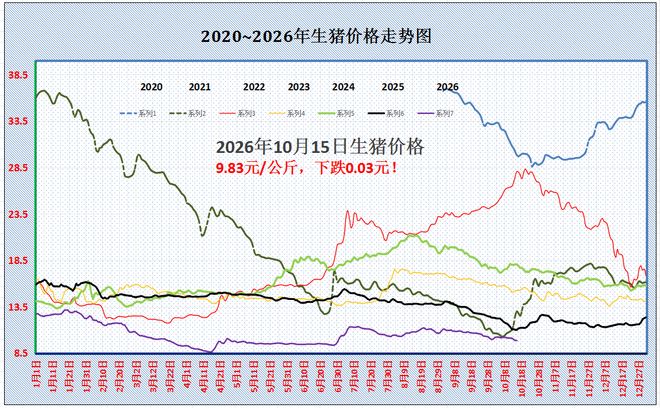
As of 10 month 15 day, the national average ex-farm price for lean-type live pigs of the Duroc-Landrace-Yorkshire crossbreed was 9.83 yuan per kilogram, down 0.03 yuan from the previous day and 11% year on year. Based on Linchi’s corn quote of 1.09 yuan per jin, the current domestic hog-to-corn price ratio is around 4.5, and losses from fattening live hogs have deepened! According to institutional analysis, the full cost of production for sample large-scale pig producers in China is currently 11.5-12.5 yuan per kilogram. Leading mainstream pig-fattening companies may be losing more than 200 yuan, while smallholder farms that breed and raise their own pigs may be losing more than 450 yuan per head!
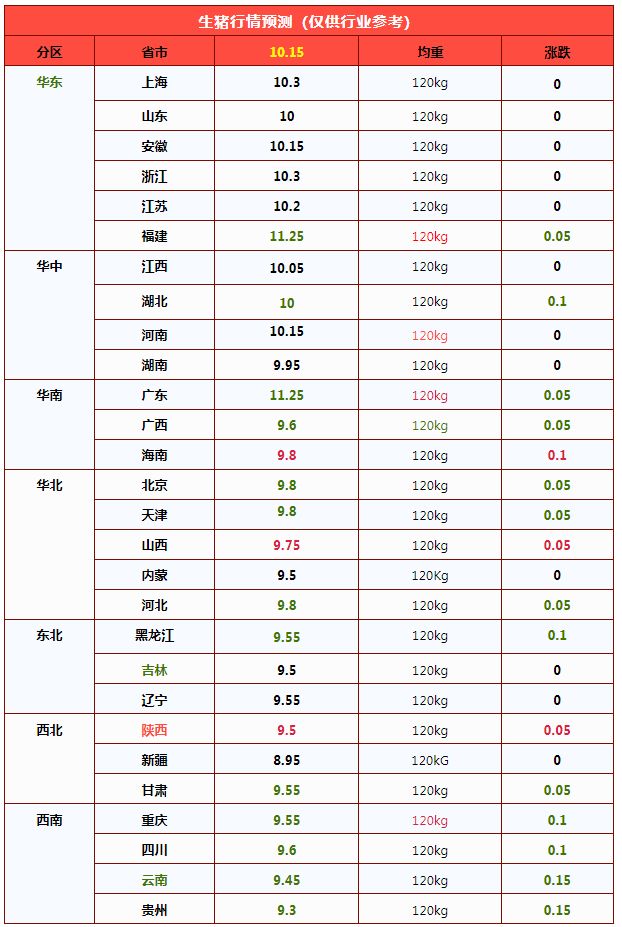
According to data monitoring across 7 pig-producing regions in northern and southern China, among the 28 provinces, municipalities, and regions monitored, the live hog market was mostly stable, with only minor fluctuations. Aggregated pig price movements showed “3 up, 13 down,” with prices largely steady! Prices rose by 0.05-0.1 yuan per kilogram in Hainan, Shanxi, and Shaanxi. Prices fell by 0.05-0.15 yuan per kilogram in Fujian, Hubei, Guangdong and Guangxi, Beijing and Tianjin, Hebei, Heilongjiang, Gansu, Sichuan and Chongqing, and Yunnan and Guizhou. The market was mostly stable, though sentiment was somewhat divided, with both bullish and bearish views. There may be little room for further declines, and prices could stabilize and rise!
Earlier, the live hog market slid lower. During the month, pig prices briefly rose to 10.25 yuan per kilogram before gradually falling. In particular, after the National Day holiday, the decline widened and prices broke lower, with standard-weight pigs hitting a low of 9.83 yuan per kilogram! In my view, the reasoning behind the decline is that, after the National Day holiday ended, marginal support from consumer demand weakened, and demand continued its usual seasonal decline. In addition, the recovery in household demand in the domestic market remained sluggish, while reduced urban mobility cooled demand from group catering, weakening support from demand!
However, on the supply side, group-affiliated pig enterprises were slow to market hogs at the beginning of the month, while the holiday affected the normal pace of marketing by large-scale pig enterprises. However, a survey last month found that the planned hog sales completion rate among large-scale pig enterprises was 99.01%. The pressure from this month’s combined sales volume has surged, and monitoring data show that group-affiliated pig enterprises will increase their hog sales by 1.91% this month. Moreover, after slower sales in the first ten days of the month, sales willingness across the various links of the industry has strengthened since the middle of the month. In particular, losses from hog fattening have deepened, and livestock producers’ need to recover funds has increased. The resulting high level of involuntary sales across the industry has intensified the pressure from a temporary supply surplus!
As a result, with supply and demand fundamentals weighing on the market, hog prices have recently come under pressure and fallen! However, after hog prices fell below 5 yuan/jin, support at the market bottom may gradually firm up, and the hog market may turn around after reaching a low point!
On the one hand, the average hog price is low, which may encourage livestock producers to hold out for higher prices. Their willingness to sell among independent producers and group-affiliated pig enterprises may ease, while resistance to price cuts may strengthen. Hog circulation may contract, and slaughterhouses in both northern and southern regions may slow their procurement pace, with procurement becoming progressively more difficult!
On the other hand, marginal support from demand may improve. As temperatures fall further, rural market purchases and sales of pork in the northern domestic market may improve. Meanwhile, with the cost of standard-sized hogs low, interest in secondary fattening in both northern and southern markets may pick up, helping to firm up support at the bottom of the hog market!
In summary, amid the tug-of-war between supply and demand, hog prices fluctuated downward. However, as the price center of gravity fell, market sentiment may gradually improve. Going forward, attention will focus on changes in shipments by large-scale hog producers and the sentiment around secondary fattening. Hopefully, hog prices will soon reach the turning point for a seasonal rise! However, the mainstream view is that although the market trend may gradually improve in the second half of 10 month, pressure on the supply side remains undiminished, and the subsequent rise in hog prices may fall short of expectations!
Prices Keep Falling! Hog Prices Have “Fallen Too Sharply”—Will Things Turn Around at the Extreme?
With half of 10 month gone, the domestic live hog market continued to fluctuate downward during the first half of the month. Demand fell back at the margin as expected, supply pressure was released at a high level, and cold-storage pork inventories remained high. Under pressure from multiple factors, the live hog market continued its downward trend, and the seasonal turning point for an increase proved elusive. Farmers endured a slow, grinding loss, and the live hog market remained in a periodic “winter”! However, with half of 10 month gone and the weather gradually turning cooler, the average live hog price fell below 10 yuan per kilogram and continued to decline. Sentiment on the farming side strengthened slightly, and there were attempts to hold prices firm. This latest decline in hog prices may lack momentum, and the market may see a “reversal at the extreme”!
According to data cited from an industry institution, on 15 10 month, the national average ex-farm price for lean-type three-way crossbred hogs was 9.83 yuan per kilogram, down 0.03 yuan from the previous day. Hog prices have “fallen too sharply”; the average price for standard-weight hogs has entered the “4-yuan era,” and farming losses have deepened further. The mainstream large-scale hog producers and those above them have reported losses exceeding 200 yuan per head, while hog prices are down more than 11% year over year!
By region, on 15 10 month, across the southern and northern markets, the average ex-farm price in the 28 key regions under observation was close to 9.8 yuan per kilogram in Hebei, Beijing, Tianjin, and other areas. Ex-farm quotations across the country’s southern and northern markets hovered between 8.95-11.25 yuan per kilogram. Xinjiang had the lowest quotation, while Guangdong and Fujian had the highest! In traditional production and sales markets, quotations were 9.5-9.55 yuan per kilogram in Heilongjiang, Jilin, and Liaoning; 9.75-9.8 yuan per kilogram in Shanxi and Hebei; and 9.5-9.55 yuan in Shaanxi and Gansu. Quotations were 9.55 yuan in Sichuan and Chongqing; 10-10.15 yuan in Shandong and Anhui; 10.2-10.3 yuan in Jiangsu and Zhejiang; 10.15 yuan in Henan; and 11.25 yuan per kilogram in Guangdong!
By region, on 10/15, hog prices across northern and southern China were generally steady to slightly weak. Bearish and neutral sentiment was strong, while bullish sentiment edged up slightly. Hog prices may briefly show signs of forming a bottom!
It is reported that recently, the center of hog prices has shifted lower, with the market showing a sharper-than-expected decline, mainly due to pressure from both supply and demand!
On the one hand, the hog supply situation is ample! Since domestic commercial hog shipments are affected by the sow inventory from 10 months earlier, the sow inventory at the end of last year was 3961 ten thousand head, an increase of 4 ten thousand head month on month, theoretically boosting this month's shipment plans! In addition, last month, accelerated sow culling, a quiet secondary fattening market, weak pre-holiday stocking by slaughterhouses, and poor completion of shipment plans by large-scale hog enterprises all contributed to an increase in this month's shipment plans! Shipment plans at sampled large-scale hog enterprises rose by 1.91%, and SteelHome data show that hog supply pressure remained high in 10 month!
In addition, as farming losses deepened, mainstream hog-fattening operations faced greater funding pressure, increasing the need to realize funds and strengthening the willingness to ship. Meanwhile, the increase in hog shipment weights curbed widening of the price spread between standard and heavyweight hogs, further limiting bullish market sentiment and accelerating the pace of capacity shipments;
On the other hand, consumer support has weakened! As the festive atmosphere fades, marginal support from demand has weakened. Downstream markets are seeing lackluster demand for the purchase and sale of white-striped carcasses, and slaughterhouses lack additional orders. Moreover, second-round fattening activity in both northern and southern markets is low, leaving insufficient demand for standard-weight pigs. With slaughterhouses producing according to sales, procurement is generally not difficult, and the pressure to lower prices is relatively strong!
Based on this analysis, the hog price remains weak amid excess supply and demand. However, after the average price of standard-weight pigs fell to 9.83 yuan per kilogram, market sentiment shifted somewhat. Producers have become less willing to market their pigs, while farms in the spot market are inclined to hold back sales and support prices. In addition, as the weather gradually cools, seasonal demand may gradually improve, potentially strengthening the price floor for hogs! Hog prices are expected to resume rising in the coming period. Pay close attention to changes in marketing by large-scale hog enterprises and in sentiment toward second-round fattening!
The pace of reduction in the breeding sow population has diverged, delaying the realization of the cycle
Introduction:2026 Domestic breeding sow inventory continued the reduction trend that began in the second half of 2025, with capacity exiting at a relatively gradual pace in the first half of the year. In 8, concentrated production cuts by leading corporate farms drove the largest month-on-month decline of the year. The cumulative reduction in the third quarter, based on the sample data, was 4.42%, up 0.87 percentage points from the first half. In 9, capacity adjustments slowed again, and behavior among industry participants became more divergent. Sow inventory continued to decline in the fourth quarter, but multiple constraints limited the scale of reductions. This round of capacity reduction is likely to continue through the first quarter of 2027, with the contraction in commercial hog supply expected to gradually take effect after the second quarter of 2027.
I. Capacity reduction: the quarterly pace accelerated, with 8 marking a temporary peak and significant divergence in behavior among market participants
In 2026, the national breeding sow inventory remained in a contraction phase, but the monthly pace showed pronounced fluctuations. Industry herd reduction was relatively gradual in the first half of the year. In 8, leading pig farming companies culled large numbers of inefficient sows, driving a sharp month-on-month decline in sampled capacity; in 9, the pace of reduction quickly narrowed, and pressure to reduce capacity shifted from large groups to small and medium-sized farms.
According to data from 208 monitored sample enterprises in the agricultural products sector by SteelHome: in 8, the number of breeding sows in the sample herd fell by 2.94% month over month. Among them, the month-over-month decline at 123 large-scale farms was 3.01%, the largest single-month decline of the year. The implementation of capacity-control policies, coupled with deep industry losses, led leading enterprises to accelerate capacity reduction in phases, while also driving the transaction prices of culled sows down rapidly. In 9, the month-over-month decline in the number of breeding sows in the sample herd narrowed to 0.86%, and the decline at large-scale enterprises eased to 0.8%. Small and medium-sized farms, weighed down by factors such as regional disease risks and tight funding, saw the month-over-month decline in herd numbers widen to 2.37%, shifting capacity-reduction pressure to smaller and medium-sized operators.
Quarterly comparison: the 208 sample enterprises reduced capacity by a cumulative 3.55% in the first half of the year, while the official figure for the same period was a cumulative decline of approximately 4.58%. In the third quarter, the sample’s cumulative reduction was 4.42%, an increase of 0.87 percentage points compared with the first half. The cumulative reduction in capacity for the year to date, based on the sample figures, approached 8 percentage points, with the pace of capacity reduction accelerating markedly in the third quarter.
II. Deep, prolonged losses form the core underlying logic behind capacity reduction
This round of sustained reduction in the breeding sow population has been driven by two forces: capacity regulation policies and ongoing losses across the industry, with a year of industry losses serving as the core driver. The hog farming industry entered a loss-making period in 2025年10月, and by 2026年10月, the loss-making period had lasted a full year.
Full-year figures for 2026: the average loss under the farrow-to-finish model was 171.4 yuan per head, with the daily loss recently widening to 214.6 yuan per head; the average full-year loss for fattening purchased piglets was 163.2 yuan per head, with the current loss at 133.6 yuan per head. Even leading groups with strong cost-control capabilities generally maintained a complete hog production cost range of 11.5–12.6 yuan per kilogram; the national average hog price in the third quarter was only 10.7 yuan per kilogram, and leading companies lost 0.8–1.9 yuan per kilogram. Corporate cash flows remained under sustained pressure, and debt-to-asset ratios rose.
Different types of producers have adopted structurally divergent capacity-adjustment strategies based on their respective resource endowments:
Large corporate pig farming groups: They have mature farming systems and relatively ample cash reserves. Their production capacity adjustments are manageable and primarily involve gradually phasing out inefficient capacity; they will not carry out a hard, one-off clear-out;
Medium-sized farms: While phasing out older sows with low PSY, they are also replenishing stocks with efficient replacement gilts. There is a possibility that inventories will stop falling or even turn slightly positive in the fourth quarter;
Small and medium-sized retail farmers: Their decision-making is flexible, and they exhibit a typical cyclical pattern of operations: replenishing breeding sows in the fourth quarter, then culling them in large numbers after farrowing in the first quarter of the following year. Short-term production capacity is highly elastic.
Three- and fourth-quarter production capacity outlook: Capacity reduction continues, but is limited in scale, with intensifying competition between bullish and bearish forces
Considering fundamentals, policies, animal disease, seasonal consumption, and other variables, the number of breeding sows in stock is expected to remain on a downward trend in the fourth quarter, but the high rate of destocking seen in 8 is unlikely to be repeated. The average month-on-month decline is likely to remain within 1%.
Bullish factors (driving further capacity destocking)
Continued losses in both finishing and piglet production: Piglet prices fell from 7 yuan per head in mid-258.6 to 10 yuan per head in early 105.2, a decline of nearly 60%. The sharp drop in piglet quotations directly reflects pessimistic expectations for future profitability among producers, compelling sow farms to reduce capacity;
Capacity adjustment policies continue to be implemented: At the end of the second quarter, the national breeding sow inventory stood at 3780 ten thousand head, already close to the regulatory target range. Policy continues to guide capacity back to a green and reasonable range. A capacity adjustment symposium was recently convened again, with a clear direction toward reductions in the fourth quarter;
Seasonal disease risks are rising: as temperatures drop in the fourth quarter, preventing and controlling African swine fever in northern regions becomes more difficult, increasing the risk of involuntary capacity exits.
Bearish factors (limiting the extent of capacity reduction)
Herd efficiency offsets the decline in inventory: Medium-sized farms are “phasing out old stock and replenishing with new,” continuously replacing sows with high-performing gilts. As PSY improves, the supply contraction caused by falling inventory is partially offset by higher production efficiency. Inventory at some medium-sized farms is expected to stop falling and rebound in the fourth quarter;
Expectations of a seasonal recovery during the peak consumption season: Southern China’s curing season begins in 11; preparations for the winter solstice and New Year’s Day take place in 12. Slaughter volume is expected to increase by 6%–8% month over month. The market is betting that hog prices will “fall first and then rise,” temporarily improving confidence among producers and slowing the pace of voluntary culling;
Support from long-term earnings expectations: The market generally expects the industry to see an earnings recovery in 2027. As long as cash flow has not hit its limit, widespread, concentrated herd liquidation is unlikely.
Four. Summary of the underlying cyclical contradictions and forecast of the time window
The core tensions in this hog cycle: the effects of reducing capacity and livestock inventories are continually diluted by improved herd productivity; loss pressures across the industry are cushioned by leading companies’ low-cost advantages; and market-driven capacity adjustments continue to interact with dynamic capacity-control policies.
The decline in the inventory of breeding sows is the result of losses, policy, and seasonal risks converging. Assuming there are no black swan shocks such as a major, highly virulent animal disease outbreak:
The month-on-month average decline in breeding sows in the fourth quarter is likely to be no more than 1%;
This round of capacity reduction is expected to bottom out in the first quarter of 2027;
The contraction in sow production capacity has a lagged transmission effect; a substantial contraction in the supply of market hogs will not gradually become apparent until after the second quarter of 2027.