
October projections confirm a more abundant corn supply than expected in the United States, putting downward pressure on international prices despite the sharp production cut in the European Union and persistent disruptions to Ukraine’s maritime trade. Soybeans, by contrast, continue to expand: the rebound in the U.S. harvest and the boom in U.S. soybean meal exports reinforce a robust global supply, even as Argentine placements decline.
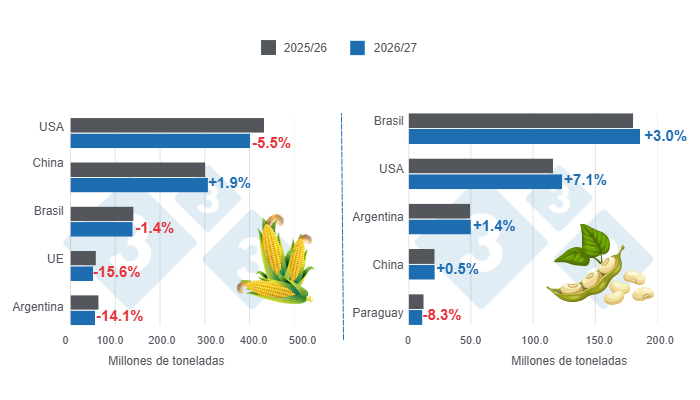 Chart 1: Harvest projection for the world’s main corn and soybean producers – 2026/27 season versus 2025/26 cycle – latest update: 9 October 2026. Prepared by the Economics and Sustainability Department of 333 Latin America using FAS - USDA data
Corn
The October report does not include a featured article specifically on corn—the cover focuses on barley imports—but the coarse grains section provides the month’s key context: the market reacted downward after the NASS grain stocks report on September 30 revised upward the old-crop corn inventories in the U.S., which dispelled expectations of tighter supply that had dominated the market. Export offers fell across all origins—the U.S. declined by USD 14/t to USD 239/t, Brazil by USD 8/t amid seasonal pressure from the Safrinha harvest, and Argentina remained virtually unchanged at USD 219/t—while Ukraine continues to report no quotations since September 1 due to attacks on its port infrastructure.
Production
- World corn production for the 2026/27 marketing year is expected to be around 1 293.8 Mt, representing a decrease of 2.8% compared with the 2025/26 season, whose latest estimate stands at 1330.6 Mt.
- In the U.S., production would reach 407.3 Mt, decreasing by 5.5 % from the previous season (430.9 Mt), while China would increase its harvest by 1.9 %, reaching 307.0 Mt. The European Union would decrease by 15.6%, with 48.0 Mt, while Ukraine, with 31.8 Mt, would register an increase of 2.9% compared with the 30.9 Mt recorded in the previous season.
- For South American harvests, Brazil would reach 139.0 Mt, decreasing by 1.4 % compared with the 2025/26 season (141.0 Mt), while Argentina's harvest would be around 55.0 Mt, a figure that would be 14.1% below the previous season (64.0 Mt).
Exports
- World corn exports would decrease by 2.4 % in this new season, reaching 210.7 Mt.
- The U.S. would lead export activity with 83.8 Mt, although it would decrease by 3.8 % from the previous season (87.1 Mt), followed by Brazil, Argentina, and Ukraine with 43.0; 38.0 and 22.0 Mt, respectively.
Imports
- Globally, corn imports would rise from 198.4 Mt in the 2025/26 marketing year to 203.4 Mt in this new cycle, representing an increase of 2.5%.
- Mexico would be the largest corn importer, at 27.2 Mt, with growth of 3.8% compared with the previous marketing year (26.2 Mt).
- Meanwhile, the European Union would reach 23.5 Mt, 17.5% above the previous marketing year (20.0 Mt); Japan would slightly reduce its purchases by 1.3%, reaching 15.5 Mt (15.7 Mt in the previous marketing year); while Vietnam would increase its purchases by 8.1%, reaching 14.6 Mt (13.5 Mt in the previous marketing year).
- Colombia would increase its corn imports by 2.4%, reaching 8.6 Mt in this new cycle.
Stocks
- Global ending stocks would decline by 8.7%, reaching 280.4 Mt. In the U.S., stocks would fall by 11.7%, while China and Brazil would record declines of 6.8% and 28.4%, respectively.
Soybeans
This month's featured article focuses on U.S. soybean meal exports, which the USDA projects at a record high of 20.6 million tonnes for 2026/27 (+11% year over year), driven by a larger harvest and greater domestic crushing capacity. By the first week of the marketing year, outstanding sales already exceeded 5.1 million tonnes, above the same period last year, with the Philippines, Mexico, Canada, Colombia, and Vietnam as the main destination markets; Mexico in particular exceeded the five-year average for first-week sales by 147 000 t.
Production
- Global soybean production for the 2026/27 cycle would increase by 3.1% compared with the previous season, rising from 429.2 to 442.7 Mt.
- Estimates for South American harvests indicate an increase of 3.0% for Brazil, which would reach 186.0 Mt, while Argentina is estimated to grow by 1.4%, reaching 50.0 Mt.
- Paraguay’s harvest would decrease by 8.3% compared with the 2025/26 season (12.1 Mt), resulting in a harvest of 11.1 Mt.
- For the U.S., a harvest of 124.1 Mt is estimated, which would represent an increase of 7.1% compared with the previous cycle (116.0 Mt).
Exports
- Global soybean exports would increase by 3.0% in this new season, reaching 192.0 Mt.
- Export activity would be led by Brazil with 118.0 Mt, a figure that would be 3.1% higher than in the 2025/26 cycle (114.5 Mt), while the U.S. would reach export volumes of 46.1 Mt, indicating growth of 11.8% compared with the previous season (41.2 Mt).
- Argentina’s exports are projected at 6.5 Mt, a decrease of 27.5 % compared with the previous cycle (8.9 Mt).
Imports
- Global soybean imports would rise from 188.5 Mt in the 2025/26 cycle to 190.8 Mt in this new season, an increase of 1.2 %.
- China would import 115.0 Mt, a volume that would be 1.8 % above the total for the previous season (113.0 Mt), while the European Union would reach 13.7 Mt, representing a decrease of 2.1 % compared with the previous season (14.0 Mt).
- Mexico is expected to import 6.8 Mt this cycle, a decrease of 2.1 % compared with the previous season (6.9 Mt).
Stocks
- Global ending stocks of the oilseed would decline slightly, reaching 124.3 Mt, 0.5 % below the previous cycle (124.9 Mt). U.S. stocks would decline by just 0.1 %, while Argentina’s would grow by 1,7 %. Brazil and China would post declines of 1.6 % and 0.2 %, respectively.
USDA | United States. https://apps.fas.usda.gov/ | Editorial team, Department of Economics and Sustainability 333 Latin America