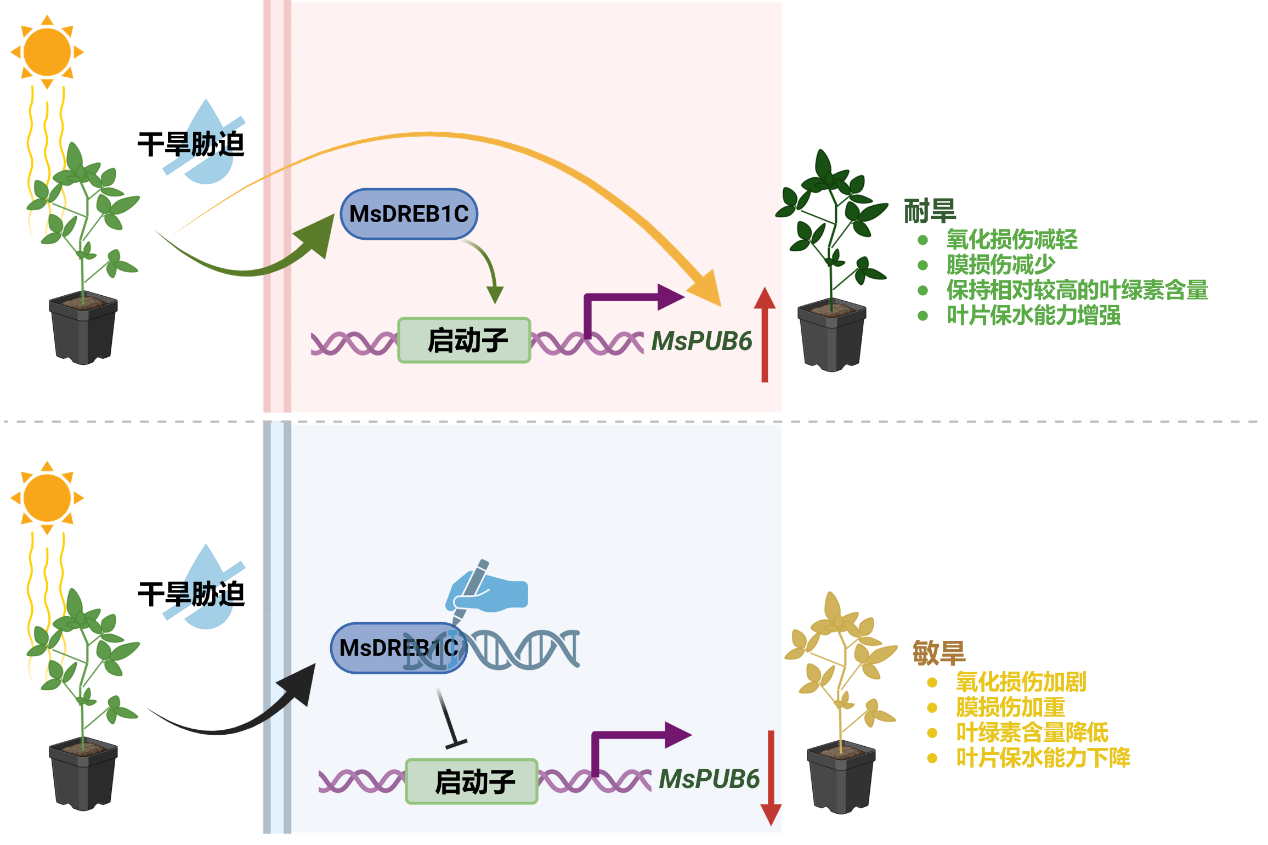
Recently, the Forage Breeding and Cultivation Innovation Team at the Beijing Institute of Animal Science and Veterinary Medicine, Chinese Academy of Agricultural Sciences, identified the drought-resistance candidate gene MsPUB6 in alfalfa using genome-wide association analysis (GWAS). The team elucidated the molecular mechanism by which the MsDREB1C-MsPUB6 transcriptional regulatory pathway positively regulates drought resistance in alfalfa. The findings were published in Plant Physiology.
Alfalfa is a high-quality, perennial, high-protein leguminous forage crop with high nutritional value and good palatability. It provides forage and also serves ecological functions in soil improvement and nitrogen fixation. It is widely grown in the arid and semi-arid regions of northern China and is an important grass species for the high-quality development of herbivorous livestock farming, soil improvement, and soil and water conservation. However, alfalfa is susceptible to drought stress during its vegetative growth stage. Prolonged water deficit inhibits plant growth and reduces yield and quality, seriously constraining the sustainable development of the alfalfa industry. Therefore, identifying key drought-resistance genes in alfalfa and investigating the molecular mechanisms underlying its stress responses are of important theoretical significance for breeding new drought-resistant, high-yielding alfalfa varieties.
U-box type E3 ubiquitin ligases (PUBs) mediate substrate ubiquitination and degradation, and participate in maintaining plant signaling homeostasis and responding to environmental stresses. However, their upstream transcriptional regulatory mechanisms in drought response pathways in alfalfa remain unclear. In this study, a GWAS of drought-related phenotypes was conducted using 171 alfalfa accessions, identifying the significantly associated drought-resistance candidate gene MsPUB6 on chromosome 3. This gene encodes an E3 ubiquitin ligase, and its expression is induced by drought, low temperature, salt stress, and ABA. Functional validation using overexpression and gene silencing (VIGS) showed that MsPUB6 positively regulates drought resistance in alfalfa by enhancing antioxidant capacity, reducing oxidative and membrane damage, maintaining chlorophyll content, and improving leaf water retention. Molecular experiments showed that the transcription factor MsDREB1C specifically recognizes the CRT/DRE element in the MsPUB6 promoter and activates its transcription. MsDREB1C mutants were obtained using CRISPR-Cas9 gene editing. Phenotypic characterization showed that the mutants had drought sensitivity similar to that of MsPUB6-silenced lines, and MsPUB6 expression was significantly downregulated. By contrast, MsDREB1C-overexpression lines showed increased drought resistance and upregulated MsPUB6 expression; they likewise enhanced drought resistance by reducing oxidative and cell membrane damage.
This study elucidated a new drought-resistance mechanism in alfalfa, established a technical system for developing new alfalfa germplasm with high water-use efficiency, and developed new drought-resistant, high-yield alfalfa germplasm. The identified drought-resistance target genes MsDREB1C and MsPUB6 provide important genetic targets and theoretical support for precision breeding for drought resistance in alfalfa. This work is of great significance for accelerating the breeding of new drought-resistant, high-yield alfalfa varieties and supporting the sustainable development of the grass and livestock industries.
Postdoctoral researchers Zhang Yangyang of the Institute of Animal Sciences, Chinese Academy of Agricultural Sciences, and Jiang Xueqian of the Agricultural Genomics Institute at Shenzhen, Chinese Academy of Agricultural Sciences, are co-first authors. Researchers Kang Junmei, Zhang Tiejun, and Yang Qingchuan of the Institute of Animal Sciences, Chinese Academy of Agricultural Sciences, are co-corresponding authors. This study was supported by the National Natural Science Foundation of China, the National Key Research and Development Program, the China Postdoctoral Science Foundation, and the State-Owned Assets Program.
Original article link: https://doi.org/10.1093/plphys/kiag679