
People have become accustomed to using all-corn-and-soybean-meal diets for laying hens. This is due not only to the long-term influence of a certain country's soybean association, but also to the many advantages of this type of diet: it is convenient to procure and process, facilitates formula adjustments and the use of standard premixes, uses ingredients of stable quality that are easy to quality-control, and delivers stable egg production. However, an all-corn-and-soybean-meal diet is not the “golden” choice with “flowers blooming all over the sky” that the “certain country's soybean association” boasts about. Against the backdrop of long-term dependence on foreign-controlled supply and currently high prices, farmers can, according to their specific circumstances, scientifically add appropriate amounts of locally produced unconventional protein ingredients that are readily available, have a stable supply, and are of reliable quality (peanut meal, rapeseed meal, as well as DDGS, pea protein, sesame cake, chrysanthemum meal, pepper meal, palm meal, etc.). To some extent, this can indeed help reduce costs, balance the diet, maintain gut health, and improve farming efficiency. However, when selecting these ingredients, pay close attention to product quality, protein content, consistency, moisture content, mold and mycotoxin status, and possible adulteration; conduct laboratory testing when necessary. In addition, strictly control inclusion rates and, under the guidance of a professional formulator, ensure that nutritional balance is properly adjusted.
1, Key nutritional characteristics of unconventional protein ingredients commonly produced in different regions
1.1Cottonseed meal
High protein content, generally crude protein >40%, and as high as 45% in dehulled and de-fuzzed meal; compared with soybean meal, it has a high arginine content (4.56%), while methionine and lysine are both low (and are easily damaged by heat during processing); gossypol residues may remain, which can easily cause egg yolk discoloration. Use with caution for breeding chickens.
1.2 rapeseed meal
Generally, crude protein >37.5%; compared with soybean meal, lysine is low (lysine 2.21%), while sulfur-containing amino acids are high (methionine content 0.69%); rapeseed meal contains sinapine (one of its end products of metabolism in the intestinal tract is trimethylamine). Because brown-shelled laying hens lack the ability to produce trimethylamine oxidase, trimethylamine accumulates in the eggs and gives them a fishy odor, so it is best not to use it for brown-shelled laying hens. In addition, excessive inclusion may affect calcium and zinc absorption, resulting in poorer eggshell quality and even leg problems. It is high in tannins and has poor palatability; adding large amounts can impair palatability and reduce egg weight. Pay attention to K, Na, Cl, S, etc. when balancing the diet.
1.3 peanut meal
Crude protein content >45%; compared with 43 soybean meal, it has a high arginine content (4.88%), while amino acid contents such as methionine (0.41%) and lysine (1.41%) are low. The most prominent problem is aflatoxin contamination.
1.4 sunflower seed meal (cake)
There are two types: dehulled and non-dehulled. Dehulled sunflower seed meal has a crude protein content of over 39%, while non-dehulled sunflower cake contains approximately 29%-32% protein. Currently, most use is of non-dehulled sunflower cake. Compared with 43 soybean meal, it is extremely deficient in lysine (0.96%), while its methionine content is comparable to that of soybean meal. The main problem is that hulled sunflower cake contains large amounts of lignin and other crude fiber (>20%); it has a low energy value, and when added in large amounts, feed intake is high, affecting feed digestion and absorption.
1.5 corn gluten meal
It is a by-product of corn syrup production, with crude protein content of up to around 60% (unlike corn gluten feed, which contains around 20% protein), comparable to animal protein. It is rich in lutein (up to 300 mg/g), which can effectively increase pigment deposition in egg yolks. Its drawbacks are its low lysine content (0.9%)—at high inclusion rates, additional lysine is needed—and the need to monitor product stability, especially mycotoxin issues.
1.6 DDGS
This refers to dried distillers grains with solubles. DDGS is produced by drying and concentrating the corn ethanol production stillage filtrate (DDS), then mixing it with the filter residue (DDG) and drying the mixture. There are currently two main types: high-fat, low-protein DDGS and low-fat, high-protein DDGS. High-fat DDGS contains 20% crude protein and 6%-8% fat or more; common low-fat, high-crude-protein DDGS has crude protein >27%. Its methionine content (0.59%) is comparable to 43 soybean meal, while its lysine content is low (0.59%). DDGS contains more crude protein, B vitamins, and amino acids than corn. It has unknown growth factors and contains lutein; when used for laying hens, it can increase egg-yolk pigmentation and may also benefit gut health. The issue is that products vary greatly among manufacturers (including imported and domestic products), and mold and mycotoxin levels can be high, so high-quality products must be selected carefully. In general, DDGS suitable for use in sows and dairy cows can also be included in layer diets at appropriate levels without major issues.
2、Four key points to control when selecting and using locally sourced non-conventional protein ingredients
2.1Strictly control quality
These protein ingredients involve complex production processes and vary in quality. They may have high crude fiber content, excessive mold and mycotoxin levels, or even be adulterated. Therefore, after selecting a stable and reliable source (preferably products from reputable large-scale manufacturers), regularly monitor and test crude protein, mold and mycotoxin levels, moisture, ash, and other contents.
2.2Add in appropriate amounts
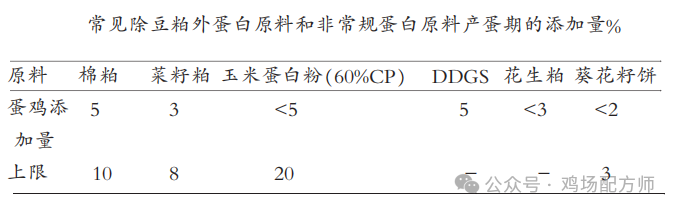
It is best not to add more than 2-3 types, and the amount added should not be increased blindly (see table). For peak-laying hens, these ingredients should be added and used on the basis that soybean meal is kept at no less than 18%; adding too many types or too large an amount poses significant risks to healthy and efficient poultry farming.
2.3Conduct a good ingredient analysis (or have relatively accurate parameters)
The protein raw material products used should be stable, with batch-specific ingredient analysis data or reference data from a relatively accurate raw material database; otherwise, you can only grope in the dark.
2.4Make good formula adjustments
Under the guidance of a professional, make appropriate supplemental additions of amino acids and other substances based on the amount of raw materials added and their active ingredient content.
The nutritional requirements of laying hens are like a wall of a certain height. Its foundation—made up of so-called additives such as vitamins, amino acids, calcium and phosphorus, and enzyme preparations (commonly known as minor ingredients or premix)—and its wall—made up of bulk ingredients such as corn, soybean meal, oils and fats, calcium and phosphorus, and other protein sources—together make up the wall. When unconventional protein sources are used in large quantities, multiple adverse effects arise, including insufficient levels of certain components, an imbalance of amino acids, and reduced digestibility. To reach the same or a similar nutritional level as before (including the level of digestion and absorption), the inclusion level of the minor ingredients or premix that form the foundation must therefore be adjusted and increased. Adjustments, increases, and balancing are also needed for methionine, lysine, phytase, and other digestive enzymes (protease, xylanase, glucanase), and even for macrominerals, trace minerals, and vitamins. The cost of the additives required at this point will increase (otherwise, the effectiveness of their use will decline significantly). Clearly, not everyone can do this; help from a laying-hen nutrition specialist is needed.