
After nearly a century of development, modern parent-stock broiler breeders have high potential for egg production and chick production.
Breed is the main factor determining a chicken's egg production rate, and egg-laying performance varies among breeds. The production performance of AA+ parent-stock broiler breeders and Cobb 500 parent-stock broiler breeders is shown in Table 1.

In commercial farming, egg production rate directly affects the economic returns of broiler breeder production.
Production results in many flocks often fluctuate considerably and fail to meet manual standards. The main issues include: breeder flocks starting to lay earlier or later than expected; low egg weight and a low proportion of hatching eggs meeting standards; a low peak in egg production and a short peak period; and a rapid decline in egg production after the peak. Since the egg-laying performance of breeder chickens directly affects a company's economic returns, how to improve this performance has become a primary concern for relevant companies.
In addition to breed differences, the main factors are daily management, feed nutrition, and health and disease.
01, Management Factors
Uniformity
Flock uniformity refers to the percentage of birds in a flock that meet the same physiological standard or have reached the target body weight (generally within ±10%). The higher the uniformity, the better. If broiler breeder uniformity is below 80%, flock grouping management measures must be implemented.
Uniformity during the rearing period has a significant impact on the level and duration of the hens’ later egg-production peak, as well as on egg weight. Good body-weight uniformity helps the breeders begin laying together on the desired date, reach peak production, and sustain it for a longer period. Therefore, feed restriction should be used during the breeder rearing period, together with weekly body-weight monitoring, to continually adjust body-weight uniformity so that the breeder flock reaches the desired uniformity at the appropriate age. Birds that are overweight or underweight should have their feeding methods adjusted promptly to bring them to the target weight.
Flocks with poor uniformity do not respond synchronously to lighting, environmental control, vaccines, medication, or feed nutrition. This makes flock management considerably more difficult and can lead to a vicious cycle in which uniformity becomes progressively worse.
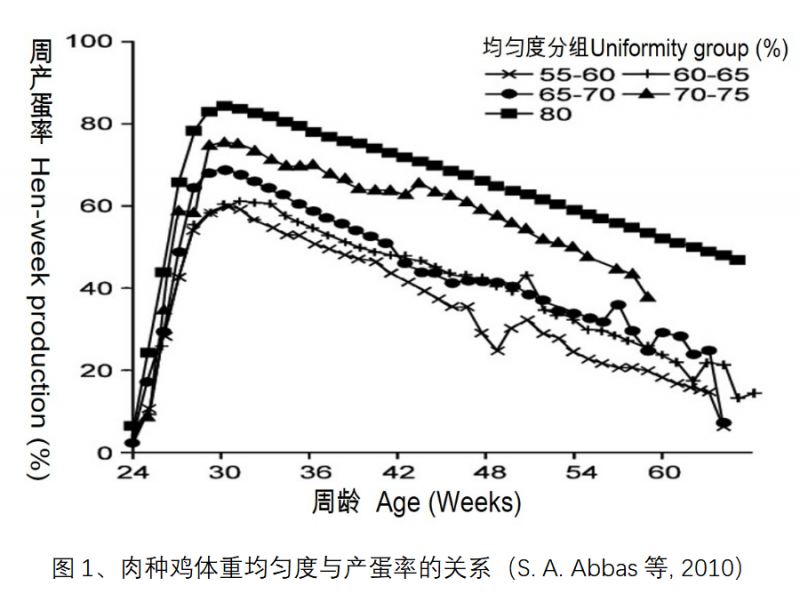
Poor uniformity is a key factor in reducing egg production. It affects not only peak production but also the persistence of egg production. As shown in Figure 1, as body-weight uniformity in broiler breeders decreases, both peak egg production and overall egg production show a clear downward trend.
Lighting Management
Lighting in poultry houses mainly involves two aspects: photoperiod and light intensity. It can also be further specified in terms of wavelength and lighting uniformity.
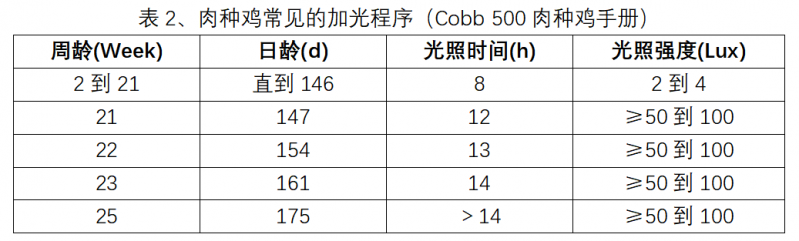
Light can stimulate the secretion of gonadal hormones, so it has a significant effect on breeder egg-production performance. Sudden changes in the lighting program or light intensity can reduce flock egg production. For example, suddenly delaying the lighting time or increasing light intensity can easily cause prolapse and pecking in breeders. Therefore, the lighting program should be stable and the intensity appropriate. If the lighting program does need to be changed, the transition should be gradual. A common light-increasing program for environmentally controlled, windowless poultry houses is shown in Table 2.
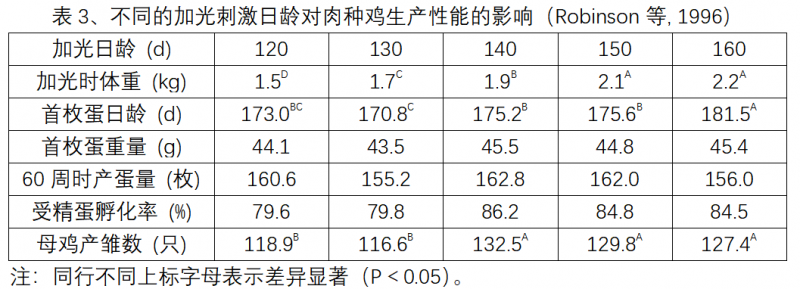
The age at which supplementary lighting is introduced also affects broiler breeder performance. Therefore, choosing the right age to introduce supplementary lighting is critical to maximizing breeder performance; see Table 3. However, this was an older trial, and as breeder genetics have advanced, the appropriate age for introducing supplementary lighting has shifted later.
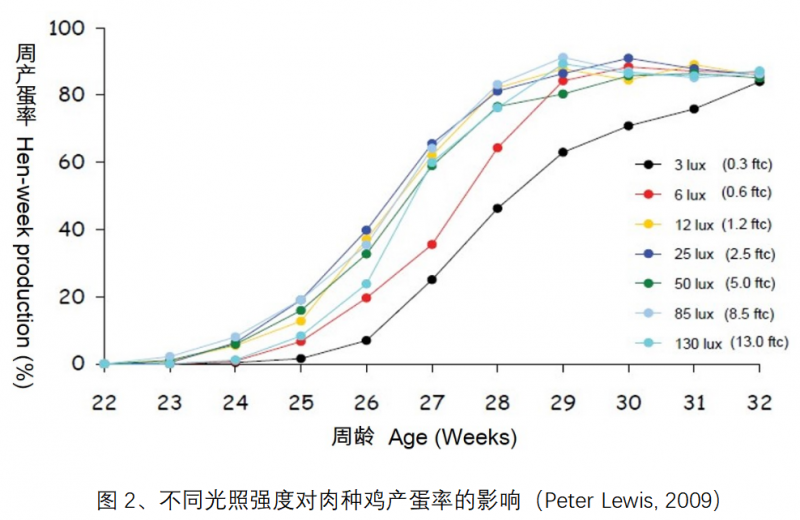
Different light intensities affect both peak egg production and overall egg production rates in broiler breeders. Both lower light intensities (3 lux or 6 lux) and higher light intensity (130 lux) reduce egg production rates, as shown in Figure 2.
Implementing a forced lighting program before conditions are suitable can cause a range of problems, including slow onset of egg production, more double-yolk eggs, egg-yolk peritonitis, prolapse, high mortality and culling rates, and a delayed peak in egg production.
Poultry house environmental management
In an enclosed poultry house, temperature, humidity, and air quality must be brought up to standard by adjusting ventilation, heating, or other measures; see Table 4. The suitable temperature in the poultry house during the rearing and laying periods is 18-22℃, with a day-night temperature difference of less than 3℃.
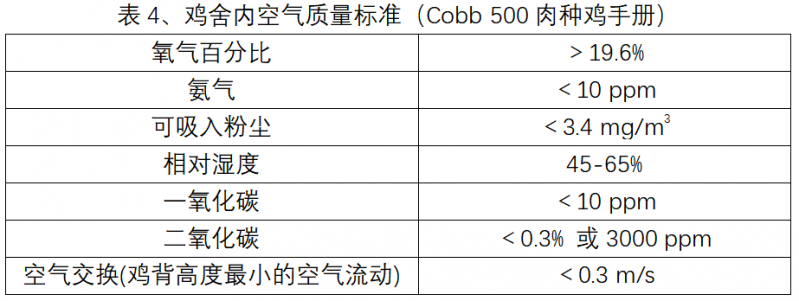
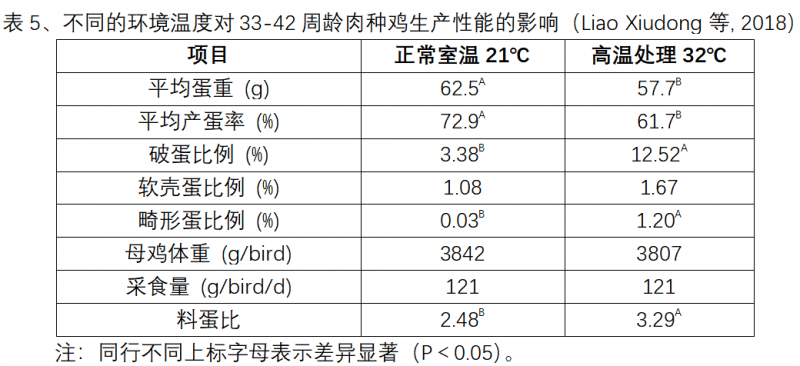
High temperatures reduce broiler breeder performance; see Table 5. A high temperature of 32℃ significantly reduces the egg production rate and egg weight of broiler breeders, and increases the proportion of cracked eggs and the feed-to-egg ratio.
Broiler breeders can achieve their full production potential only under good poultry house environmental conditions. In winter, maintaining warmth and ventilation often presents conflicting requirements. Some farm workers, concerned that the birds may get cold, completely seal the poultry house and do not run the exhaust fans for ventilation. This may bring the temperature up to the required level, but the air inside the house becomes stale, harmful gas concentrations increase, and the birds' resistance declines. They are then more susceptible to respiratory diseases, resulting in reduced egg production. Therefore, to maximize breeders' egg production performance, keep the air inside the house fresh and dry, maintain warmth in winter, carefully address the conflict between ventilation and heat retention, and provide breeders with a good environment by preventing heat stress and reducing temperatures in summer.
02, feed and nutrition
Feed formulation
Nutritional factors are among the more important factors affecting the egg production performance of breeding chickens. During egg production, breeding chickens expend a considerable amount of energy, so an adequate energy supply must be ensured.
The nutritional requirements of broiler breeder feed formulations should be comprehensive and balanced, including energy, crude protein, amino acids, vitamins, and trace elements. Attention should also be paid to the optimal ratios among nutrients. Formulations should be adjusted according to the flock’s body weight, egg production rate, egg weight, house environment, temperature, season, and other factors to meet the flock’s normal production and living requirements, while avoiding sudden changes to the feed formulation.
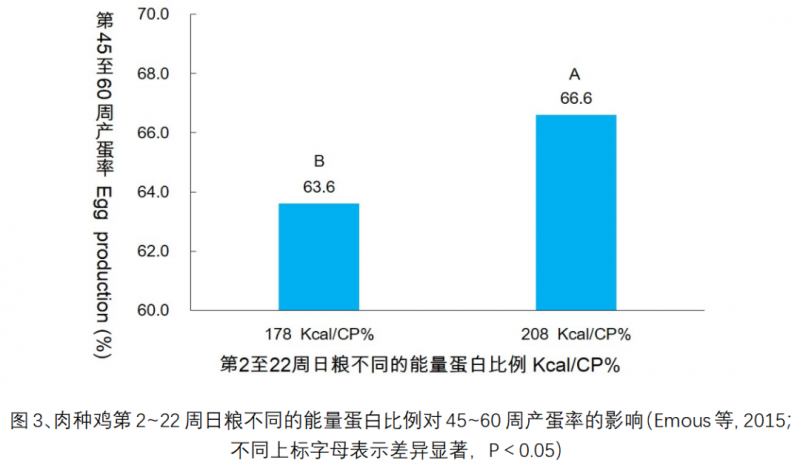
As shown in Figure 3, feeding broiler breeders diets with different energy-to-protein ratios during weeks 2~22 significantly affected the egg production rate during weeks 45~60, and a higher energy-to-protein ratio could improve the egg production rate.
In addition to energy, attention should be paid to the levels of lysine and sulfur-containing amino acids in hen feed; arginine has a substantial effect on rooster reproductive performance.
During peak egg production and the late laying period, vitamin and trace element levels should be increased appropriately to ease the conflict between heavy production demands and the gradual decline in intestinal digestion and absorption capacity.
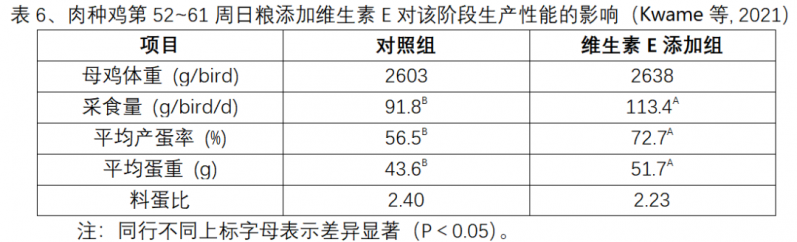
As shown in Table 6, adding extra vitamin E to broiler breeder diets during weeks 52~61 significantly increased the average egg production rate, egg weight, and feed intake during that period.
Gut Health
The gut is the chicken’s largest “fuel station” (absorbing 99% of nutrients) and largest “waste treatment plant” (eliminating 80% of toxins from the body), while also being the largest immune organ (providing 70% of the body’s immunity).
For feed, it is recommended to use larger cracked corn particles and limestone powder (2~4mm), which helps promote gastrointestinal health.
The scientific and appropriate use of organic acids, prebiotics + probiotics, high-quality vitamins, and organic minerals in CP premix, together with strict and effective quality control and production processes, helps ensure the gastrointestinal health and egg production performance of broiler breeders.
Feed Supply During the Laying Period
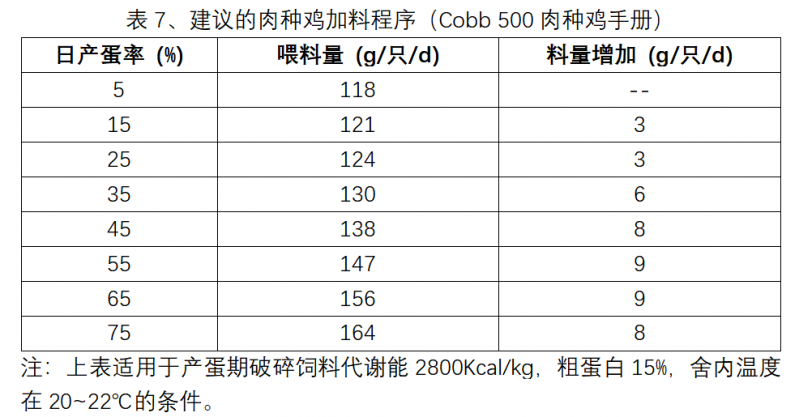
A suitable feeding program should be developed for breeder hens according to body weight and body conformation standards. A particularly important point is to adjust feed amounts appropriately based on changes in the laying rate from the onset of lay to peak production (the recommended feed increase program for broiler breeders is shown in the table below7). After the peak, adjust feed amounts appropriately based on changes in laying rate, egg weight, and other factors.
Peak laying rate is generally reached around week 31, and can be determined when the laying rate has not increased for 5d consecutively.
Once the daily laying rate reaches 75% or higher, provide the peak feed amount. If peak laying rate exceeds 86%, the peak feed amount can be increased appropriately or maintained for an additional 1~2 weeks.
At peak egg production, breeder hens typically require 450~470 Kcal of metabolizable energy, 24~25 g of protein, and 1000~1050 mg of digestible lysine per day. Overfeeding or underfeeding can affect the egg production rate of broiler breeders.
During the laying period, it is recommended that breeder roosters be fed a separate formula or feed specifically formulated for roosters, with their body weight and body condition strictly controlled.
Appropriate feeder and drinker space
Because broiler breeders are subject to restricted feeding, ensure that there are enough feed pans or adequate feeder space and that stocking density is appropriate. There should be enough drinkers or water lines, positioned near the feeding areas. Insufficient feeder space can cause competition for feed, which is harmful to breeders and can result in poorer flock uniformity, bird injuries, and even culling, thereby affecting egg production and other performance indicators.
Feed and water
Pay attention to the quality of both feed and water. In addition to nutritional and microbiological indicators, mycotoxins such as aflatoxins and zearalenone require particular attention. Heavy metals such as lead and arsenic can affect egg production by impacting the reproductive system of breeder birds.
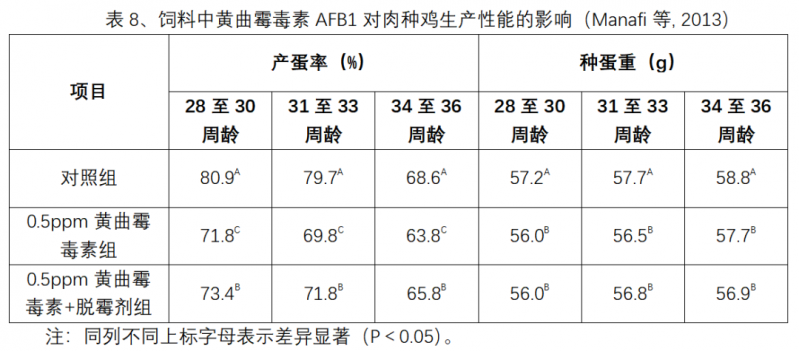
As shown in Table 8, adding 0.5 ppm of aflatoxin AFB1 to feed significantly reduced the egg production rate and hatching egg weight of broiler breeders compared with the control group (National Standard GB 13078-2017 stipulates that the aflatoxin AFB1 content in complete compound feed for broiler breeders must be ≤0.02 ppm). Although adding a mycotoxin binder can provide some relief, it is difficult to achieve the production performance of the control group; therefore, good-quality raw materials are the fundamental solution.
03, disease factors
The main diseases that occur during the laying period include Newcastle disease, avian influenza, infectious bronchitis, egg drop syndrome, colibacillosis, coccidiosis, chronic respiratory disease, infectious coryza, and leucocytozoonosis caused by Leucocytozoon caulleryi, among others. Once laying hens contract any of these diseases, their reproductive systems may be damaged to varying degrees. The disease course is also prolonged, resulting in a decline in egg production.
The egg production rates of laying hens affected by Newcastle disease, bacterial infectious diseases, or coccidiosis are 45.6%, 44.8%, and 29.7% lower, respectively, than those of normally reared laying hens.
Viral infectious diseases, such as infectious bronchitis, Newcastle disease, infectious laryngotracheitis, egg drop syndrome, avian encephalomyelitis, lymphoid leukosis, and fowlpox, can cause a sudden drop in a flock’s egg production rate from the normal 70%~90% to 20%~40%;
Bacterial infectious diseases, such as colibacillosis and fowl cholera, can cause the egg production rate to fall from 70%~80% to 20%~30%. In addition, poisoning caused by mycotoxins can also reduce egg production in laying hens. Mycotoxins are toxins produced by molds. They are highly toxic to animals, plants, and humans, and can damage the reproductive systems of chickens, thereby causing abnormalities in egg-laying performance.
The occurrence of disease is itself a stressor for a flock. Administering emergency medication or carrying out preventive vaccination before or after an outbreak adds another stressor.
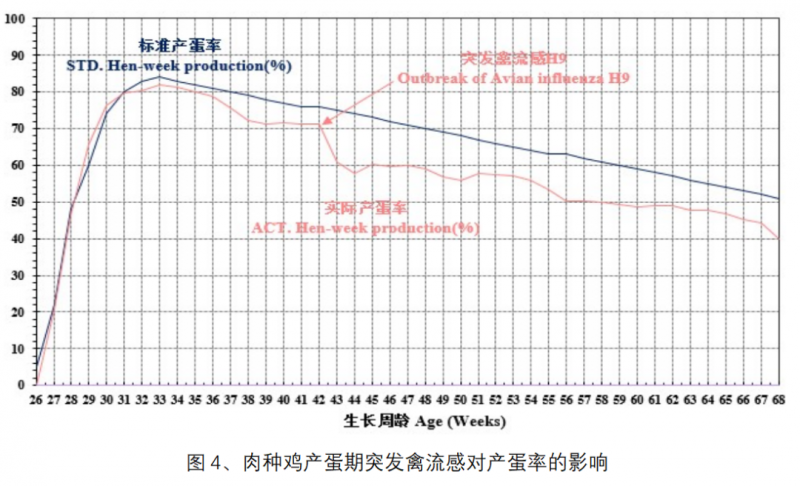
As shown in Figure 4, an outbreak of avian influenza occurred during the laying period at a certain broiler breeder farm. From week 42 to week 43, the egg production rate fell by 10% in one week and did not recover. The serious harm caused by disease is a constant reminder of the importance of maintaining biosecurity and preventing and controlling disease.
04, Summary
Because broiler breeder farming has a long production cycle, any factor during that period related to day-to-day management, feed nutrition, health, disease, or any other detail can affect the production performance of broiler breeders. As a result, raising breeder chickens is a lengthy and meticulous technical undertaking.
Factors affecting the egg-laying performance of breeder chickens are complex and multifaceted. To improve their egg-laying performance, it is necessary to fully implement breeder chicken feeding and management systems, improve disease prevention measures, and raise management standards. This will eliminate unstable factors affecting their egg-laying performance and improve overall production efficiency.