
[Introduction]Since 10月, the Northeast egg market has experienced a fairly typical “rise first, then fall” trend. At the beginning of the month, driven by concentrated restocking downstream after the National Day holiday, egg prices briefly rebounded and reached a stage high. Subsequently, as restocking demand quickly faded and sales at the retail end slowed, prices fell consecutively, with the decline gradually widening. By reviewing and analyzing the Northeast market trend in early 10月, and considering changes in the supply-demand structure and seasonal patterns, we can make a forward-looking assessment of the market trend in the middle and latter part of the month.
Early-month review: rose first, then fell, with a clear turning point
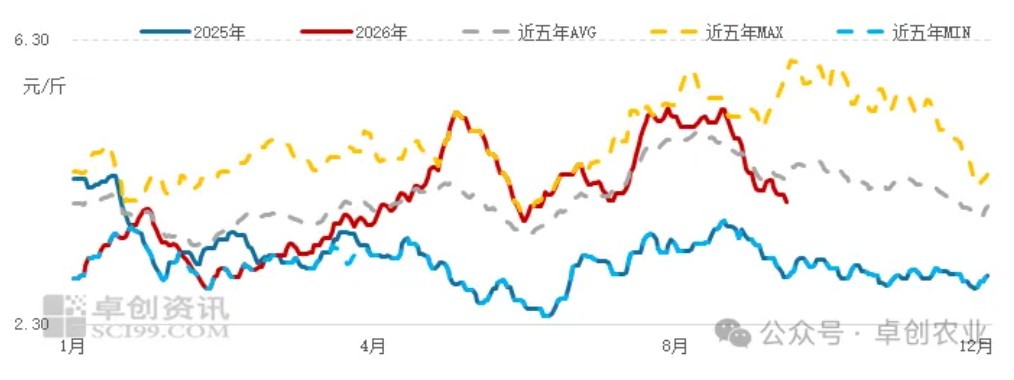
10 saw the Northeast China egg market generally follow a pattern of “rebounding at the beginning of the month, weakening in the middle, and declining consecutively,” with prices peaking early in the first ten days. At the beginning of the month, during the National Day holiday, market trading slowed somewhat under the holiday’s influence. Shipments from producing areas were mainly for local sales, while outbound shipments decreased. After the holiday, a concentrated release of restocking demand from downstream businesses led supermarkets, restaurants, and food factories to replenish inventories depleted during the holiday, and purchasing volumes increased noticeably in the short term. Meanwhile, following the consecutive declines in late 9, egg prices in Northeast China had reached relatively low levels. Producers became more reluctant to sell at low prices, slowing the pace of shipments, while traders became more willing to buy on dips. With short-term demand increasing and supply tightening temporarily, egg prices in Northeast China rose slightly and consecutively from the beginning of the month, reaching the month’s high.
However, the rebound failed to continue. As downstream restocking was gradually completed, market purchasing volumes fell rapidly and the pace of end-market sales slowed noticeably. After completing one round of restocking, traders shifted to a wait-and-see stance and became more cautious in their purchasing, bringing supply pressure in production areas to the fore. Meanwhile, after prices rebounded, livestock and poultry farms became more willing to sell, and market supply increased. The balance between supply and demand shifted from being tight in the short term to being loose, and prices entered a sustained downward trend from mid-month. By early in the latter part of the month, egg prices in Northeast China had recorded a notable cumulative decline from the month's peak, and bearish market expectations gradually became dominant. As of 10 month 12, the average egg price in Northeast China was 4.02 yuan/jin, down 4.06% from the beginning of the month.
Northeast market egg price trend chart
Outlook for mid-to-late month: The weak trend is clear, with insufficient momentum for a rebound
Looking ahead to the middle and latter part of 10 month, the supply-demand balance in the Northeast egg market is expected to remain loose, with prices mainly trending weaker and little apparent momentum for a rebound. On the demand side, the middle and latter part of 10 month is a relatively slow season for consumption over the year, with no support from a concentrated purchasing window. After stocking up for the two holidays has ended, food manufacturers enter a purchasing lull, making it difficult for substantial demand to emerge in the short term. Once the holiday effect fades, end-consumer demand is lackluster, and purchasing volumes through household and food-service channels fall significantly from peak-season levels. Amid a downward price trend, traders are becoming more cautious about buying, generally maintaining low inventories; demand at intermediate stages is also weak. Overall, the demand side has few bright spots and provides very limited support for prices.
On the supply side, falling temperatures have driven a continued recovery in the egg-laying rate, and egg output is increasing steadily. Hens added to flocks earlier are gradually beginning to lay, further releasing production capacity, and a slight increase in the number of laying hens in production appears likely. Against a backdrop of weak demand, the increase in supply will continue to put downward pressure on prices, and inventories in producing areas may accumulate further. In terms of market sentiment, industry participants generally have a bearish outlook for the future. Producers are keen to sell, while traders are cautious about purchasing, and bearish sentiment has yet to fully dissipate. With this sentiment prevailing, even if prices stabilize briefly, a sustained rebound is unlikely; more likely, the decline will temporarily slow at certain stages.
Overall, the Northeast egg market is expected to remain weak in mid-to-late 10 month, with the price center having moved noticeably lower than the highs seen in early month. A brief stabilization cannot be ruled out if prices fall to low levels, prompting producers to hold back sales and downstream buyers to restock at lower prices. However, any rebound is likely to be limited in both strength and duration, making it difficult to change the overall weak trend. It is recommended that market participants maintain a low-inventory operating strategy in mid-to-late month, arrange shipment schedules reasonably, and avoid the risk of inventory devaluation caused by continued price declines. They should also closely monitor inventory changes in production areas and the pace of downstream sales, and seize shipment opportunities during periods of temporary stabilization.