
As of 10/11, listed companies with hog farming businesses have successively released their sales data for the first three quarters. The information disclosed in the data shows that, due to low sales prices throughout the year, the companies concerned are still facing considerable operating pressure.
Wang Hongyan, a hog industry analyst at Shanghai Ganglian, told a reporter from Securities Daily that hog prices were relatively stable in the first half of this year, and most farming companies remained profitable or slightly profitable. As hog prices fluctuated downward in the second half of the year, the industry as a whole moved close to the break-even line. Companies with better cost control were still able to stay afloat, while those with higher costs had already incurred losses.
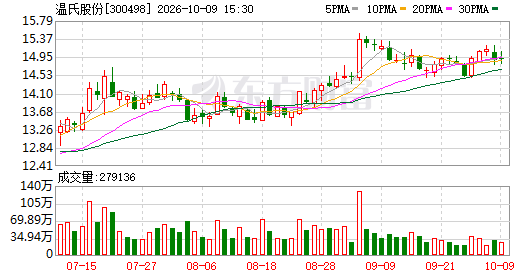
This price trend in the industry is also reflected in the monthly sales figures of leading livestock producers. According to an announcement by Wens Foodstuff Group Co., Ltd., in 2026 9, the company sold 298.83 ten thousand live pigs (including live pigs and fresh products), generating revenue of 40.56 billion yuan. The average selling price of live pigs was 10.75 yuan/kg. The month-on-month changes were 0.50%, 1.00% and -1.01%, respectively, while the year-on-year changes were -10.13%, -18.47% and -18.44%, respectively. An announcement by Jiangsu Lihua Animal Husbandry Co., Ltd. also showed that in 9, the company sold 20.32 ten thousand live pigs, with sales revenue of 2.74 billion yuan and an average selling price of 10.99 yuan/kg. The month-on-month changes were -6.32%, -7.74% and -1.17%, respectively, while the year-on-year changes were 0.35%, -16.46% and -17.55%, respectively. The selling prices of both companies in 9 were lower than in 7 and 8 this year.
Persistently weak hog prices and mounting operating pressure not only directly affect livestock producers’ revenue and profits, but also have a significant impact on the industry’s production capacity structure and pace of development.
Zhu Danpeng, vice president of the Guangdong Food Safety Promotion Association, told a Securities Daily reporter that in 2026, domestic live-hog prices remained weak, increasing operating pressure on producers. Against this backdrop, the situation may help accelerate the reduction of production capacity in the industry. On the supply side, the release of breeding-sow capacity built up earlier, coupled with weak off-season consumption, means that live-hog supply remains relatively high. The market’s supply-demand imbalance, with supply exceeding demand, has not been fundamentally reversed.
Looking at the year as a whole, although the fourth quarter is traditionally a peak season for consumption and the market’s supply-demand balance may improve temporarily, the supply pressure accumulated over the long term in the industry has not been fully alleviated, adding uncertainty for the future.
“Seasonal demand, including demand for cured meats in the fourth quarter and stocking for New Year’s Day and the Spring Festival, will support the market, and consumption is expected to improve month on month. However, the current supply of live pigs remains ample, slaughter weights are high, and supply pressure has yet to fully ease. Although peak-season demand may provide a temporary boost, it will be difficult to reverse the pattern of strong supply and weak demand,” Wang Hongyan said.
Wang Hongyan, a hog industry analyst at Shanghai Ganglian, told a reporter from Securities Daily that hog prices were relatively stable in the first half of this year, and most farming companies remained profitable or slightly profitable. As hog prices fluctuated downward in the second half of the year, the industry as a whole moved close to the break-even line. Companies with better cost control were still able to stay afloat, while those with higher costs had already incurred losses.
This price trend in the industry is also reflected in the monthly sales figures of leading livestock producers. According to an announcement by Wens Foodstuff Group Co., Ltd., in 2026 9, the company sold 298.83 ten thousand live pigs (including live pigs and fresh products), generating revenue of 40.56 billion yuan. The average selling price of live pigs was 10.75 yuan/kg. The month-on-month changes were 0.50%, 1.00% and -1.01%, respectively, while the year-on-year changes were -10.13%, -18.47% and -18.44%, respectively. An announcement by Jiangsu Lihua Animal Husbandry Co., Ltd. also showed that in 9, the company sold 20.32 ten thousand live pigs, with sales revenue of 2.74 billion yuan and an average selling price of 10.99 yuan/kg. The month-on-month changes were -6.32%, -7.74% and -1.17%, respectively, while the year-on-year changes were 0.35%, -16.46% and -17.55%, respectively. The selling prices of both companies in 9 were lower than in 7 and 8 this year.
Persistently weak hog prices and mounting operating pressure not only directly affect livestock producers’ revenue and profits, but also have a significant impact on the industry’s production capacity structure and pace of development.
Zhu Danpeng, vice president of the Guangdong Food Safety Promotion Association, told a Securities Daily reporter that in 2026, domestic live-hog prices remained weak, increasing operating pressure on producers. Against this backdrop, the situation may help accelerate the reduction of production capacity in the industry. On the supply side, the release of breeding-sow capacity built up earlier, coupled with weak off-season consumption, means that live-hog supply remains relatively high. The market’s supply-demand imbalance, with supply exceeding demand, has not been fundamentally reversed.
Looking at the year as a whole, although the fourth quarter is traditionally a peak season for consumption and the market’s supply-demand balance may improve temporarily, the supply pressure accumulated over the long term in the industry has not been fully alleviated, adding uncertainty for the future.
“Seasonal demand, including demand for cured meats in the fourth quarter and stocking for New Year’s Day and the Spring Festival, will support the market, and consumption is expected to improve month on month. However, the current supply of live pigs remains ample, slaughter weights are high, and supply pressure has yet to fully ease. Although peak-season demand may provide a temporary boost, it will be difficult to reverse the pattern of strong supply and weak demand,” Wang Hongyan said.