
No farm controls the price, but each one decides how many animals it produces and at what weight it sells them. 333 Latin America spoke with three Colombian producers about the measures they are taking in response to the crisis.
More kilos than the market can absorb
One of the main causes of the crisis is the increase in national production, which grew by 14,6 % between January and August of 2026, according to calculations by 333 Latin America based on data from Porkcolombia. Much of that growth comes from expansions and new investments made when prices were high in 2024 and 2025, which were exacerbated by PRRS outbreaks. Imports fell by 11,7 % through July, so for now they do not explain the excess supply.
According to Porkcolombia’s Historical Price Round, live hogs closed September 2026 at 6 444 COP/kg, 42 % below the January 2025 level (Chart 1).
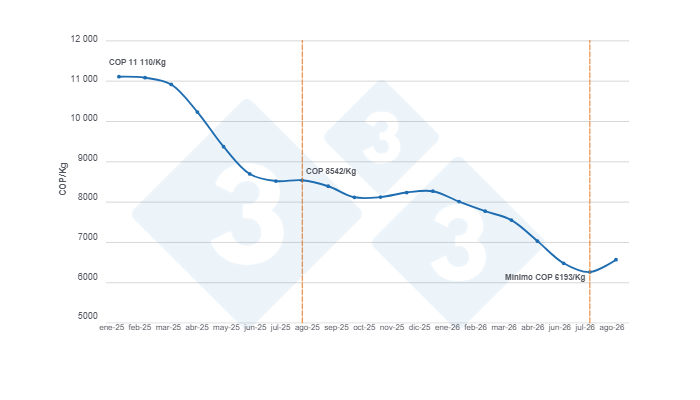 Chart 1. Trend in the national price of live hogs in Colombia, January 2025 to September 2026 (COP/kg).
Source: Porkcolombia’s Historical Price Round.
Chart 1. Trend in the national price of live hogs in Colombia, January 2025 to September 2026 (COP/kg).
Source: Porkcolombia’s Historical Price Round.
The decisions made by these three producers show where losses can be reduced, and several of them can be replicated on other farms.
Cercaldas
Mateo Gómez Restrepo, general manager
Cercaldas, with 450 females, has been working on efficiency for years to lower costs, but those results take time to show up on the income statement. “In response to this crisis, we chose strategies with a quick return that would not affect the farm’s productivity,” he explains.
The first was to reduce the market weight from 126 to 113 kg. The feed conversion ratio went from 2,19 to 2,09, and feed savings are around 50 000 COP per animal. He also postponed until May 2027 the increase in the number of females that had been planned for October, along with the construction work, to avoid taking on more debt or paying more interest.
In terms of animal health, he now immunocastrates only the males, cutting in half the doses he used to buy. “It is the only vaccine or medication that we consider can be partially discontinued without affecting productivity.” He is also stricter about removing small piglets showing signs of illness during lactation and the nursery phase.
He studied the option of reducing the number of females and ruled it out. A financial simulation with 50 fewer sows showed that production costs would rise by 195 COP/kg. The facilities and utilities remain the same, but their costs are spread over fewer kilos, and the savings would be limited to one finishing-house worker and some of the medications, which account for 4% of costs. “It is not worth making that sacrifice and not having the pigs we need when prices recover.”
Corredor López
Jaime Andrés Corredor Duarte, general manager
“We have an excess of kilograms reaching the market,” he summarizes. Based on this diagnosis, the company reduced the sale weight from 138 to 121 kg, more than 12% less per animal. “The final kilograms are the most expensive: conversion worsens, and more feed is needed for each additional kilogram.” The measure has not gone down well with some marketers, who are asking for heavier pigs. “If those kilograms are not remunerated, the producer cannot bear their cost indefinitely.”
Selection was also tightened. Piglets weighing less than 1 kg at birth and animals that are significantly behind in the nursery stage are removed from the normal flow, always following animal welfare protocols.
The most impactful decision was structural: the company went from 1 000 to 700 breeding sows by closing a unit of 300 females and concentrating production in a single unit. “Maintaining an inventory designed for a different market can be more expensive.” He warns: “Continuing to produce the same way while waiting for prices to recover can deepen losses.”
For Corredor, the conclusion is: “Protect cash flow and avoid continuing to invest in kilograms or animals that are not profitable.”
Empresas Floresta
Carlos Maya Calle, general manager
At Floresta, the adjustment is happening on two fronts: the farm and finances. “We are being especially strict in order to reduce supply,” says Carlos Maya. The team has been instructed to carry out a three-stage culling process—at farrowing, at weaning, and when animals leave the pre-finishing stage—to remove the least viable animals.
The sale weight fell from 130 to 114 kg, an average decrease of 16 kg. In reproduction, the company suspended 70 % of replacement-stock rearing and accelerated the culling rate, with the aim of reducing the breeding-sow population by 18 %.
On the financial side, it conducted a thorough review of its cash position, reviewed the components of its debt to improve its cost, and redefined terms with some of its main suppliers.
Maya sums it up this way: “Reducing the number of females may increase unit costs, but given the market saturation, it is our responsibility as an industry to work toward balancing supply and demand. We should all do that.”
What they share and what they don’t
| Measurement | Cercaldas | López Corridor | Floresta Companies | Effect period |
|---|---|---|---|---|
| Sales weight | 126 → 113 kg | 138 → 121 kg | 130 → 114 kg | Immediate |
| Piglet selection | More demanding during lactation and pre-weaning | Criterion below 1 kg at birth and during pre-weaning | Triple culling: farrowing, weaning, and exit from pre-weaning | Weeks |
| Breeding females | Growth postponed; cull reduction (+195 COP/kg) | 1 000 → 700 (−30 %), closure of one unit | −18 %: 70 % less breeding and more culling | 9–10 months |
| Finance | Projects postponed to curb debt and interest | Cash flow, avoid investing in animals with low viability | Cash flow, debt, and suppliers renegotiated | Immediate |
All three reduced the sale weight, which is the fastest way to take kilos off the market. The differences lie in how they handle the females. Corredor López cut by 30 % and, by closing one complete unit, also saved that unit’s fixed costs. Floresta reduced by 18 % by slowing replacement, even knowing that the unit cost could rise, in order to help balance supply. Cercaldas ran the numbers using its existing infrastructure, and the cost per kilo would have risen, so it is maintaining inventory.
Before culling sows, each farm needs to know what matters most in its situation (cost per kilo, market balance, or surplus capacity) and which costs will go with them. In any case, the effect on supply will not be seen before mid-2027.
What measures is your company implementing?
Editorial 333 Latin America