
In France, between the end of June and the end of August, the price on the French Pork Market rose every week, recording a cumulative increase of 33 cents over two months. This trend is mainly explained by the decrease in pork supply, exacerbated by heatwaves.
In June, July and August, the average weight of slaughtered pigs in the Uniporc zone was 926 g below the average for the period 2021-2025. Many farms also recorded losses of fattening pigs. In the first half of the year, slaughterings of fattening pigs in the Uniporc zone were still 0,9 % higher than in 2025. Their decline in July and August offset this increase (+0,1 % for the cumulative total over the first 8 months of 2026). In addition to the loss of pigs ready for slaughter, farmers were also affected by increased mortality among sows and piglets. These effects will become more apparent by the beginning of 2027.
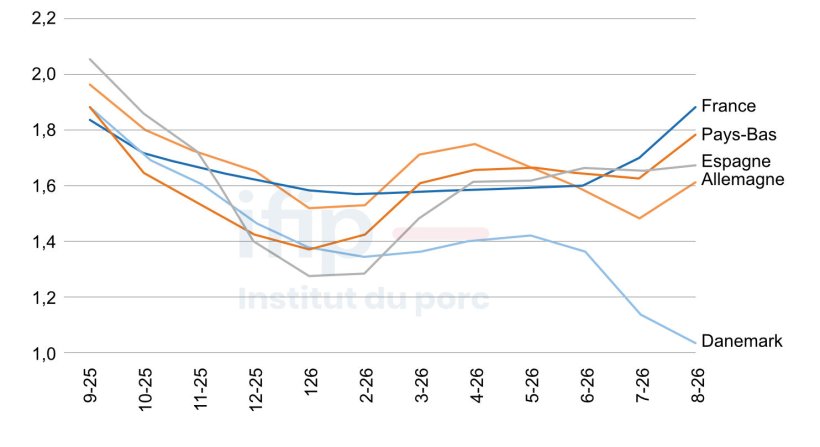 Prices received in the EU in € per kg carcass: Source: Estimate of the average price received by farmers, calculated by Ifip based on national sources.
These developments put the French market back at the top of the main European quotations
Other European markets were also affected by heat waves. Slower pig growth and excess mortality limited supply, while the European meat market remains sluggish and well supplied.
Driven by slaughterhouses in northern Europe, the price of Class E pork fell by 3,9 % in July. It recovered in August, supported by the shortage of animals and by the recovery in demand at the end of the holidays in several regions. German and Dutch slaughterhouses which had tried to contain prices in July, ultimately accepted increases.
The Denmark stands out for maintaining very low prices. Market operators are seeking to limit meat stocks.
In Spain, the market changed little: the drop in supply caused by the heatwave and tourist consumption supported prices, while limited outlets in third countries curbed this increase.
In August, the price received in France reached 1,88 €/kg, ahead of the Netherlands (1,78 €), Spain (1,67 €), Germany (1,65 €) and Denmark (1,04 €).
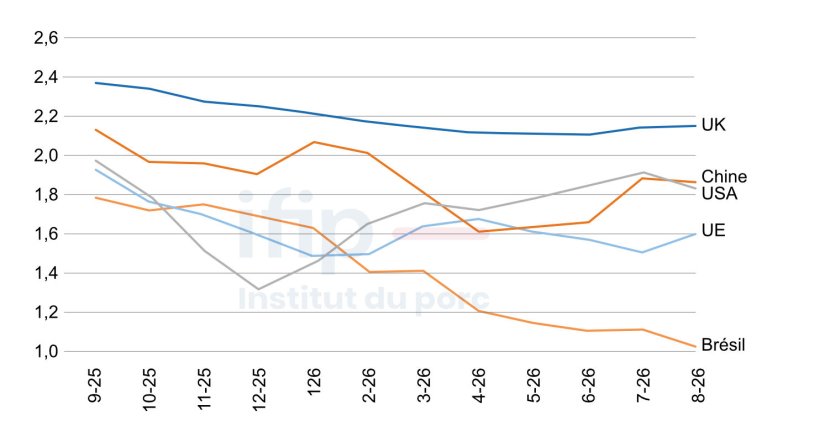 World pig prices (€/kg): EU-27: weighted average of the 27 countries USA: FIP calculation based on Iowa market prices Brazil: FIP calculation based on Sindicarne integration prices China: Calculation based on prices from the Chinese Ministry of Agriculture
Exporting countries also continue to face competition from Brazil and the United States, as well as moderate demand in Asia.
In Brazil, pork prices have continued to fall for 6 months. This is happening amid declining domestic demand. At the same time, investments made in 2025 have increased production capacity and available supply. In the first half of 2026, slaughter numbers rose by 4,3 % year on year, exacerbating the market imbalance.
In China, pork prices rebounded by 12 % in July before stabilizing in August. The effects of national regulations governing production capacity are beginning to emerge. Weather-related disruptions in the south of the country also led to stockpiling ahead of schedule in July, contributing to the rise in prices. At the end of June, the breeding herd had fallen by 6,5 % year on year, as financial difficulties led farms to reduce their sow herds.
In the United States, production increased slightly in the first half of the year, thanks to higher carcass weights, up by an average of 0,7 % year on year. Stabilizing feed costs made it possible to produce heavier pigs. Exports remained dynamic, with volumes up by 4,1 %, but U.S. pork is facing increasing competition from Canadian and Brazilian products in Mexico. Signs of a slowdown in this market emerged as early as the second quarter. Despite recovering through the end of July, U.S. prices remained well below those of 2025 before falling sharply in August. The 9,4 % increase in refrigerated stocks in July, particularly bacon and ham, confirms the sluggishness of domestic and international demand.
Elisa Husson, IFIP agricultural economist