Australian pig meat production is forecast to remain virtually stable (+0,6%), reaching 475000 tonnes (carcass weight equivalent – CWE) in 2027, compared with the estimated 472000 tonnes in 2026 and 475000 tonnes in 2025. At first glance, economic conditions for producers seem favourable: prices for bacon pigs (*baconers*) rose sharply from the beginning of 2024, while feed grain prices fell and remained relatively low for much of 2025 and early 2026. However, the production response has been much weaker than the signal that margins alone would suggest.
The main limiting factor is downstream demand (at retail and processing level), not the price of feed on the farm. Australian fresh pork is supplied essentially by local producers, since biosecurity restrictions prevent imported chilled pork from being sold as fresh meat. Consequently, imported frozen pork is concentrated in processed products such as ham, bacon and sausages. When retail prices for fresh pork rise faster than those for competing proteins, processors and retailers cannot replace the supply in the fresh-meat market with imported meat; instead, they may reduce promotions, adjust the cut mix or limit purchases of pigs. Pork prices have risen faster than poultry prices and, during some periods, faster than beef prices, weakening pork’s relative value proposition and constraining the demand signal transmitted to producers.
Population growth will support baseline demand, but continued pressure from lower-cost poultry and competitive imports of processed pork will limit the price and volume signals needed for a significant increase in domestic pork production.
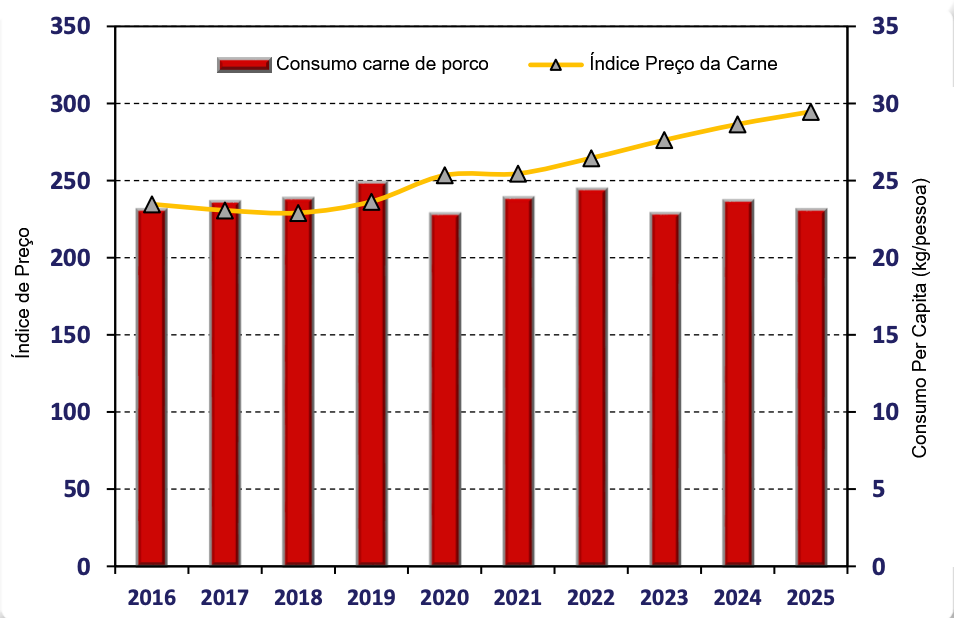
Pork consumption in Australia is projected to increase by 0,8%, rising from an estimated 650000 tonnes (carcass weight equivalent) in 2026 to 655000 tonnes in 2027. This increase is driven by population growth, while Per capita pork consumption is expected to continue its gradual decline.
Australian pork imports are forecast to remain steady at 220000 tonnes (carcass-weight equivalent) in 2027, after rising from 214000 tonnes in 2025 to an estimated 220000 tonnes in 2026. There has been a change in the source of imports.Prices charged by major European suppliers fell more sharply than U.S. prices, increasing the competitiveness of Denmark, the Netherlands, and other EU suppliers, and reducing the U.S. share from 51% in the January–June period of 2025 to 37% in the same period of 2026.
As Australian pork exports are expected to fall 4,8%, rising from an estimate of 42000 tonnes (carcass weight equivalent) in 2026 and 46000 tonnes in 2025 to 40000 tonnes in 2027. Export volumes remain low relative to domestic production and are therefore highly sensitive to demand in specific destinations, freight costs, and Australia’s price competitiveness compared with larger global suppliers. Shipments to Singapore—historically the largest destination for Australian pork exports—declined in the first half of 2026. In contrast, exports to Papua New Guinea increased.
28 of September 2026/ USDA/ United States.
https://www.fas.usda.gov/