
“I was curious to see where I stood compared with others thanks to this assessment.” When Théo Albaniac was offered a Cap'2ER assessment After its operation by the Natera cooperative, the farmer did not hesitate to take the plunge. Since setting it up in 2019, he has been seeking to improve the farm’s technical performance, which he runs with his father and uncle in Roqueredonde, on the Escandorgue plateau, in northern Hérault.
“An environmental analysis with a technical approach.”
In 2019, the Gaec has 400 ewes of the Massif Central White breed (BMC) and a fattening facility for 2 500 lambs, partly destined for Natera. But the rate of prolificacy of BMCs is capped at 138%, and the mortality of the lambs reached 20%, due to insufficient milk from the mothers after lambing.
Meat Lacaune sheep for greater prolificacy
The decision is then made to stop the fattening operation and to change breed. To improve lambing rates, prolificacy and lamb conformation, the partners are gradually replacing BMC with Lacaune meat sheep from the GID Lacaune (Gènes Innovation Diffusion) scheme. To date, they raise 200 white sheep from the Massif Central and 400 purebred Lacaune sheep.
Read also: Aveyron: “We are exploring new ways to reduce the environmental impact of our 250 dairy Lacaune sheep through breeding”
The Cap’2ER assessment carried out in 2021 confirms the relevance of these changes. In addition to affecting productivity, high mortality and low prolificacy also affected the environmental footprint per lamb. The reason: this involves using resources and emitting greenhouse gases to produce a ultimately limited number of lambs.
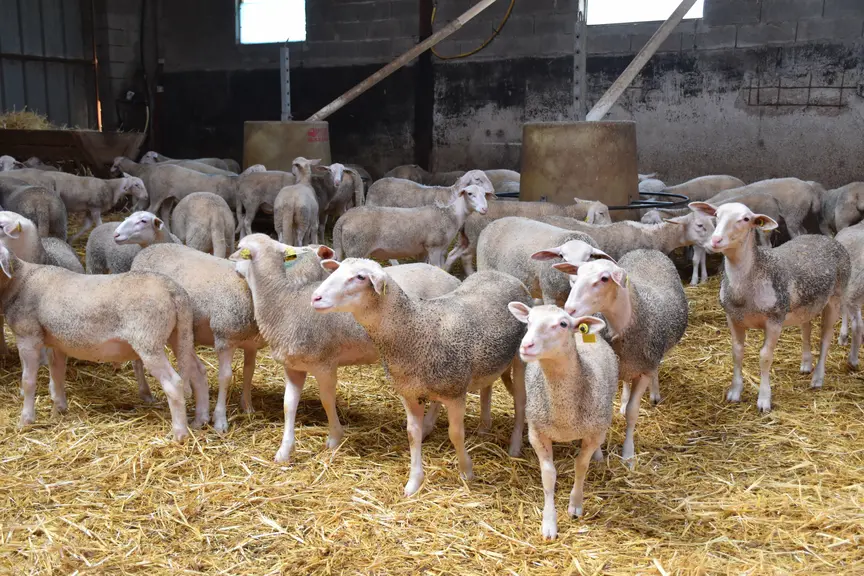
Two lambing periods, one in May and the other in November, make it possible to spread out lamb sales and make up for the shortfall in May. Credit: D. Séailles
Greater productivity, less CO2
The three partners then decide to increase productivity further while reducing their environmental footprint. To increase milk production, they review the feed of the ewes. “ We increased the share of legumes in the crop rotation by introducing alfalfa. ” This is one way to obtain heavier ewe lambs. “ We are now self-sufficient in feed, apart from lamb feed compliant with the Label rouge, and minerals ”, Théo explains. In addition to the feed, monitoring of the lambs is also increased in order to reduce their mortality rate.
Read also: Cévennes: “We have started grazing vines in response to climate change”
The Gaec has 110 hectares of grazing land out of 200 hectares of utilized agricultural area, ensuring rich biodiversity on the farm. But increasing grazing, desirable from an environmental perspective, remains complicated. “Our land is located on limestone plateaus: regular rainfall is needed for the grass to grow”, explains Théo. Rainfall is becoming increasingly scarce due to climate change. “It is unfortunately a lever limited by the lack of rain caused by global warming especially during the summer », explains Marion Guibert, sheep technician at Natera.
Technique and the environment go hand in hand
The combination of these technical levers has a reduced emissions of greenhouse gases per head by 6%. The rate of emissions offset by the operation went from 43 to 48%. The lambs have gained an average of 1 kilogram of carcass weight, with better conformation. “We’d never had a lamb classified U before,” Théo says proudly.
Stay up to date in real time!
Follow topics, legislative projects, companies and public figures to be notified as soon as we publish an article.
The the farrowing rate has increased by 6%, the mortality rate fell by 7%, and feed costs decreased by an average of 15 kilos of feed per ewe. “ We struggled to get the BMCs’ lactation started, so we stimulated them with feed.” There were also no more lambs classified as outside the label because of artificial rearing. Satisfactory results, achieved, however, at the cost of increased workload.
A transition underway
Today, the the transition to a Lacaune flock is still underway and should be completed in 2-3 years. “It’s taking longer than expected,” Théo admits. The farmer would like to continue increasing prolificacy in the flock, which is still a little disappointing. “Prolificacy is improving little by little because, at first, we weren’t selecting Lacaune ewes. All the ewe lambs were kept for replacement, to make the transition as quickly as possible. We’ve only just started selecting the most prolific ewe lambs and choosing rams based on their index.”
Lambs sold through short supply chains
Two lambing periods, one in May and the other in November, make it possible to spread out lamb sales and make up for the May gaps. The lambs are finished on grass from the end of March. They are marketed through Natera under the Label rouge Agneau fermier des pays d’Oc label, which requires lambs to be weaned after a minimum of 70 days of suckling and sold before 150 days. Lambs born in May are sold in September, making it possible to receive the out-of-season bonus: 18 euros more per lamb, or one euro more per kilo of carcass. « Work organization is sometimes difficult: May is a very busy month, with haymaking and lambing », Théo admits.
To find out more
« The aim of the CAP’2ER® tool is to provide advisors and farmers with a multi-criteria environmental assessment tool at the level of the farm, its production units and its products. It is designed to assess the farm’s environmental performance, compare it with benchmarks and take action to improve. » Cap2ER team
Key figures 2026
220 hectares, including 111 of grazing land.
200 Massif Central White ewes and 400 purebred Lacaune ewes.
700 births, of which 120 were kept for replacement.
15 rams.