
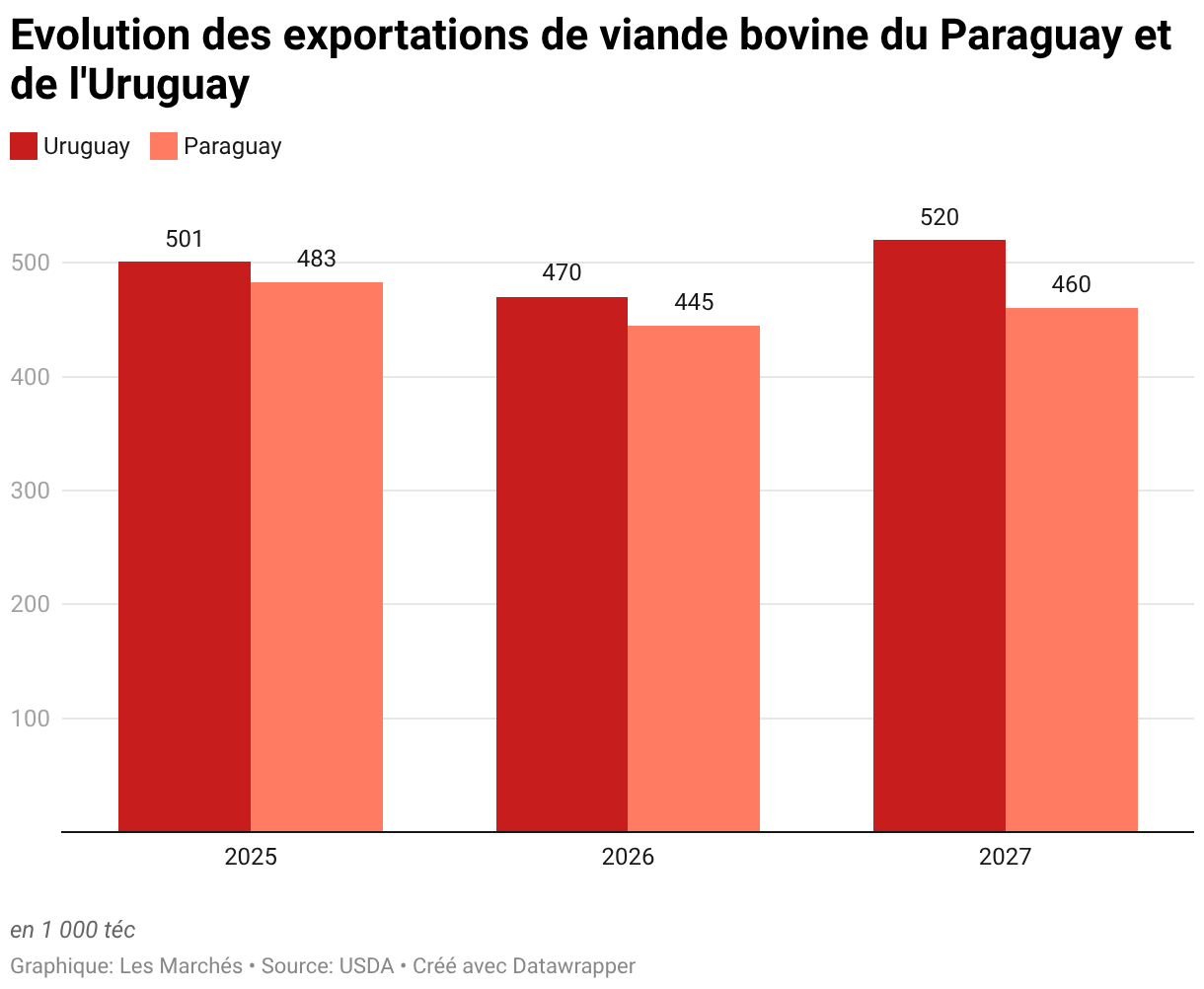
The Paraguay’s beef exports could reach 460 000 tonnes carcass weight equivalent (tec) in 2027, making it one of the country’s top 5 years. In Uruguay, shipments could reach 520 000 téc next year, the highest level since 2021, according to USDA forecasts. This compares with the 4,1 million téc that their Brazilian neighbor, the world’s leading beef producer and exporter, is expected to export in 2027.
In Uruguay, cattle farming intensifies
The increase in Uruguay’s beef exports is attributable to increased production, which, at more than 650 000 téc, is also expected to reach its highest level since 2021. More than 80% of the country’s beef production is exported. In total, 2,35 million cattle are expected to be slaughtered in the country, an increase linked to the dynamics of calvings in 2025 and 2026. Uruguayan cattle farming intensifies, and more than 40% of the animals slaughtered in 2027 will have been grain-fed, according to the USDA. This is pushing carcass weights to record levels. Uruguay’s participation in the EU’s high-quality beef quota for grain-fed animals has also helped accelerate the adoption of grain finishing. Feedlots are expanding, and nearly 900 000 cattle could be finished there in 2026, with an expected increase of 10% in 2027. Yet Uruguay continues to promote its grass-fed livestock farming, without growth promoters or animal meals.
Read also: Food sovereignty: “Either we produce or we import,” says Yves Fantou of Culture Viande
Uruguayan beef less present in China, more in the United States
While the China was, by far, the main market for beef exported by Uruguay a few years ago, shipments fell while those to the United States rose. In the first half of 2026, these two markets were equivalent in volume, while exports to the United States exceeded those to China by 25% in value. These two countries are the destinations for three quarters of Uruguay’s beef exports.
Read also: Beef: on the global market, some doors close while others open
Uruguay is little affected by the quotas introduced by China, as they are generous and based on years with high volumes. The Uruguay’s exports to the European Union are strong and have benefited since 2024 from the supply shortage in the EU, and could benefit from the ban on Brazilian beef in the EU. Israel is another important market for Uruguayan beef.
Stay up to date in real time!
Follow topics, legislative projects, companies, and public figures to be notified as soon as we publish an article.
Uruguay is developing its live cattle exports to Turkey, Morocco and Israel
At the same time, Uruguay is expected to export 350 000 to 400 000 live cattle, as in 2025 and 2026. The Turkey is the main destination, with calves and feeder cattle for fattening. Israel is expanding its purchases of calves, feeder cattle and heifers, while Morocco has become an important destination since 2025, with beef cattle.
Read also: EU-Mercosur Agreement: What is the initial assessment of agricultural and food trade?
In Paraguay, slaughter numbers are stabilizing
The Paraguay could slaughter 2,4 million cattle in 2027, a limited increase due to the herd being at its lowest level in 15 years. However, the intensification of livestock farming is driving up carcass weights. One-third of cattle in Paraguay are finished in feedlots, one-third on productive tropical pastures, and one-third on pastures with supplementary feeding.
Paraguay, like Uruguay, has a complete traceability system.
Read also: Beef: EU imports reach a historic record in the first half of the year
Paraguay directs few of its meat exports to the EU
The main export markets for Paraguayan beefare Chile, the United States, Taiwan and Israel, which account for 78 % of export volumes in the first half of the year. Paraguay sent only 1 000 téc of boneless frozen meat (-28 %) and 600 téc of chilled meat (-29 %) to the EU during the first 7 months of the year.
Paraguay’s beef exports
In téc for the first 7 months of 2026, source: USDA
| Frozen boneless | Chilled bone-in | |
| Chile | 2 600 | 47 400 |
| USA | 30 000 | - |
| Taiwan | 21 000 | - |
| Israel | 17 700 | 7 600 |
| Canada | 8 600 | - |
| Brazil | 900 | 6 300 |
| Russia | 2 000 | - |
| Uruguay | - | 3 400 |
| Colombia | - | 1 100 |
| European Union | 1 000 | 600 |