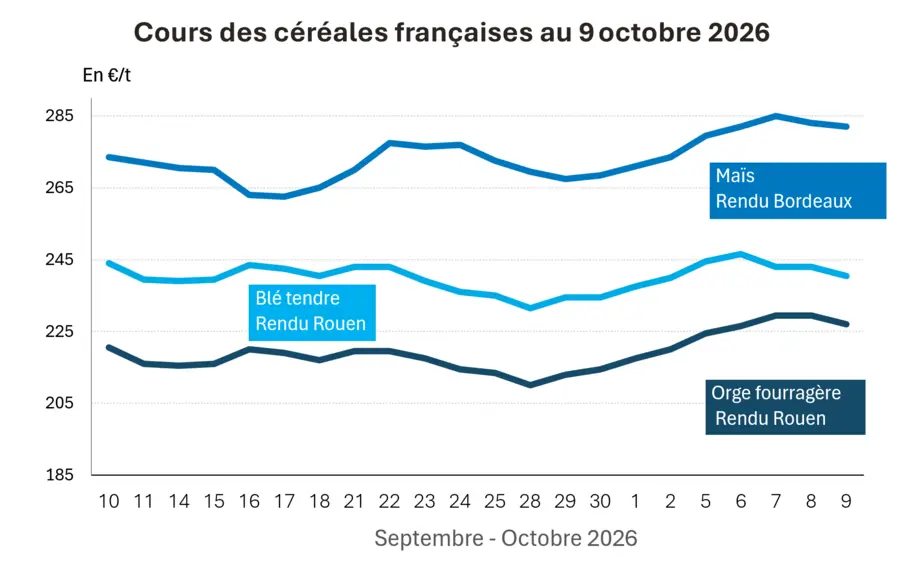
The essentials:
-
A production of corn in the United States revised upward by the USDA.
-
A drop in oil prices after the announcement of an energy ceasefire.
-
Further negotiations around a Black Sea corridor for grain transport.
L'USDA surprised with the publication of its WASDE report on Friday. Contrary to operators' expectations, the U.S. corn yield was raised, as were production and ending stocks. Wheat and corn prices therefore fell sharply on Friday.
Wheat prices fall on the CBOT
Wheat prices wheat at CBOT ont lost from 2 to more than 12 cents per bushel on Friday, depending on the delivery month, with the steepest declines recorded in the nearest contracts.
On the December 2026 contract, wheat was down 12,25 cents at 671 cents per bushel. The March 2027 contract was also down 12,50 cents per bushel, at 685,25 cents.
T'USDA slightly raised its forecast for wheat production in the United States to 41,75 Mt as well as Canada to 36,5 Mt, but lowered its estimate for the European Union to 133 Mt, compared with 133,8 Mt in September.
The estimate for global production of wheatremains virtually unchanged at 822,39 Mt, as do ending stocks, estimated at 276,04 Mt. Note that the USDA lowered its forecasts for global wheat exports and imports by nearly 3 Mt.
In contrast, given the increase in production and the decline in U.S. exports, ending stocks of wheat in the United States were raised to 740 million bushels, compared with 717 million estimated in September.
The dollar continued to appreciate against the euro on Friday. The euro traded at 1,1202 dollar, compared with 1,1217 dollar the previous day. This morning at 6 h 50 (Paris time), it traded at 1,1209 dollar.
Wheat prices remain hesitant on Euronext
Wheat prices on wheat on Euronext remained unsettled on Friday, a few hours before the release of the WASDE of the USDA. The wheat was down by 1 to nearly 4 €/t, depending on the delivery dates.
For the December 2026 contract, the price of wheat fell by 2,25 €/t to 242 €/t, while for March 2027 it lost 3 €/t to reach 243,25 €/t.
The sowing of wheatstarted late in France and accounted for, according to the report Céré'Obs from FranceAgriMer, 4% of the planned area as of 5 October, compared with 6% on the five-year average. Winter barley sowings, meanwhile, had reached 7% of the planned national area, compared with 12% on the five-year average on the same date.
Corn prices under pressure after the USDA report
Corn prices for corn to CBOT of Chicago fell after the publication of the USDA. They were down by 1 to 21 cents per bushel depending on the contract month, with the declines being more pronounced for nearby contracts.
For the December 2026 contract, the price of the corn was down 20,5 cents per bushel to 479,75 cents. For the 2027 March contract, it fell 21 cents to 494,25 cents per bushel.
The estimates published Friday in the WASDE report caught traders off guard. Against all expectations, the yield of corn in the United States was raised to 181,2 bushels per acre, resulting in a production increase of nearly 6 Mt.
Despite an upward revision to U.S. consumption of corn, both for animal feed and for the production of ethanol, ending stocks were raised to 1 849 million bushels, compared with 1 567 million estimated in September.
Corn production corn in the European Union has been revised downward to 48 Mt. Despite this, global production is now estimated by the USDA at 1 293,75 Mt, compared with 1 290,95 Mt in September. World ending stocks are therefore raised to 280,44 Mt, compared with 272,1 Mt previously.
Oil: Prices set to fall?
Oil prices oil edged slightly higher on Friday amid a still very fragile geopolitical context. The Brent December delivery was up 0,28% at 104,42 $/barrel, while the WTI November delivery was up 0,15% at 91,64 $/barrel.
To find out everything about agricultural market news, click here
If the price of crude oil is worrying markets, the situation is even more tense for diesel, whose prices have risen sharply given limited refining capacity. While Donald Trump concluded an agreement this weekend with Russia on diesel imports, he also announced a new energy ceasefire agreement in the conflict between Russia and Ukraine. Oil prices fall this morning, with WTI down 0,95 % and Brent down 0,24 %.
European corn takes a cautious approach on Euronext
Corn prices corn continued their decline that began on Wednesday, falling by 1 to nearly 5 €/t, depending on the delivery month, in the wake of the U.S. market.
For the November 2026 contract, the price of corn fell by 0,75 €/t to 273,25 €/t. For March 2027, it lost 3,75 €/t to reach 265,25 €/t.
In the latest report Céré'Obs by FranceAgriMer published on Friday, growing conditions for the corn yet to be harvested remain very poor. Only 22% of the area was rated good to very good as of October 5, compared with 66% on the five-year average.
The harvest is nearing completion almost three weeks ahead of schedule, having reached 84% of the area as of October 5, compared with 31% on the five-year average.
Turkey revives hopes for a maritime corridor in the Black Sea
Turkey is seeking to secure maritime traffic in the Black Sea by proposing the creation of two separate corridors: one for Ukrainian vessels along the Romanian and Bulgarian coasts, the other reserved for Russian vessels via the Georgian and Turkish coasts. The aim is to reduce the risk of incidents by physically separating shipping routes.
After the announcement of an energy ceasefire between Russia and Ukraine, the market is now wondering whether an agreement to once again secure grain flows in the Black Sea is possible.
Grain blockaded in the Black Sea threatens global prices in the longer term
The blockade of maritime exports in the Black Sea is causing a significant accumulation of grain in Ukraine and Russia. This situation creates a paradox: domestic prices are falling in producing countries as stocks grow, while global prices remain supported by reduced exportable supplies.
According to UkrAgroConsult, between July and September 2026, combined wheat exports from Ukraine and Russia fell by 6,5 Mt year on year. This shortfall could reach 10,2 Mt by the end of October if the disruptions persist. Logistical alternatives via the Danube, rail, or Baltic ports only partially offset the loss of maritime capacity.
In Ukraine, storage capacity saturation and rising logistics costs are weighing on farmers’ incomes. In Russia, the situation is exacerbated by an abundant harvest estimated at 140 Mt, which is increasing pressure on domestic prices in export regions.
The main risk for the global market, however, lies in the medium term. A possible reopening of maritime corridors in 2027 would allow the accumulated stocks in Ukraine and Russia. The simultaneous arrival of large volumes on markets in the Middle East, North Africa and Asia could then intensify competition among exporters and exert strong downward pressure on global wheat prices.
FUNDAMENTALS
Production, wheat, USA : 1534 million bushels (41,74 Mt) versus 1531 million bushels (41,66 Mt) estimated in September for 2026-2027 (source: USDA)
Domestic consumption, wheat, USA : 1109 million bushels (30,18 Mt) versus 1099 million bushels (29,91 Mt) estimated in September for 2026-2027 (source: USDA)
Exports, wheat, USA : 750 million bushels (20,41 Mt) versus 775 million bushels (21,09 Mt) estimated in September for 2026-2027 (source: USDA)
Ending stocks, wheat, USA : 740 million bushels (20,14 Mt) versus 717 million bushels (19,51 Mt) estimated in September for 2026-2027 (source: USDA)
Production, wheat, World : 822,39 Mt versus 822,44 Mt estimated in September for 2026-2027 (source: USDA)
Production, wheat, Canada : 36,5 Mt versus 36 Mt estimated in September for 2026-2027 (source: USDA)
Production, wheat, EU : 133 Mt compared with 133,8 Mt estimated in September for 2026-2027 (source: USDA)
Domestic use, wheat, World : 827,9 Mt compared with 826,75 Mt estimated in September for 2026-2027 (source: USDA)
Exports, wheat, World : 208,97 Mt compared with 211,77 Mt estimated in September for 2026-2027 (source: USDA)
Yield, corn, USA : 181,2 bushels per acre versus 178,5 bushels per acre estimated in September at 2026-2027 (source: USDA)
Production, corn, USA : 16 034 Mio bushels (407,28 Mt) versus 15 800 Mio bushels (401,33 Mt) estimated in September at 2026-2027 (source: USDA)
Domestic consumption, corn, USA : 13005 Mio bushels (330,34 Mt) versus 12 905 Mio bushels (327,8 Mt) estimated in September at 2026-2027 (source: USDA)
Exports, corn, USA : 3 300 million bushels (83,82 Mt) versus 3 275 million bushels (83,19 Mt) estimated in September for 2026-2027 (source: USDA)
Ending stocks, corn, USA : 1849 million bushels (46,97 Mt) versus 1567 million bushels (39,79 Mt) estimated in September for 2026-2027 (source: USDA)
Production, corn, World : 1293,75 Mt versus 1290,95 Mt estimated in September for 2026-2027 (source: USDA)
Production, corn, EU : 48 Mt versus 50,6 Mt estimated in September for 2026-2027 (source: USDA)
Domestic consumption, corn, World : 1320,47 Mt versus 1320,23 Mt estimated in September for 2026-2027 (source: USDA)
Exports, corn, World : 210,72 Mt versus 210,08 Mt estimated in September for 2026-2027 (source: USDA)
Ending stocks, corn, World : 280,44 Mt versus an estimated 272,1 Mt in September for 2026-2027 (source: USDA)
Stay up to date in real time!
Follow topics, legislative projects, companies, and public figures to be notified as soon as we publish an article.
futures market
Tracking
Follow
(Week 40, from 29 September to 5 October 2026)