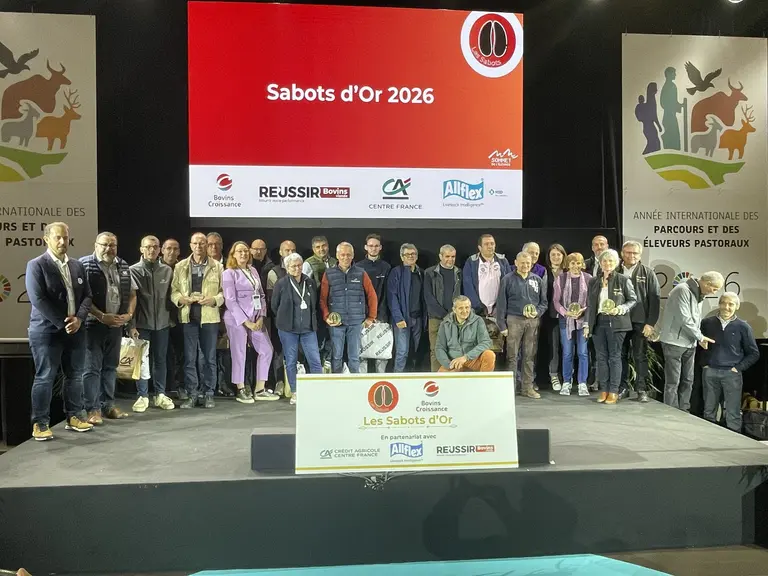
In 2026, for its 35th edition, the Sabots d’Or trophies were awarded for eight beef cattle breeds. The winners were selected from among ? farms eligible to compete. For each farm, a score is calculated based on IVMAT, ISEVR, weight at standard age at 210 days, calving interval and calf mortality rate. This year, a bonus was added for farms larger than the breed average, to take into account the fact that maintaining an average across a large herd is more difficult. This score is then compared with the breed averages and standard deviation, and with the score the farm had achieved in year N-4, to establish the final ranking. The competition therefore aims to reward not only performance, but also farms’ progress.
The Sabots d’Or are organized by Eliance and Réussir Bovins Viande in partnership with Allflex MSD, and the financial support of Crédit Agricole Centre France.
Golden Hoof Aubrac: Daniel Elcher (Cantal) and Bernard Boyer of Conseil Bovins Viande Cantal
Daniel Elcher calves 70 cows from January to April, managed with 60 % purebred and 40 % Charolais crossbreeding, and sells store cattle. The use of AI has returned to a high level over the last two campaigns. In the early 2000s, the farm owned the bull Napoléon from the Lacroix farm, which was indexed at the top level of the breed for ALait. Even today, the calves are heavy without supplementary feeding. The average calving interval is below the breed average over the last three years (it was 364, 366 and 374 days). The calf mortality rate was 0 % in 2025. Bulls for the farm are purchased directly from farms, selecting males whose offspring have calving ease and strong suckling capacity. In principle, heat synchronization is practiced on around twenty cows before spring. Daniel Elcher is regularly ranked among the top three in the Golden Hoof standings and has already won the trophy.among the top three in the Golden Hoof standings and has already won the trophy.
Read also: Golden Hoof 2022 in the Aubrac breed: steady genetic progress
Golden Hoof Blonde d’Aquitaine: Gaec Villeneuve: Damien Belleannée, Mathieu Bazantay, Julien Bourasseau, and Samuel Bellannée (Deux-Sèvres) and Fabrice Pottier of Bovins Croissance Sèvres Vendée Conseils
This is the second time the farm has taken first place in the Golden Hoof competition. With four partners and four employees, the Gaec raises 450 registered cows, runs an Anjou geese operation, and operates a farmers’ shop. It is one of the largest registered herds of the breed. The goal is to have easy-to-manage cows, with 90 % of calvings now taking place without assistance. The nine bulls are selected first for their calving ease indices and abilities. First-calving cows that do not produce enough milk are systematically culled. In 2025, the average IVMAT based on maternal ancestry was 101,7, and that based on paternal ancestry was 105,3. Health management is paramount. Calvings take place throughout the year, with two busier periods: July to October and January to March. The breeders sell 2 or 3 breeding males per year and fatten young cattle.for meat.
Read also: Golden Hoof 2021 in the Blonde d'Aquitaine breed: Genealogy at the heart of farming at Gaec Villeneuve
Golden Hoof Charolais: Didier Erieau (Vendée) and Kevin L’Hermite of Bovins Croissance Sèvres Vendée Conseils
Didier Erieau raises 70 registered cows, with 60-70 % managed through insemination. A member of Bovins croissance since 195, he first worked on weaning weights, then on maternal traits. For the past few years, attention has also been paid to muscular development. Calvings are organized into two periods, with first calving at 30 months. At the same time, for about 15 years, the farmer has chosen polled lines. Heifers have been genotyped for 4 years to better manage females carrying the double-muscling gene. The average IVMAT based on maternal ancestry was 105,5 in 2025, and the figure based on paternal ancestry was 114,9.
Some of the cows are sold through the Label Rouge production sector. Four to 5 males are sold as breeding animals each year, while the others are finished as young cattle.
Read also: Sabot d’or 2024 in the Charolais breed: “My system is based on intensifying animal performance”
Sabot d'or Gasconne des Pyrénées: Evelyne Esteveny (Tarn) and Elodie Bruneau of the Maison de l’élevage du Tarn - OBC 81 (*)
The herd of 43 breeding females was established in 1993, with a constant focus on maternal traits, docility and hardiness. It is managed primarily through AI, notably using the bulls Vengeur, Essentiel and Galion, which produced uniform, high-quality offspring: a pronounced dual-purpose profile, with potential for breeding and meat-producing qualities. Calf care and nursing are given close attention. The calving interval (IVV) in 2024-2025 was 373 days. A growing share of the females are sold for breeding, while the males are reared as veaux d’Aveyron. Several Sabots d’or and Sabots d’argent awards have marked Evelyne Esteveny’s career. In 2026, her son David’s arrival on the farm opens a new chapter for its future.
Stay up to date in real time!
Follow topics, legislative proposals, companies and public figures to get notified whenever we publish an article.
(*) represented by a colleague on the day of the awards ceremony
Read also: Sabot d'or 2023 in the Gasconne des Pyrénées breed: “I manage my Gasconne des Pyrénées cows with 100% AI and an outdoor system”
Sabot d'or Limousine: Gaec Murat père et fils (Cantal) and François Martin of Conseil Bovins Viande Cantal
Alain and his son Sylvain Murat calve 160 cows and sell heavier weanlings, around twenty breeding animals and cull cows. The herd, established in 2002, shows good reproductive performance and calf survival. Around 20% of the breeding females are inseminated using IPE. The breeders also initiated the creation of a GIE to purchase top-quality bulls. The male line has made great progress. The average ISEVR of the bulls used in the latest campaign is 104 and the IVMAT is 106,7. Health, feeding and housing receive just as much attention as genetics. This is the third time the Gaec has received the Sabot d'or.
Read also: Limousine: “A Sabots d'Or award winner who calculates everything”
Sabot d'or Parthenaise: Gaec Babin: Patricia, Lylian and Antoine Babin (Deux-Sèvres) and Patrice Bodin of Bovins Croissance Sèvres Vendée
Gaec Babin raises 160 registered cows and sells weanlings, cull cows and around ten breeding males per year. The three partners have scheduled calving over a three-month period starting in August. All the cows are inseminated by the breeder. The aim is to select for maternal qualities (IFNais and Avel), fine bone and fine meat. In 2025, the calf mortality rate was 4% and the calving interval (IVV) was 364 days. The average IVMAT based on maternal ancestry was 104,6 in 2025, and that based on paternal ancestry was 113. This Sabot d'or was dedicated to the genetic work of the breeders’ parents and grandparents. It is the culmination of their work on health and genetics.
Read also: Golden Hoof 2025 in the Parthenaise breed: “I am very rigorous in managing the herd”
Golden Hoof for Rouge des Prés: Nicolas Arthus (Maine-et-Loire) and Alexis Kupperroth of Seenovia
In organic farming, Nicolas Arthus raises Rouge des Prés cattle, with 65 calvings in a cow-calf and beef-fattening system. He runs a productive, robust and simple system. The calving interval was 362 days in 2025, with a first calving at thirty months and standard-age weights of 318 kg for males and 301 kg for females. Around 20% of the calves are from AI. One of his bulls, Album, born in 2025, is used for AI. The farm had received a first Golden Hoof award when his father was in charge, and a second shortly after he set up in 2007. This award confirms his work and has been a recurring achievement since the farm was established in 1926.
Read also: Red meadow golden hoof: a passion passed down through generations, brought to fruition
Salers Golden Hoof: Gaec Alban and Samuel Crèvecoeur (Seine-Maritime) and Maxence Berteaux of Littoral Normand
This is the fifth time the Gaec has received the Golden Hoof since 2010, not counting the times it came out on top but was ineligible for the award (a herd is ineligible for the three years following its title). The herd was established from 1972. The 150 cows calve at two years old. Around fifty females are sold for breeding, along with a few males—five of them have already been distributed for AI. The others are fattened as young cattle and yield 445 kgC at 16 months. Cull cows reach 500 kgC at 2025. The aim is to achieve weight gain during fattening, and the animals will not be made any larger. The polled gene was introduced from 2012, and today one-third of the calves are born polled. The farm aims to maximize EBITDA. In the 2024-2025 campaign, it produced 111 734 kg of meat, or 674,20 kgVV/UGB.
Read also: Golden hoof 2024 in the Salers breed: “breeding and growth are my two main objectives”