In Switzerland, STEV-Motion’s autonomous Vineatrac tracked vehiclesSTEV-Motion have been running spraying operations routinely since 2023. And the solution is expected to gain new momentum following the partnership with Jaquerod et fils, in Ollon, the Swiss distributor of Rotair machines. "Finding personnel to operate sprayers on steep slopes is becoming increasingly difficult, observes Frédéric Jaquerod, and nothing guarantees this will still be permitted in the future. We wish to take the lead. "Thus, the two companies worked together to integrate STEV-Motion’s autonomous operation system, previously installed only on custom-built machines, into series-production machines.
The first autonomous Rotair R70.3 D13 tracked vehicle, equipped with its Jaquerod sprayer, completed spring tests and began demonstrations this summer. "Making it move forward, backward, or turn is easy, so to speak. But achieving a stable and linear motion is more complicated, remarks the dealer. For example, it tended to sway at the tipping point when entering a slope, causing us problems. This issue has now been resolved and the machine is fully ready. "
An inertial measurement unit (IMU) for navigation on slopes
Regarding guidance, the tracked vehicle benefits from the technology used on Vineatrac machines, developed since 2018 and already extensively proven with several STEV-Motion customers. The system relies on two centimeter-accurate GPS RTK antennas, providing the machine’s position and orientation to within one degree. These are coupled with an inertial measurement unit (IMU), which precisely measures inclination—useful on side slopes and during U-turns on slopes. "I opted for a minimalist approach to guidance equipment for greater reliability, comments Marc Stevenin, founder of STEV-Motion. In vineyards, components are subjected to harsh conditions. A Lidar sensor completes the safety suite and enables detection of abnormal presence in the machine’s environment.
During acquisition of the controller, plots must be surveyed using a surveying rod. The device then learns its trajectory. "It knows how to execute a standard U-turn, but everything is configurable: if there is a wall or a pole at a specific location, a custom maneuver can be defined", clarifies the engineer. Once the machine is configured, it only needs to be placed in the plot, the task and route selected (even rows, odd rows, all rows, etc.), and operation launched. The machine knows which engine speed to adopt to support spraying, which hydraulic flow rate is required for traction, and when to open and close the nozzles to complete the operation.
No internet connection or subscription is required.
All data is stored in an onboard enclosure—the system’s sole electronic component. There is no 4G communication, no cloud, and no smartphone app to monitor machine statistics.The remote control operates via radio communication. "Thus, there is no need to consider network coverage or cybersecurity. Simplicity is again a deliberate choice—the primary goal is a functional tool."
Stay informed in real time!
Follow topics, legislative projects, companies, and personalities to receive notifications as soon as we publish an article.
On the machine side, most components of the Rotair tracked vehicle are retained; some undergo minor modifications to accommodate automation—primarily adding solenoid valves to the hydraulic circuit. For example, the pump is replaced with a Hansa model featuring dual electric and mechanical control. The same applies to the valve block managing tool movements. "These dual controls allow the machine to be operated either manually, using joystick control, or in automatic mode”, says Frédéric Jaquerod. The tracked vehicle can therefore be operated in three driving modes: a standard, non-automated mode, like any conventional tracked vehicle; a remote-control mode, remote-controlled, and a fully autonomous.
The machine can be used with other tools, such as a mower
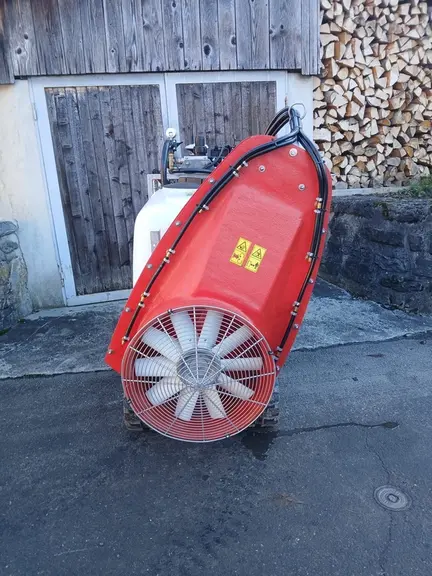
Regarding the sprayer, the basic setup includes a air-blast sprayerJaquerod with a 500-millimeter turbine, a 175-liter tank and, optionally, the turret mounted on a cylinder to adjust the angle to the slope of the terraces. However, any sprayer of a similar size can be fitted, since the tracked vehicle can accommodate all standard equipment, just like a normal Rotair machine. The machine’s versatility is another advantage. “It can also be used independently for tasks other than spraying: mowing, the grinding, the soil cultivation… only trimming and pre-pruning are activities we advise against,” explains Frédéric Jaquerod.
Now that the approval has passed and the CE standard acquired, the autonomous Rotair R70.3 D13 model enters the marketing phase with the company Jaquerod. One unit has already been ordered for Switzerland, and another for the Champagne-based dealer PMH industrie, with track widths of 68 cm. As for the price, expect almost double the price of the basic model, or nearly 65 000 euros excluding VAT. “The additional cost is due to the development of the technology and the extra parts, explains Frédéric Jaquerod. Perhaps in the future it could be reduced if Rotair agrees to fit these parts directly at the factory.” The dealer is not ruling out tackling other models from the Italian brand later on, such as the recent R70.4 with 44 horsepower. The Vineatrac models from STEV-Motion, for their part, will only continue to be produced for very specific requests that the Rotair model cannot meet.
Pros
Cons
technical data sheet
Find the other articles in our feature on spraying robots:
here
here