
Cereals
Cereal and oilseed markets remain marked by significant geopolitical and trade uncertainty. The war between Russia and Ukraine continues to intensify, with attacks on port and logistics infrastructure hindering exports from the Black Sea. However, abundant global cereal supplies and the redirection of demand to other origins have so far limited price increases.
Meanwhile, the US and China have extended their trade truce until January 2027, although they have yet to reach a final agreement. China is maintaining its commitments to purchase US soybeans, but questions remain about the volumes it will actually buy and how tariffs will evolve. The strength of the dollar, uncertainty over interest rates, and oil price volatility due to the conflict in the Middle East are additional factors that continue to shape agricultural markets and fund activity.

In Europe, particular concern surrounds the availability of raw materials for animal feed following a decline in EU maize production and an increase in import requirements. Added to this is uncertainty over the application of the EUDR regulation in 2027, which is making it difficult to obtain price quotes for soybean meal for next year and could increase procurement costs. All this is taking place in a market still watching the weather, winter sowings, and the evolution of global demand.
The USDA inventory report of September 30 surprised the market with US corn stocks of 53,2 Mt, 35% higher than in 2025 and above expectations, triggering heavy fund selling and pushing December Chicago corn below 500 c/bu. Soybean stocks stood at 8,6 Mt, 3% lower than the previous year and in line with expectations. As for wheat, stocks reached 50,3 Mt, 14% lower than in 2025, while US production remained practically unchanged at 41,7 Mt, slightly above expectations.
Table 1. USDA report, September 30 2026.
| USDA inventories (billion bushels) | |||
|---|---|---|---|
| USDA September 2026 | Average estimate | USDA September 2025 | |
| Corn | 2.095 | 1.918 | 1.551 |
| Soybeans | 0.315 | 0.324 | 0.325 |
| Wheat | 1.846 | 1.889 | 2.134 |
| U.S. wheat production 26/27 (billions of bushels) | |||
|---|---|---|---|
| USDA September 2026 | Average estimate | USDA August 2026 | |
| Total wheat | 1.534 | 1.524 | 1.531 |
| Winter wheat | 1.019 | 0.988 | 0.990 |
| HRW wheat | 0.466 | 0.462 | 0.463 |
| SRW wheat | 0.294 | 0.288 | 0.287 |
| Soft wheat | 0.259 | 0.239 | 0.240 |
| Spring wheat | 0.450 | 0.471 | 0.474 |
| Durum wheat | 0.065 | 0.066 | 0.066 |
Brent has been highly volatile over the past month, moving from 94,65 usd/barrel to a high of 108,75 usd/barrel, before correcting yesterday at the close to 100,20 usd/barrel. Prices remain influenced by the conflict between the US and Iran and the closure of the Strait of Hormuz, although indirect negotiations between the two countries have helped reduce some of the risk premium. Other factors include OPEC+'s decision to keep production unchanged in November, the planned release of strategic reserves, and the partial recovery of the Saudi pipeline to the Red Sea. The market will remain focused on a possible agreement between Washington and Tehran, as any diplomatic progress or further military escalation could trigger sharp price swings.
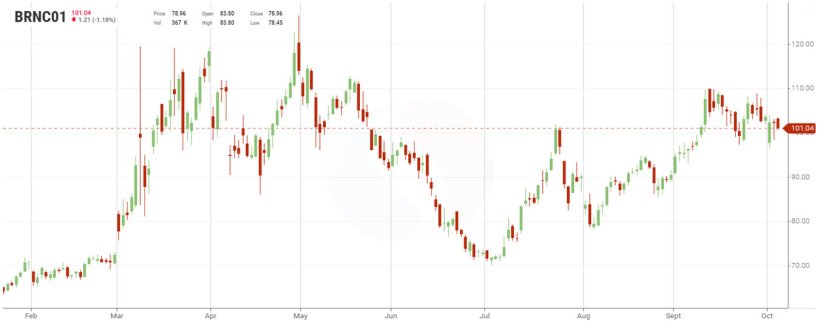 Chart 1. Brent price trends (source: sitagri)
This month, the BDI has risen to 3.148 points, well above its five-year average. Despite this increase, agricultural freight rates remain stable, with no significant changes. The situation in the Black Sea continues to make freight rate quotations from Ukraine more difficult. Meanwhile, vessel traffic through the Panama Canal is beginning to decline due to the arrival of El Niño and falling water levels, which could create further pressure on maritime transport costs.
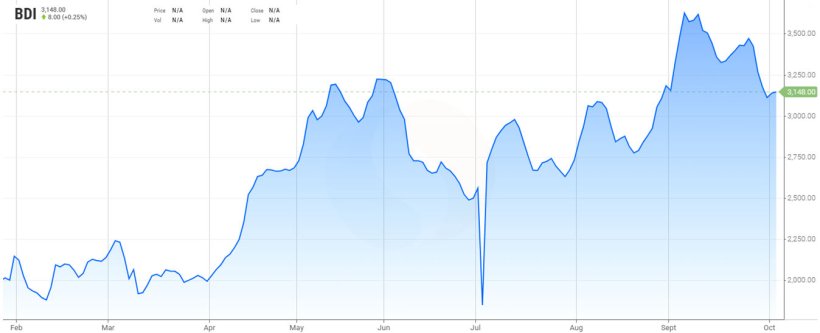 Chart 2. Baltic Dry Index trends, the maritime freight index (source: https://es.tradingeconomics.com/commodity/baltic).
Weather will remain a key factor for agricultural markets. In the US, around ten more days of drier, warmer weather are expected, allowing the corn and soybean harvests to accelerate, while Canada will also initially remain dry. In Europe, rain will arrive from the west, with heavy precipitation in some parts of Spain, while eastern Europe, Ukraine and Russia will remain dry, complicating winter cereal sowing. In Brazil, abundant rainfall will persist in the south and moisture conditions will improve in central regions, although temperatures will remain high. Finally, Australia will receive rain towards the weekend, while South Africa will remain dry, with temperatures rising.
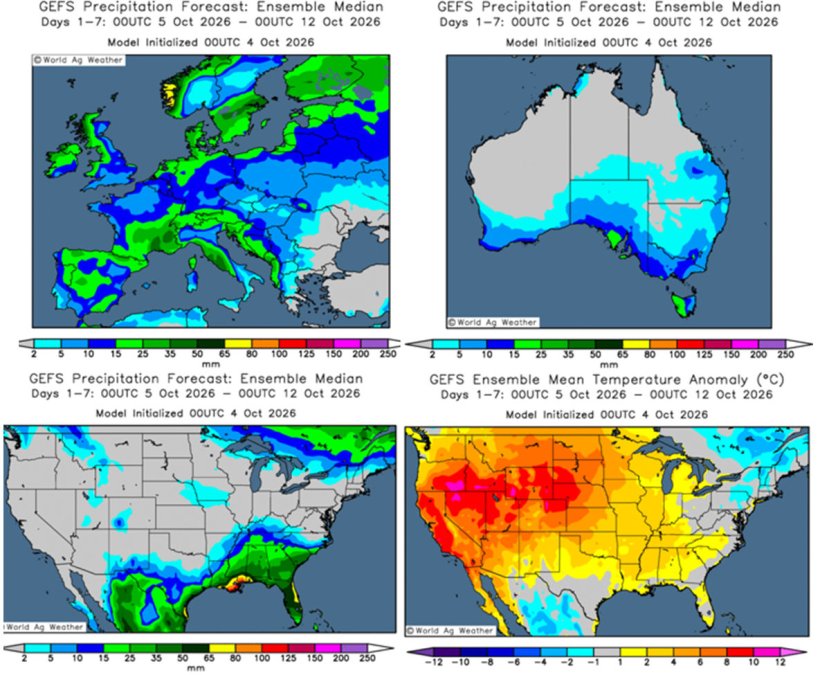 Weather forecast for the Southern Hemisphere and Europe (source: Grads/Cola)
In the September report, the USDA (Table 2), for the 2026/27 season, revised world wheat production upwards by 3,1 Mt to 822,4 Mt, 21,6 Mt less than a year earlier, mainly due to the recovery in production in Australia (+3Mt), Canada (+1Mt), Ukraine (+600 thousand t) and Argentina (+500 thousand t), while production fell in Kazakhstan (-1Mt), Russia (-500 thousand t) and the EU (-400 thousand t).
World corn production for 2026/27 falls sharply by 7,9 Mt to 1291 Mt (39,9 Mt below the previous season) due to lower production in the US (-5,4Mt), India (-2Mt) and Russia (-700 thousand t), while it rises in the EU (+400 thousand t). Imports remain stable at 23,5 Mt in the EU and 5 Mt in China, the world's third-largest importer, behind Mexico and the EU.
Table 2. USDA September forecast 2026 for cereal production and change from the August forecast 2026 (Mt).
| 2025/2026 | 2026/2027 | |||
|---|---|---|---|---|
| World Production (Mt) | ||||
| Wheat | 844,0 | 0,6 | 822,4 | 3,1 |
| Corn | 1330,8 | 0,9 | 1291,0 | 7,9 |
| European Production (Mt) | ||||
| Wheat | 157,1 | 0,0 | 145,8 | 0,4 |
| Corn | 56,8 | 0,0 | 50,6 | 0,4 |
According to the USDA, in 2025/26, global wheat production increases by 600 thousand t to 844 Mt, 44,9 Mt above 24/25, due to an increase in Canada (+600 thousand t), and global maize production increases by 900 thousand t to 1330,8 Mt, 95,8 Mt more year on year, with increased production in Brazil (+1Mt). We note that EU imports are revised upwards by 500 thousand t to 19 Mt, while those of China remain at 4 Mt.
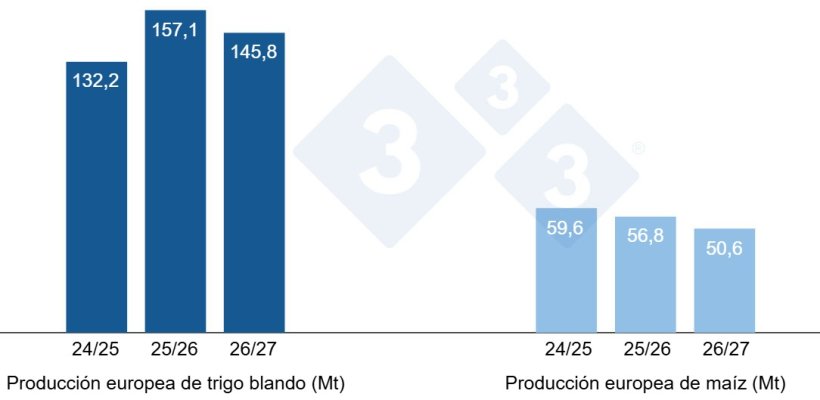 Chart 3. Forecast for the European harvest of soft wheat and maize (source: USDA).
According to chart 4, for the 2026/27 marketing year, the European Commission reduces its forecast for soft wheat production by 0,2 Mt compared with July, to 124,2 Mt (11,1 Mt less than in 2025/26), and its forecast for maize by 3,6 Mt, to 48,3 Mt (11,9 Mt less than in 2025/26). By contrast, it increases its forecast for barley by 2,6 Mt, to 53,6 Mt, although this figure is still 2 Mt below that of the previous marketing year.
For the 2025/26 marketing year, soft wheat production remains at 135,3 Mt (24,3 Mt above that of 24/25), maize production at 60,2 Mt (1 Mt above a year ago), and barley production at 55,6 Mt (6,9 Mt above 24/25).
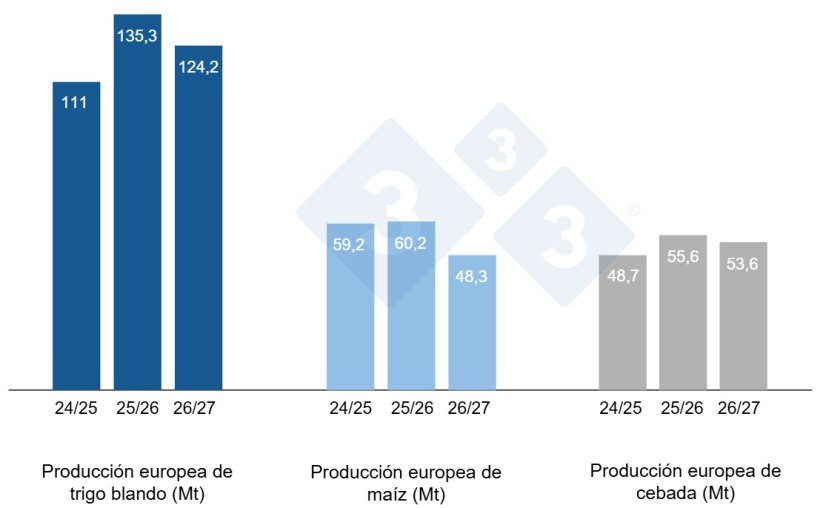 Chart 4. European Commission forecasts for soft wheat, maize and barley (source: European Commission).
Looking at price differentials, corn is at around 246 €/t (2 euros above early August levels) for nearby delivery at the port of Tarragona; wheat is at around 250 €/t for nearby delivery at the port of Tarragona (8 euros above its early August level and 4 euros above the corn price). Barley delivered to Lleida is at around 245 €/t (15 euros more than in early August and 13 euros below the price of corn delivered to Lleida). Cereal prices are correcting upwards despite the correction in futures, due to farmers holding back sales and the weakness of the euro against the dollar, alongside the volatility that geopolitics continues to bring to our markets and the lack of new information at the 24 September meeting between Xi and Trump on potential new Chinese agricultural purchases.
The price of domestic wheat is 10 euros above the port price, at 260 €/t, at the same level as French wheat. Domestic corn is 12 euros above the port price, at 258 €/t, with no French corn offered.
Oilseeds
The price of soybean meal has gained 70 €/t to 440 €/t compared with early August, following futures, with a weaker euro and concerns about the implementation of the EUDR on 31 December. Sunflower meal is up 43 €/t to 335 €/t, following the rise in soybean meal, alongside low market activity and concerns about availability due to the situation in the Black Sea. Rapeseed meal, priced at 45 €/t, is up to 330 €/t, following the broad-based rise across the oilseeds complex, although with less concern and less supply tightness in this market.
During August and September, the price of soybean oil rose 75 €/t to 1226 €/t, with oil supporting vegetable oils and the latest NOPA report providing some price support amid tight US inventories. The price of palm oil rose 10 €/t to 1140 €/t, with the risk posed by El Niño. Animal fat rose 60 €/t to 1165 €/t, with somewhat stronger market demand and limited availability.
Euro/dollar exchange rate
Over the past month, the euro has depreciated against the dollar (chart 5).
The euro-dollar depreciated by 3,6%, standing at 1,1177 over the past month, pressured by the strengthening dollar, rising interest rates and US bond yields, which have increased the appeal of dollar-denominated assets. In Europe, weak economic growth, doubts about further ECB rate hikes, and political and budgetary uncertainty in France and Germany have weighed on the currency. In addition, tensions in the Middle East and rising oil prices have strengthened the dollar as a safe-haven asset.
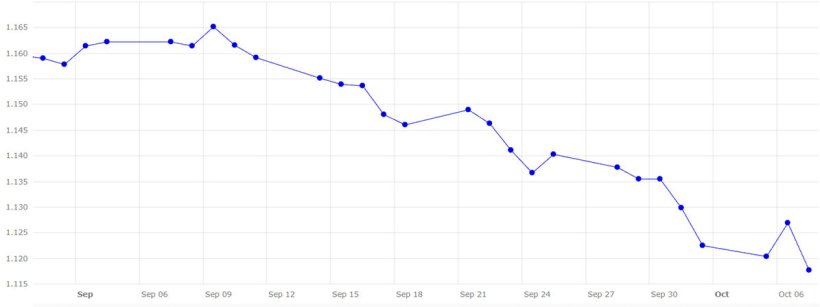 Chart 5. Euro/dollar exchange rate movements in September and early October (source: European Central Bank).
Over the next month, we will need to closely monitor the conflicts in the Middle East and Russia-Ukraine, their impact on oil and Black Sea flows, as well as the euro-dollar exchange rate and the Fed and ECB interest rate decisions. In the agricultural market, we will be watching the upcoming USDA and CONAB reports, crop progress in the US, winter planting in Europe, and the weather in South America, with the possible arrival of El Niño. China’s agricultural purchases from the US, fund activity and trade tensions will also be key, together with the impact of the EUDR regulation and the availability of Ukrainian corn.