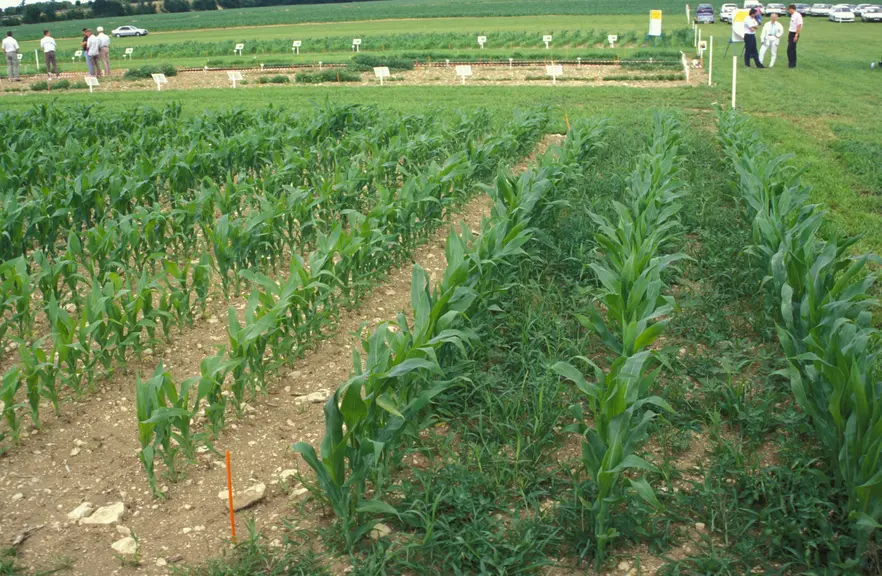
A new “fast and powerful” herbicide for corn
With the herbicide Botiga (= Bavadi, Diva Extra, Sansa), Certis Belchim makes available to corn growerscorn a post-emergence solution, “designed to meet current weed control challenges: speed of action, a high level of efficacy on a broad range of weeds, and consistent results, even under demanding application conditions,” the company says. Botiga consists of two active substances, mesotrione (90 g/l) and pyridate (300 g/l), at an approved application rate of 1 l/ha. According to Certis Belchim, these two molecules have a synergistic effect, giving the herbicide rapid and persistent action, as well as consistent performance by limiting the impact of weather conditions, and a very broad spectrum of control against most dicotyledonous weeds and summer grasses harmful to corn. The product’s oil-based adjuvanted (OD) formulation improves the spreading and retention of herbicide spray droplets on the weed, which promotes contact and penetration of the active substances. The product will be marketed from the 2026-2027 season in 5-litre containers.
Read also | Corn: how to manage an increasingly severe black-grass pressure?
Minecto Gold reauthorized against winter flea beetle larvae... and adults
A derogation marketing authorization for 120 days has been granted for the use of the insecticide Minecto Gold (Syngenta, from 25 September 2026 to 23 January 2027 on oilseed rape. As with the previous campaign, exemption covers the entire territory, under the same conditions of use: control of flea beetle in winter, a single application at the maximum rate of 100 g/ha from the “6 leaves” stage of oilseed rape (BBCH16); a Berlèse test must be carried out beforehand. This derogation was subsequently extended to allow use against adult flea beetles and to permit the use of Minecto Gold twice during the season, against adult winter flea beetles and the larvae of the same pest.
Read also | Oilseed rape insecticide: how to achieve the best possible efficacy with Minecto Gold against flea beetles?
Stay up to date in real time!
Follow topics, legislative projects, companies, and public figures to be notified as soon as we publish an article.
New Saatbau maize varieties for next spring
The Austrian company Saatbau offers a new variety of corn grain. Early hybrid (group G1), Gardamo is characterized by good early vigor and consistent ear production. The company already offers varieties in other maturity groups: Antaro (G2), Combrezzo (G3) and Immezo (G4), which confirm their good potential and consistency. The seed company has a stronger presence in forage maize varieties, with many new products: Jamilo and Manolo in the mid-early group; Escando, Rodrigo, Academo and Farmico in the early group; Pueblo and Activo in the very early group. Saatbau also offers 15 organic maize varieties for forage and grain. Developed through breeding programmes conducted in a continental climate, Saatbau maize varieties stand out for their good early vigour and adaptability to water and heat stress. This robustness is sought after in the face of increasingly unpredictable summers. Saatbau currently develops more than 130 varieties.
Read also | Maize varieties: prioritize early maturity in the face of the risk of water shortages
Distribution agreement for an innovative biofungicide between Syngenta and Amoeba
The company Amoeba, specializing in the development of biocontrol products, and the group Syngenta have concluded an exclusive distribution agreement in Europe for a biofungicide usable on cereals. The product is based on an extract from an amoeba (Willaertia magna) and will target septoria and yellow rust, two major diseases of wheat. Once approved, the specialty of biocontrol will be marketed under a Syngenta brand. The first commercial registrations are expected in the third quarter of 2028. The first sales in the main EU markets are planned by the end of 2028, for use by farmers in the spring of 2029 on wheat, spelt and triticale.
Exemption for TS Lumisena on peas and winter faba beans
The commercial specialty Lumisena (Corteva Agriscience), effective seed treatment against the downy mildew, benefits from a derogation allowing use for 120 days for the 2026-2027 campaign on pois and faba bean in spring. Seeds treated with this product will be usable precisely between 15 October 2026 and 12 February 2027. The Lumisena product in TS targets primary downy mildew infections originating in the soil. This disease can cause significant plant losses and yield losses.Terres Inovia also submitted an application for a derogation of 120 days for peas and spring faba beans.