
The latest BRGM bulletin, dated October 1er, indicates that the groundwater situation remains mostly very poor, linked to the effective rainfall deficit in September, with 66 % of monitoring points whose levels are below the monthly averages. Recharge has only begun at 7 % of monitoring points, implying a decline in levels compared with the averages, which remain current. 81% of groundwater levels are falling.
To review: Groundwater: 61% of levels below monthly norms
An overall deteriorated and mixed situation
The groundwater level is deteriorated across most of the country, with the exception of the southeast as is the case for the aquifers of Vistrenque or Valras-Agde. It is very low for the aquifers of Limousin, Morvan, Livradois, Forez and Vivarais, Champagne, Jura, Vosges, Lorraine and the northern Alsace plain.
Read also: Drought: the Grand Est region calls for “a massive European plan to safeguard and secure the future of agriculture”
A situation dependent on the return of precipitation
The BRGM explains that the very degraded situation of reactive aquifers will depend on the return of precipitation, forecast from October. However, there is uncertainty regarding the distribution and effectiveness of autumn rainfall that would help rehumidify the soils. The reduction in withdrawals from groundwater to meet the needs of the various summer uses (irrigation, drinking water supply) will make it possible to put less strain on groundwater resources.
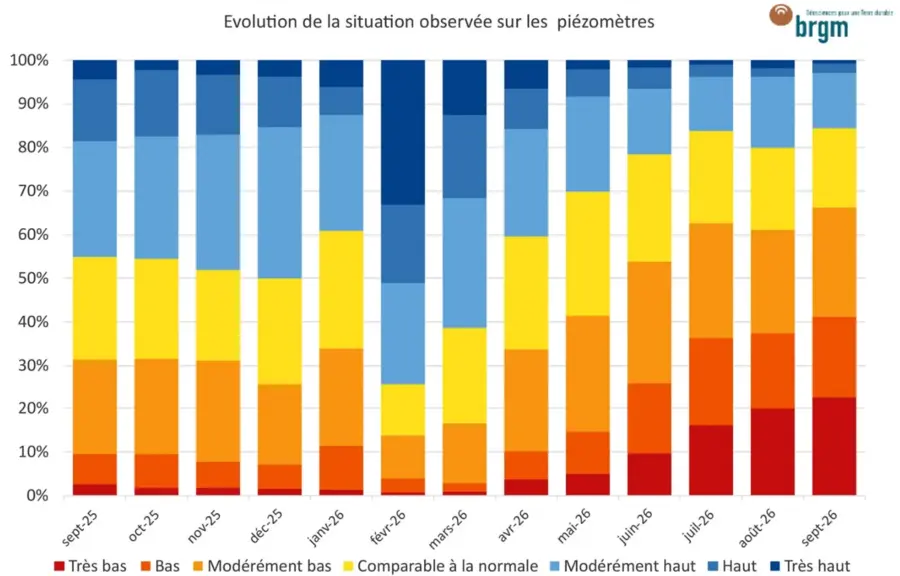
Inertial aquifers: a downward trend until the end of autumn
According to the BRGM, the levels of inertial aquifers are determined by the levels reached during the previous low-water period, as well as by the cumulative effective precipitation over the entire recharge period. With levels already declining, they will continue to show a downward trend until the end of autumn. However, projections for autumn 2026 remain uncertain. “Groundwater levels will necessarily be lower than those observed in 2025, due to more moderate recharge in 2025-2026 but above all because of the deficit in effective rainfall observed since May” says the BRGM.
Stay up to date in real time!
Follow topics, legislative projects, companies and public figures to be notified as soon as we publish an article.
Read also: Drought: livestock farmers await answers from the Minister of Agriculture at the Livestock Summit
For reactive aquifers with surplus levels, the outlook is favorable
The effective precipitation deficit recorded in September led to a continued drainage of the responsive aquifers. As for aquifers with above-average levels, ranging from moderately high to high, seasonal forecasts remain favorable. For the other aquifers, whose levels are around or below normal, uncertainty remains.
Read also: Faced with the historic drought, livestock farmers are calling for swift and proportionate measures
The situation remains concerning for highly responsive aquifers
“Everything will depend on autumn rainfall. The medium-term outlook will depend heavily on the return of rainfall on a structural basis to make up the deficits. While above-average rainfall will be needed this winter to return to levels around normal, sustained rainy spells could at least quickly reverse the downward trends currently observed” says the BRGM.
Aquifers with high responsivenessaquifers with high responsiveness are sensitive to a prolonged and intense drought. This is the case for the aquifers of Limousin, Morvan, Livradois, Forez and Vivarais, the Jura and the northern Alsace plain, for which the situation is concerning.
Read also: Drought and heat waves: the Hauts-de-France Region approves a funding package of 2 million euros for farmers