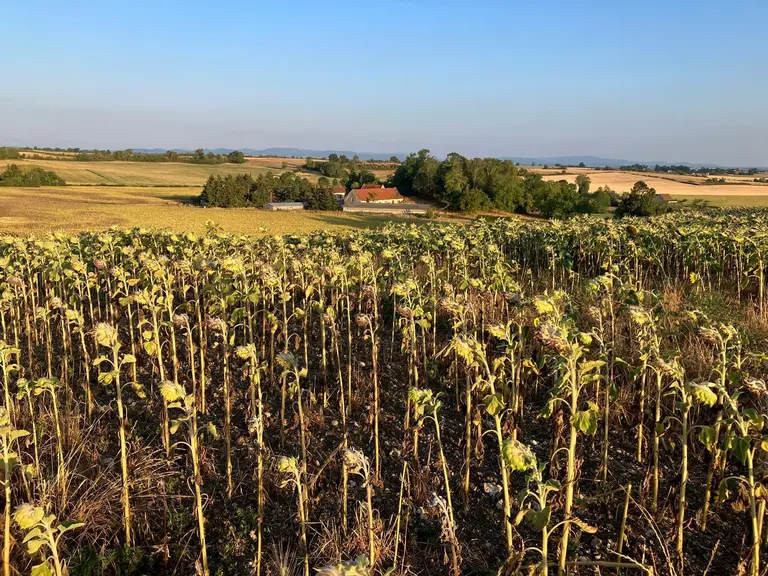
Prices for grains organic and oilseeds organic have generally followed an upward trend over the past fifteen days. Only organic rapeseed meal and organic sunflower meal recorded a price decline, explained by the change in harvest: stocks left over from the previous season have been replaced by new volumes produced from this year’s oilseeds.
Read also | Organic animal nutrition: compound feed production could rise again
High-quality French organic milling wheat holds its own
The average price of organic milling wheat on the French physical market continued to rise over the past two weeks.
Read also | Organic market: in France, milling soft wheat prices rose from one season to the next
On the one hand, the French harvest 2026, although slightly lower in volume than last year, has good protein content, with exportable supply available. On the other hand, Germany is looking for organic milling wheat with protein levels between 11 % and 11,5 %, which it cannot find domestically or even abroad. Some batches of imported wheat from Eastern Europe, heat-damaged and/or insect-infested, consequently have weak baking strength* (below 90), insufficient for breadmaking. In this context, German millers are prepared to raise their price offers to obtain good organic breadmaking wheat, from €350-365/t previously to €380-390/t.
Organic feed wheat is in high demand
Organic milling wheat is also following the firming trend in organic feed wheat, for which available volumes are lower than for organic milling wheat on the French market and prices are supported by strong demand from Scandinavia, where buyers are paying high prices.
Read also | Organic market: shortages of feed straw cereals in France are driving prices up and prompting imports
Amid a nationwide shortage of organic maize, animal feed manufacturers are importing organic feed wheat, mainly from Eastern European countries (Romania, Poland and Ukraine) but also ofItaly.
It should be noted that high-protein wheat with 13 % protein from Kazakhstan arrives by coaster vessels at Dutch ports via the Baltic countries.
Imports of organic maize continue
The average price of organic maize The new crop has also gained ground since September 23 on the French physical market, with the harvest generally confirmed as catastrophic. Old-crop maize is no longer quoted due to a lack of availability for sale.
At the moment, Italian organic maize is the cheapest, at prices of around €370/t on the domestic market, compared with €420-430/t in Germany, or even €420-450/t in France (or €400/t for clearance).
To make up for the limited availability of French feed wheat and maize, animal feed manufacturers in northern and eastern France are buying Ukrainian, Romanian and Polish maize, which is transported by truck via the Baltic countries.
It should be noted that in Poland, the first part of the harvest is better than expected, unlike the initial harvest results in France and southern Germany, which are poor.
The price of organic feed barley is unlikely to increase much.
The average price of theorganic feed barley has stabilized on the French spot market over the past fifteen days. The domestic harvest—although slightly lower than last year—is satisfactory and more abundant than organic feed wheat and organic triticale. Prices are unlikely to fall much, or at least to rise much, because lots oforganic malting barley are being downgraded to feed quality due to the lack of demand from maltsters, affected by a sluggish beer market.
Stay up to date in real time!
Follow topics, legislative projects, companies, and public figures to be notified as soon as we publish an article.
The average price of organic triticale has not changed on the French physical market. It complements organic feed wheat in animal feed formulations. This is unlike organic oats that enters animal feed in small quantities.
If the harvest is good in organic spelt this year, the collection in organic einkorn is poor. Its prices are very firm and soar with the wind.
Organic sunflower and organic soybean production is in free fall
The average price of the organic rapeseed seed and, to a lesser extent, organic sunflower seed rose on the French spot market over the past two weeks. That of organic soybean seed stagnated. All this, amid a shortage of oilseeds.
In France, organic sunflower and soybean production is expected to decline by around 40 % year on year. The farmers and the grain storage organizations are waiting to get a clear picture of the available volumes and quality before committing to a market where buyers are cautious. Buyers are more or less interested depending on their level of coverage.
Imports of soybean seeds from Eastern Europe and Italy have been reported. Italy has brought in a very good harvest. In southern France, only irrigated crops managed to do well; dryland fields were devastated.
Organic rapeseed and sunflower meal prices down compared with the previous crop year
Initial prices for organic rapeseed meal and organic sunflower meal from the new harvest are below the remaining prices for the previous harvest, down by 10 €/t to 20 €/t for organic sunflower meal and by as much as 45 €/t to 50 €/t for organic rapeseed meal, which is more readily available.
Read also | Organic protein: animal feed manufacturers concerned about limited availability
The average price of organic soybean meal from the old crop has not changed. For the new crop, prices are still being established in a market with little buying or selling activity.
Only organic feed faba beans are used in animal nutrition
The average price of the organic feed faba bean in the French physical market has risen over the last fifteen days, while that of organic feed peas has not changed.
Organic feed faba bean prices are higher than those recorded during the previous marketing campaign, due to a lower volume collected year on year. The animal feed manufacturers do not have huge requirements over the October–December period.
Organic field peas are less available than organic feed faba beans, which explains why they are not included in manufacturers’ formulations.
In luzerne bio, we are experiencing a shortage, with imports at exorbitant prices.
Karine Floquet
* The baking strength, or W, of a flour determines the dough’s deformation properties and ability to retain gases during fermentation. A flour with a W below 150 will not be strong enough for breadmaking. It is better suited to pastry-making.