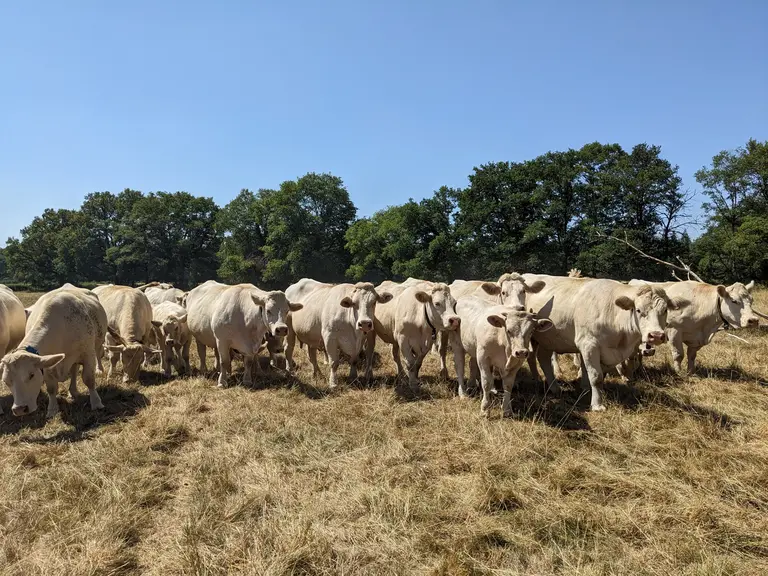
“Summer 2026 was marked by a significant rainfall deficit, with 40 % less precipitation on average across the country. In September, it was worse, with a deficit of 70 %”, said Caroline Monniot, an agricultural economist at the French Livestock Institute, during a conference at the Livestock Summit.
The drought and heatwaves had a major impact on grass growth. “Some regions, such as Bourgogne Franche-Comté, Centre Val-de-Loire and Grand-Est, were particularly hard hit. In the Charolais basin, on 20 September, the grass growth accounted for 50% of annual production, compared with an average of 88% at this time of year”, noted Christèle Pineau, project manager for the Institut de l’élevage.
Read also: Drought and heatwave dossier 2026
On many farms, cattle have been fed since the since the month of July, and the pasture was unable to recover in the autumn, affecting the forage stocks. The Inosys beef cattle team in the Charolais basin carried out simulations to try to assess the economic impacts of the forage deficit linked to the drought on the suckler cattle farms.
Simulations on two systems: cow-calf and cow-calf with finishing
They considered two types of farms (typical cases): Cow-calf with young cattle finishing (1 labour units, 140 ha of UAA, including 107 ha of grassland and 6 ha of silage maize, 80 calvings, from November to January, 370 kg liveweight/LSU of meat produced, 27 ha of arable crops, including 14 ha of cereals used on-farm), or cow-calf with sales of finished females (1,7 labour units, 165 ha of UAA, including 140 ha of grassland and 5 ha of silage maize, 110 calvings, from December to March, 339 kg liveweight/LSU of meat produced, 20 ha of cereals, including 10,5 ha used on-farm).
The two systems are usually self-sufficient in forage at 100 %, with 2,35 tDM of forage per LU for the breeding and finishing system, and 1,92 tDM of forage per LU for the breeding system.
Read also: Drought: “The priority for livestock farmers will be to keep the cows pregnant; we need calves!”
“We simulated the economic results for 2025 and 2026 without drought impacts, taking into account changes in selling prices and costs. We then looked at the impact of drought, considering different assumptions”, explained Christèle Pineau.
In 2025, the simulations for both systems show good economic efficiency, with an EBE of 121 237 € and an EBE/gross output ratio of 43% for the cow-calf-to-finish system, and an EBE of 170 060 € with an EBE/gross output ratio of 50 % for the cow-calf system with sales of finished females.
In 2026, without the impact of the drought, the economic efficiency of both systems would have remained good, despite a slight deterioration due to rising costs and falling prices this summer. The EBE of the cow-calf and finishing system would have been 125 696 € with an EBE/PB of 42%. The EBE of the cow-calf system would have been 143 265 € with an EBE/PB of 45%.
An assumed yield loss of 75% for maize, 20% for harvested grass
To assess the potential impacts of drought on economic results, the Inosys beef cattle team in the Charolais basin assumed a 75% reduction in yield for the silage maize, and 20% for harvested grass. It also assessed a feed supplementationsummer for 120 days, from July through October, followed by a 150-day winter, from early November to early April.
The advisors based their calculations on a maintenance ration composed of hay, straw and molasses, and based on a purchase price for forage of 160 €/t.
“In the simulations, we did not include the working time additional, nor the increase in mechanization costs for feeding and water distribution in the summer”, specified Claude Vincent, beef cattle advisor at the Indre Chamber of Agriculture.
The effect of drought and heatwaves on the zootechnical performance has also not been assessed, but could affect livestock farming for several years, with reduced fertility or abortions.
Stay up to date in real time!
Follow topics, legislative projects, companies, and individuals to be notified as soon as we publish an article.
In the simulations, EBITDA falls by nearly 50% in cow-calf systems
For the cow-calf system, with finished female animals sold, the winter forage deficit was estimated at 94 tDM. Only one scenario was simulated: purchasing the missing forage with early weaning of the calves. In this scenario, the additional cost associated with the drought is estimated at 400 €/LU. “In this situation, EBE falls by nearly 50% compared with a situation without drought; that’s considerable!”, warned Claude Vincent. EBITDA falls to 79 591 €, with an EBITDA/PB ratio of 25 %.
“In the suckler-to-finish system, the forage balance simulation shows a winter deficit of 73 tDM, Claude Vincent stated. We studied the impact of three different strategies on economic results: purchasing the missing forage while keeping the same management approach, purchasing forage to feed the breeding herd in summer, and switching to dry ration for young cattle and the cessation of fattening of males ”.
For the first two scenarios, the additional cost associated with drought is estimated at 310 and 319 €/LU, respectively. EBITDA falls, and EBITDA/Gross Output drops to 25%.
A risk of livestock capital depletion
The third scenario, with fattening stopped and the sale of weanlings postponed is even more impactful. The additional cost of purchasing forage for the breeding herd is 256 €/UGB. The loss in meat revenue is estimated at 195 €/UGB. EBITDA falls to 57 484 €, with an EBITDA/Gross Output ratio of 21%.
The simulations therefore still favor finishing, by purchasing the necessary forage, over selling weanlings.: “production still pays”, Claude Vincent summed up. However, the limited availability of forages and prices that can exceed 160 €/tDM can make it difficult to implement scenarios involving the purchase of forages.
Read also: “There will not be enough forages on the market for everyone”
“Decisions will be made based on the supply of forage and by-products available and on thefarms’ cash flow, says Christèle Pineau. Even if it is not yet visible in slaughterhouse figures, there is a risk of destocking herds, with more cull cows, and perhaps fewer young bulls for 2027 and subsequent years».
Find the conference slideshow on the website of the Livestock Institute