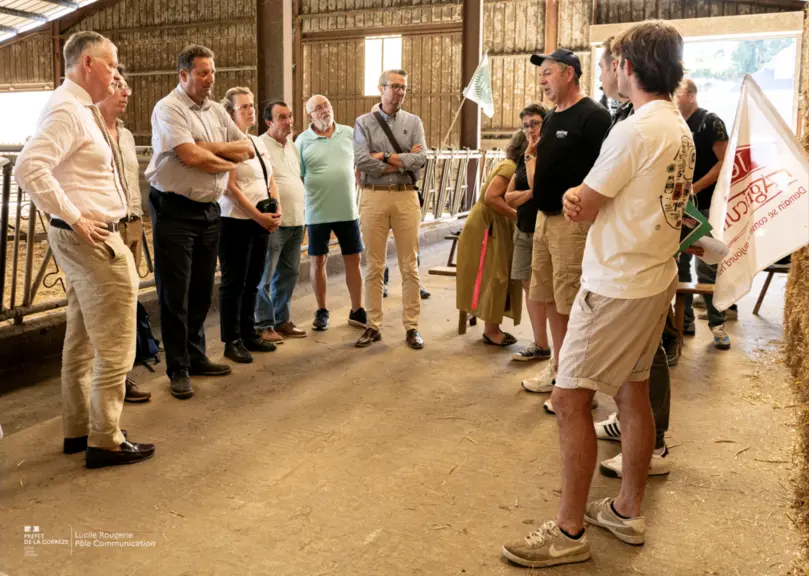
Present since the work of the departmental assessment unit (CDE), the FDSEA and JA continue to raise the alarm about the economic and structural consequences durable of this climatic episode exceptional.
Since spring, the water deficit and the high temperatures have profoundly disrupted the production cycles. The livestock farms were the first to be affected, with grass growth greatly reduced, forage yields declining and winter forage stocks begun sometimes as early as mid-summer.
For many livestock farmers, the consequence is immediate: the purchase of external forage becomes essential to ensure the feeding of the herd until next spring. These purchases represent several thousand euros in additional costs on farms whose cash flows are already fragile. But the drought did not only affect livestock farming. Market gardeners, arborists, corn producers or even nursery growers have also suffered lossessometimes significant. For several weeks, the industry representatives and the government services have therefore been working to document all the losses in order to enable access to compensation schemes.
Which productions are compensated?
To date, several productions have already received recognition for crop losses linked to the climatic event. These include, in particular: red berries, stone fruits, the field and market-garden vegetables (tomatoes, eggplants, cucumbers, peppers, green beans, carrots, parsnips, beets, ...), grain maize, silage maize. The file concerning maize has already been approved at the national level.
The DDT is now working on opening the online declaration procedure for online declaration, planned for the end of October or the beginning of November.
In addition, a supplementary file has been submitted for pome fruits, the kiwis, the tree nuts and the strawberry. A favorable decision is expected in the coming weeks. Other productions are still being assessed, notably the forest nurseries, the horticultural production as well as beekeeping.
Regarding the prairies, operators are now covered by the new insurance scheme introduced as part of the reform of climate risk management. Insured farmers should therefore contact their insurer while the uninsured must contact their authorized representative to review their compensation options.
CASI: livestock farming and market gardening are priorities
Given the urgency of the situation, the Prefect decided to mobilize a first tranche of the CASI plan by prioritizing the available resources for the sectors considered to be the most vulnerable – livestock farming and market gardening – which will share nearly 75% of the allocation. For livestock farms, several criteria have been selected to target farms that depend most heavily on grass and are most exposed to drought.
To qualify for the aid, farms must in particular:
• have at least 25 livestock units;
• have a ratio of forage area greater than 75 %;
• meet a minimum stocking thresholdthat varies by livestock-farming area;
• receive no more than two SMICs in non-agricultural income (RNA).
According to the estimates presented at the prefecture, 1 334 Corrèze farms would meet these criteria, with aid of around 8,61 € per livestock unit and a bonus of 50% for the Young Farmers and farms in the agri-accompagnement. Specifically, this would represent an average amount of around 1 049 € per farm. A simplified procedure to speed up payments The public authorities have set a clear objective: to distribute the aid as quickly as possible.
At this stage, potentially eligible operators do not need to take any action. The DDT will soon send each eligible farm a personalized letter specifying the amount of the aid. Then simply sign this document and return it to the government services. To secure the procedure and limit the risk of non-return, a reminder SMS will be sent a few days after the postal letter is sent. The files are expected to be returned within approximately three weeks, with a deadline set around 30 October, with the aim of enabling aid to be paid quickly and the entire available budget to be used.
Read also: Casi Plan: Finistère doubles its budget, unions refuse to sort beneficiaries in several departments
Specific support for market gardening
Market gardening will also benefit from a dedicated scheme. Applications will be processed in two stages : initially, farms identified via the CAP will receive a letter, following a process similar to that adopted for livestock farming. A more detailed second phase of work will then be carried out for market gardening farms that do not submit a CAP declaration. The eligibility threshold currently adopted corresponds to an area greater than 3 500 m² of market gardening. The aid will take the form of a fixed-rate grant, with several tiers defined according to the areas in use. The precise amounts still need to be refined.
“ The figures don’t add up! »
While the FDSEA and the JA welcome the mobilization of the State services, they nevertheless consider that the announced financial resources are disconnected from the needs of Corrèze producers. In a joint statement following the Prefect’s press conference presenting the Corrèze implementation of the CASI plan, the FDSEA and the JA recall the'scale of the consequences of the drought. Livestock farmers have already used up a large part of their winter forage stocks and now have to make additional purchases to feed their animals. These costs add to cash flows that are already severely strained. For both unions, the conclusion is clear:
"1,4 million euros, that's peanuts compared with the scale of the crisis and the needs of farms! » « Farmers don't need announcement effects, they need resources to get through this exceptional period », the FDSEA and JA emphasize.
The FDSEA and JA warn of the risk of a acceleration of herd destocking. With forage stocks already depleted and soaring costs due to the drought, some livestock farmers may be forced to reduce their herd sizes to generate cash quickly. To Emmanuel Lissajoux, president of the FDSEA of Corrèze, this situation goes far beyond the question of cash flow alone:
“When farmers no longer have the means to buy fodder or cover the additional costs, they end up selling animals to improve their cash flow a little. In the short term, this brings in money. But in the medium term, it is our entire production capacity that is weakened.”
And this loss of capital could also permanently weaken Corrèze’s livestock sectors. In a department where livestock farming is a cornerstone of the agricultural economy and of land-use planning, every animal sold under duress is one that will no longer contribute in the future to the renewal and development of herds. The president of the FDSEA also warns of the risk of a domino effect on markets : “If many livestock farmers are forced to sell animals at the same time, the supply of meat on the market increases sharply. This overproduction can cause a drop in prices, even though livestock farmers are already weakened. We find ourselves in a vicious circle : costs are rising, animals are being sold earlier or in greater numbers, and prices may then fall.”
For the FDSEA and JA, breeders must therefore be given the means to get through this difficult period without being forced to sacrifice their production assets. The goal is to preserve herds today in order to preserve Corrèze’s production potential for the future.