
- The average price of A1 pellet at the end of September and beginning of October was around 2334 PLN/t, while in retail stores 15 kg usually cost 32–40 PLN, equivalent to as much as 2670 PLN/t.
- Requirements for A1 pellet and the cascading use principle for biomass (RED III) limit the supply of raw material: clean sawdust and wood shavings count, not “wood from the forest.”
- The crisis in the furniture industry and reduced activity at sawmills have cut the supply of wood waste, while sawdust prices have jumped by as much as 100% as the number of pellet boilers continues to grow.
Pellet for home heating remains expensive
At the beginning of October, the price situation remains tense. According to data from the end of September, the average price of A1-class pellet is around 2334 PLN per tonne, and the cheapest available offers start at around 2050 PLN per tonne. PelletRadar As recently as 20 September, the median of offers monitored by PelletAlert was 2435 PLN/t, practically the same as a week earlier.
Prices are sometimes higher in DIY stores. In September, a 15 kg bag usually cost around 32–40 PLN, which worked out to roughly 2150–2670 PLN per tonne. When buying whole pallets from manufacturers and distributors, offers could be found in the range of around 2000–2400 PLN/t.
Legal requirements and the myth of “wood from the forest” going straight into the stove
Contrary to popular belief, foresters do not produce finished pellets, and simply harvesting roundwood does not automatically mean fuller fuel stores. The legal requirements for Class A1 pellets—the only kind that may legally be burned in domestic boilers—are strict. The Regulation of the Minister of Climate and Environment of May 2025 clearly states that the only permitted raw materials are clean sawdust, wood shavings and clean waste wood free of bark.
Wood chips from forest branches, branches left over after harvesting, glued or painted wood, or waste from furniture boards cannot be added to the production process.
Furthermore, the RED III Directive establishes the principle of cascading use of biomass: roundwood must first go to sawmills and processors that generate higher added value in the local supply chain.
“Pellets are a by-product of working with wood, and without raw material, there is no heating fuel,” emphasizes Piotr Poziomski of the Polish Chamber of Commerce of the Wood Industry.
The relationship is straightforward, though often overlooked: without active operations at sawmills and carpentry workshops, the waste generated during processing simply does not exist.
The real problem behind rising pellet prices: a slump in the furniture industry and expensive sawdust
Increasing the supply of roundwood by the State Forests alone will solve nothing if processors cut production. And that is exactly what is happening in Polish industry. Although in 2018–2024 the State Forests’ average timber sales remained high, averaging 40,9 million m³ per year (reaching 41,7 million m³ in the record year 2022), the furniture and wood industries fell into a deep slump.
The key reasons for the slump are:
- A drastic decline in furniture exports: a decrease in volume of nearly 100 thousand tonnes and the lowest business confidence indicators since 2014.
- Price pressure from Asia: The value of furniture imports from China to Poland rose from approximately 417,6 million euros in 2018 to more than 1,11 billion euros in 2025 (an increase of 167%).
- Rising operating costs: Soaring energy, labor and material costs reduced plants’ profitability, forcing them to slow production.
Lower production at sawmills and furniture factories means a physical shortage of sawdust and wood shavings on the market. As a result, the price of sawdust alone jumped by as much as 100% in a year—from 60–70 zł to 120 zł per stacked cubic metre.
Additionally, producers of wood-based panels and industrial plants that burn sawdust for their own energy needs compete for this same raw material.
Boom in pellet boilers and market reversal
While the supply of this secondary raw material faces constraints, demand in Poland and Europe is surging.
According to data from the Central Register of Building Emission Performance (CEEB):
- In 2022, approximately 304 thousand pellet heat sources were registered in Poland.
- By March 2025, this number had increased to 395 794 (over 6,2% of all solid-fuel boilers).
- Industry estimates indicate that in 2026, this figure will approach 450 thousand installations, with a long-term scenario reaching as high as 800 thousand by 2030.
This effect was reinforced by the "Clean Air" program — by mid-2024, as much as 53% of funding applications concerned biomass boilers, while heat pumps accounted for only 25%.
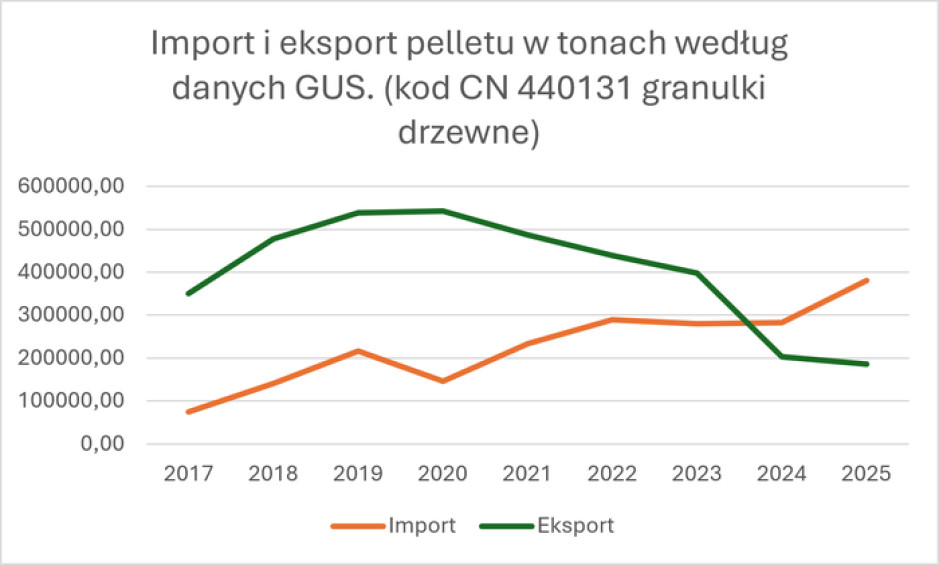
Annual domestic pellet demand is currently estimated at approximately 2,3 million tonnes, whereas domestic production fluctuates around 2 million tonnes. A turning point occurred at the turn of 2023 and 2024, clearly shown by GUS data (CN code 440131): Poland shifted from being a net exporter to a net importer of wood pellets. This trend is illustrated by the trade balance chart:
A similar divergence is visible across Europe, where consumption (approx. 32,7 million tonnes in 2024) exceeds EU production (approx. 22,7 million tonnes). Price pressure is therefore a global phenomenon — in Germany, during the freezing winter of February 2026, the average pellet price exceeded 422 euros per tonne. On top of this, local winter complications arise: raw material freezing, machine breakdowns, and reduced deliveries from Ukraine.
The pellet market situation is a textbook example of a complex interplay of factors: from legal requirements for Class A1, through the crisis and competition from China in the furniture market, to the sharp rise in installed boiler numbers. Blaming State Forests entirely for the wood supply shortage is a convenient mental shortcut that does not withstand scrutiny against hard market data.
Source: State Forests