Wheat prices fall sharply on the CBOT
CBOT wheat prices fell by 13 to nearly 18 cents per bushel on Wednesday, depending on the contract month, with the steepest declines recorded in the nearby contracts.
For the December 2026 contract, wheat was down 17,75 cents at 686,5 cents per bushel. The March 2027 contract was down 16,50 cents at 701 cents per bushel.
The strength of the dollar was also a headwind for agricultural commodities in the United States. The euro lost further ground against the greenback on Wednesday, trading at 1 1196 dollar, compared with 1 1262 dollar the previous day. At 6:33 a.m. Paris time on Thursday, the euro was trading at 1,1203 dollar.
Corn prices plunge in Chicago
After a period of consolidation, CBOT corn prices resumed their downward trend sharply on Wednesday, with steeper declines in nearby contracts. However, volatility remained limited during the session.
Operators were able to take some profits after the sharp rise the previous day. Tuesday’s move had notably been supported by a three-point drop in the proportion of US corn rated good to excellent. Despite this rebound, the market was still 14 cents below its level at the beginning of the week.
Large US supplies and caution ahead of the WASDE on 9 October also weighed on the market.
The November Brent contract edged up slightly this Wednesday, by 0,23%, to 101,31 $/barrel, while the November US WTI contract fell 1,11%, to 88,94 $/barrel. High oil prices helped limit pressure on corn. At 6:39 this Thursday morning, Brent was up 1,29% and WTI 1,09%.
For the December 2026 contract, the price of corn fell 6 cents to 502 cents dollars per bushel. For the March 2027 contract, it fell 5,25 cents to 517 cents dollars per bushel.
Wheat prices fall back below 245 €/t on Euronext
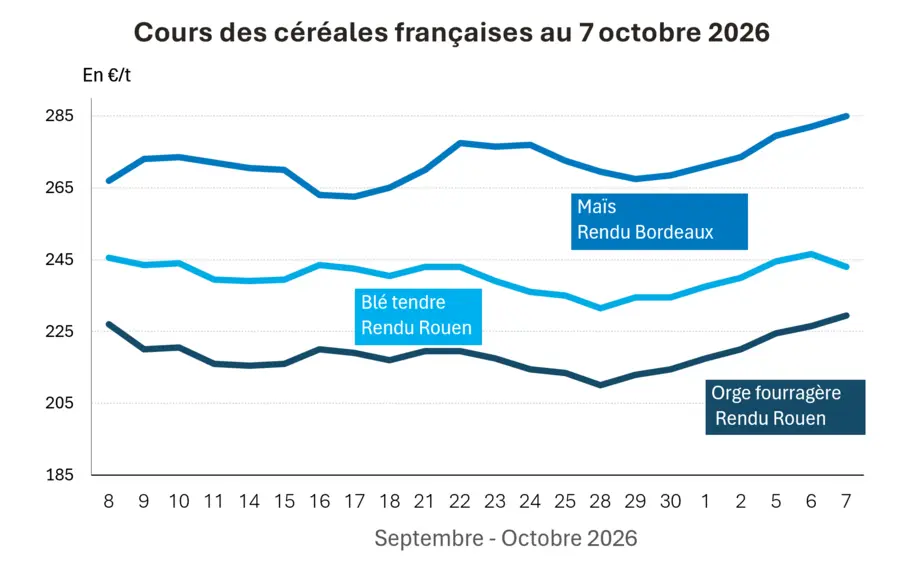
On Euronext, volatility remained low throughout the session, with limited intraday fluctuations. Prices moved lower, losing from 1 to just under 5 €/t depending on the contract, despite the serious difficulties in the Black Sea.
The December 2026 contract fell 3,25 €/t to 244,25 €/t, while the March 2027 contract fell 2,50 €/t to 246,75 €/t.
Financial operators on Euronext reduced their net long position to 177 228 lots, from 191 181 lots the previous week. Commercial operators also reduced their net short position. They therefore bought back some of their hedges while remaining net sellers overall, according to market analyst Aziz Laaziz.
Major global grain-importing countries are also returning to the market, which could benefit Western Europe given the logistical problems in the Black Sea. On 7 October, Jordan’s Ministry of Industry, Trade and Supply relaunched a tender for the second time for 100 000 to 120 000 t of wheat.
Corn prices resume their decline on Euronext
Corn prices resumed their decline this Wednesday, falling by up to a few euros per tonne depending on the contract. Volatility remained limited.
For the November 2026 delivery, corn prices fell by 1 €/t to 276 €/t. For March 2027, they declined by 0,75 €/t to reach 272 €/t.
As with wheat, financial operators reduced their net long position by approximately 600 lots, bringing it back to around 8 600 lots.
Ukraine: Corn harvest accelerates and yields improve
As of 5 October, Ukrainian farmers had harvested 1,62 Mt of corn, more than double the volume harvested one week earlier. Harvested area nearly doubled to reach 294 200 ha, representing 6,5 % of the expected 4,56 Mha. The national average yield improved, rising from 5,15 to 5,52 t/ha.
Despite this strong acceleration, harvesting remains at an early stage. Results also remain extremely heterogeneous across regions, with yields ranging from 2,58 to 11,44 t/ha.
Thus, Ukraine's corn harvest is rapidly gaining momentum and the national yield is improving; however, the low overall progress of fieldwork and the substantial regional disparities make any definitive conclusion about the final campaign yield premature.
Russia: Oilseeds may gain ground in 2027
Export difficulties and weak domestic prices could prompt Russian producers to reduce wheat and barley sown areas in 2027 in favor of soybeans, rapeseed, flax, and leguminous crops, which are better valued—particularly due to local processing. Corn is expected to remain preferred by farms possessing drying and storage capacity or secured market outlets.
Wheat appears to be the most vulnerable crop: wheat appears as the most vulnerable crop — its accumulation on the domestic market weighs on prices, while transport costs reduce profitability for farms located far from ports. According to the cited survey, 32 % of farmers plan to reduce their sown area and 26 % intend to forgo winter crop sowing.
FAO: Abundant cereals, but trade under strain
In its latest bulletin, the FAO confirms a globally well-supplied cereal market, yet increasingly disrupted in its trade flows. Global cereal production 2026 is estimated at 2,979 billion tonnes, the second-highest ever recorded. The global wheat harvest is revised upward from 3,2 Mt to 813,9 Mt, notably due to improved prospects in Australia. Conversely, secondary cereal production is reduced by 3,3 Mt to 1,612 billion tonnes, mainly due to deteriorating maize outlooks in the EU and the United States.
However, the main pressure concerns trade. The FAO lowers its forecast for global cereal trade by 3,5 Mt compared with September, to 505,8 Mt, representing a year-on-year decline of 3,5 %. Navigation difficulties in the Black Sea and insufficient alternative transport capacity are particularly hampering wheat and maize exports. For wheat, improved export prospects from Kazakhstan do not offset the expected decline in Russian and Ukrainian shipments.
FUNDAMENTALS
Production, Russia, wheat: 87,5 Mt, versus previously estimated 88,2 Mt (source: SovEcon)
Production, world, wheat: 813,9 Mt, i.e., +3,2 Mt compared with the previous estimate (source: FAO).
Production, world, secondary cereals: 1 612 Mt, i.e., -3,3 Mt compared with the previous estimate (source: FAO).
Utilization, world, maize: forecast reduced by 4,6 Mt (-0,4 %) compared with September (source: FAO).
Global end-of-season cereal stocks: 950 Mt in 2026/27, i.e., +2,8 Mt compared with the previous estimate (source: FAO).
INTERNATIONAL TRADE:
Global cereal trade: 505,8 Mt, i.e., -3,5 Mt compared with the previous estimate and -3,5 % year-on-year (source: FAO).