
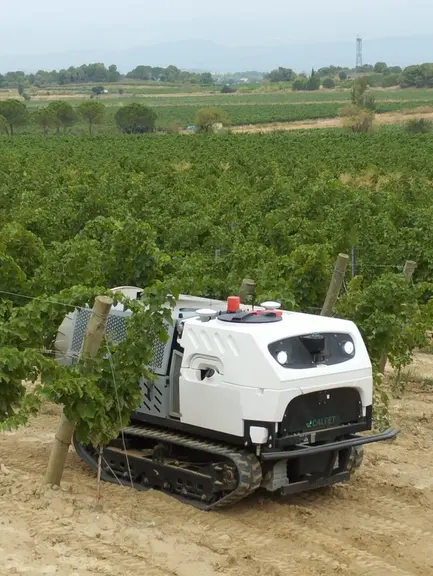
More expensive than a sprayer, but less expensive than a tractor with a sprayer and driver, Calvet’s brand-new robot for spraying can provide a solution when time is short or labor is in short supply. “With this robot, we have managed to combine technological innovation with affordability. We started from the principle: one robot, one task,” explains Gaëtan Marty, sales director of the SME based in Lézignan-Corbières, in the Aude department.
A specialist in the vineyard and orchard sprayer segment, the company naturally targeted spraying for automation. It is a task operators dislike because of the health risks and the treatments increasingly needed at night. It is also viewed unfavorably by neighbors. “Here we have a discreet machine that can pass through every row without coming into contact with the operator,” the manager sums up.
Fuel autonomy for a full day
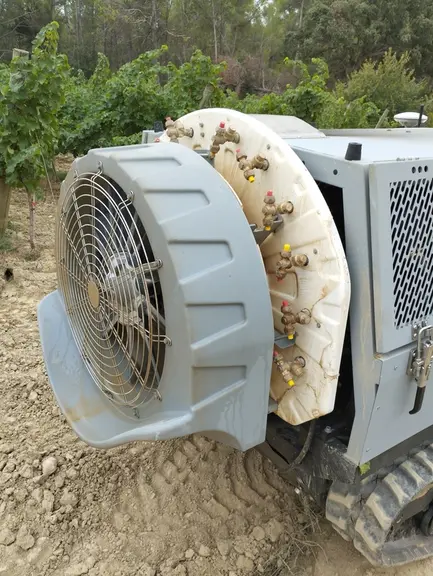
Calvet’s designers purchased a carrier base and installed a spraying unit on it, comprising an in-house air-blast fan. Two types of canopy are available: round or vertical, with the option to shut off sections on the right or left. Both canopies can be fitted with all types of nozzles. This equipment makes the machine versatile: it can be used in vineyards as well as in orchards, in low fruit hedges.
The “liquid” section is positioned at the front of the vehicle, with the spray mixture tank, the 50-litre rinse tank and the 25-litre diesel tank. At the rear, the engine section is on the right-hand side, and the pump for spraying is on the left. Two side covers that open upwards make it easier to access the vehicle for maintenance and repairs.
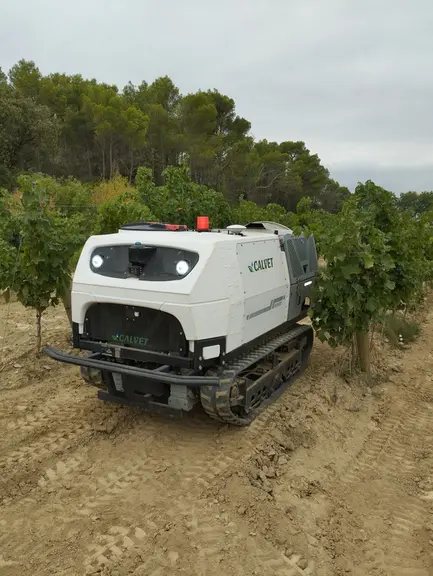
Compact (2.65 m x 1.26 m x 1.36 m) yet equipped with a 500-litre tank, the robot requires a row width of 1.50 m to 1.80 m to move through the vineyard. Its 45-horsepower combustion engine drives a pair of tracks fitted with agricultural tread, as well as the spraying pump. With a stated consumption of 4 litres per hour, the robot has enough autonomy for a day (or night) of work.
“The advantage of tracks is that they provide good load-bearing capacity. The robot can therefore operate shortly after rain, which can be an advantage in years when weather windows are limited,” notes Gaëtan Marty. Another advantage: it can turn around almost on the spot at the end of a row, requiring a headland width of only 2.50 m.
For spraying, the robot is equipped with a flow meter that allows it to automatically regulate the quantities of spray mixture dispensed according to its travel speed and the instructions it has received. Its maximum speed is 4.5 km/h. The machine is equipped with artificial intelligence to assist the user in planning the work: “the AI calculates, based on the amount of spray mixture remaining in the tank and the length of the rows the machine has to cover, when it needs to stop for a refill so that it can complete entire rows and avoid stopping halfway along a row,” explains the director.
Prior plot surveying required
Equipped with two GPS antennas for greater accuracy, the robot can be guided via a GSM subscription or a fixed antenna, which must be purchased separately. In both cases, accuracy is centimetric (RTK correction system).
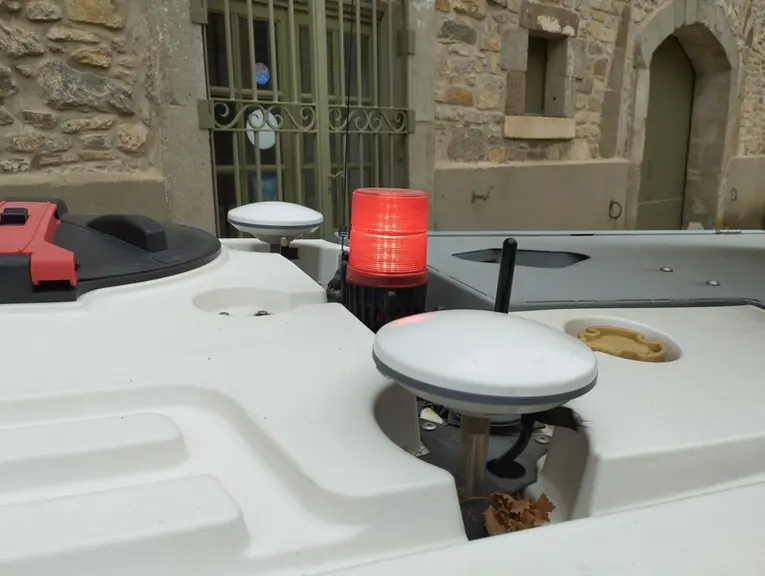
Before use, a survey is required so that the robotknows where to position itself: on regularly shaped plots, a pass at the four corners is sufficient. For plots with pointed sections, the perimeter must be walked or driven around with a quad bike. Non-straight rows require a pass along the row. Calvet estimates that it takes a quarter of an hour per hectare. Once the plots have been recorded, the robot moves around inside them and turns at the ends of rows autonomously. It can use paths, but cannot travel on the road and must be transported on a trailer.
Regulationsrequire the operator to remain close to the machine while it is running. This requirement can be met by using the remote control: equipped with a screen connected to the robot's camera, it provides a view from the front of the machine. The upper section is designed to hold a smartphone containing the farm's data, accessed through a dedicated app, supplied with the robot.
Bumper and LiDAR for safety
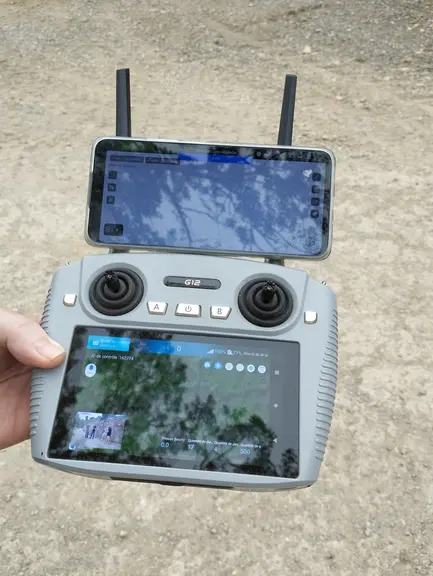
The lower section is used for manual steering via a joystick, for example during loading or when moving the machine for filling. At the start of the job, the robot must be paired with these two components, which communicate via Wi-Fi. The remote control also serves as a tank-level gauge.
As for safety, the vehicle is equipped with a bumper at the front that stops it if it comes into contact with an obstacle. As a preventive measure, a LiDAR detects people or objects in front of the robot, whether human, animal or plant, and also stops the machine if they are considered too close (from 3 m).
For the sprayingsystem, the machine's maintenance requirements do not differ from those of a sprayerClassic: the rinse tank uses the manufacturer's already proven technology. The exterior is rinsed using a pressure washer, taking care to avoid the more fragile antennas. For the engine, Calvet recommends maintenance at "normal" intervals, approximately every 200-300 hours. Lubrication points (e.g., grease fittings) must be serviced regularly, depending on usage intensity and operating conditions.
Stay informed in real time!
Follow topics, legislative projects, companies, and personalities to receive notifications as soon as we publish an article.
Pros
Proven classic spray technology
Versatile for viticulture and arboriculture
Large tank capacity (500 L)
Cons
Requires monitoring (regulatory requirement)
May stop due to signal loss
technical specifications
Power supply: thermal
Engine: 45 hp engine
Drive type: agricultural tracks
Architecture: inter-row
Dimensions: 2,65 m x 1,26 m x 1,36 m
Spray technology: air-assisted convector with carried jet
Tank capacity: 500 L
Independent closure of right and left sections
Maximum working speed: 4,5 km/h
Guidance mode: GSM or antenna
Cost: 70 000 EUR ex. VAT