
Pigs exhibit variations in feed intake, growth rate, and nutrient utilization efficiency, influenced by genetic, physiological, and environmental factors. For example, entire males have lower voluntary feed intake and greater efficiency in protein deposition and, consequently, higher lysine requirements than sows and castrated males (Figure 1; Brazilian Tables for Poultry and Swine, 2024). When these differences are not taken into account in feeding management, underfeeding or overfeeding may occur, compromising the productive and economic performance of the production system.
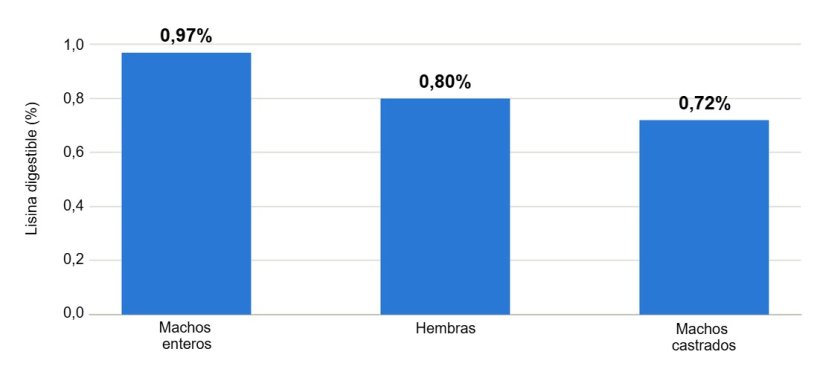
Figure 1. Digestible lysine requirements by category (70–100 kg). Source: Brazilian Tables for Poultry and Swine, 2024

As has been discussed on several occasions, precision feeding is based on the principle that each animal has individual nutritional requirements, which vary over time according to growth, physiological status, health, and the environment. In practice, this means adjusting nutrient supply daily to the animal’s actual demand, avoiding the excesses and deficiencies common in the phase-feeding system.
Precision feeding uses data such as individual feed intake, body weight, and weight gain to estimate each animal’s daily nutritional requirements (Hauschild et al., 2010), allowing the diet to be adjusted continuously and reducing nutrient losses to the environment, especially nitrogen and phosphorus. Finishing pigs fed individually using precision-feeding systems showed a 30% reduction in nitrogen excretion and feed costs compared with pigs kept in group-feeding systems, without affecting performance (Figure 2; Andretta et al., 2016). This effect is due to more precise adjustment of protein and mineral supply to actual requirements, thereby reducing the excess that would be excreted as urinary nitrogen and fecal phosphorus.

Figure 2. Individual precision feeding versus group feeding, without compromising animal performance. Source: Andretta et al., 2016.
Another relevant aspect is the variability among animals within the same batch, arising from factors such as health history, immune status, and gut microbiota composition. By accounting for these differences, precision feeding better adjusts nutrient supply to each individual’s needs. For example, in a batch of finishing pigs (30–60 kg) with an estimated average requirement of 0.95% digestible lysine, animals with greater protein-deposition potential may require close to 1.05%, while those with lower potential need only 0.85%, representing a variation of ±10–15% from the average (Hauschild et al., 2012). However, in a conventional system, all animals receive the same single diet.
After ingestion, absorbed nutrients are used for multiple biological functions: growth, tissue deposition, maintenance of homeostasis, and immune response. Under stressful conditions, such as a health or heat challenge, nutrients are physiologically prioritized for maintaining and defending the organism at the expense of productive functions (growth, milk production, and reproduction), since the immune response and stress-adaptation mechanisms increase the demand for energy and amino acids, in addition to the energy cost of thermoregulation and inflammation. This metabolic redistribution partly explains the decline in performance when the diet is not adjusted to the animal’s actual physiological needs, even when feed intake remains at the same level.
Amino acids play a fundamental role in this process, as they are components of defense cells and are involved in the synthesis of immunoglobulins, cytokines, and acute-phase proteins. Diets with a higher supply of amino acids tend to be more suitable for pigs subjected to a health challenge: at levels above the requirements for tryptophan, methionine, and threonine, supplemented animals showed different feed efficiency compared with unsupplemented animals (Figure 3; Valini et al., 2024). However, this response is not uniform across animals and depends on their individual ability to cope with the challenge. More “resilient” animals, with greater immune and metabolic competence, allocate amino acids to both the immune response and productive functions, while more compromised animals prioritize maintenance and defense at the expense of production.
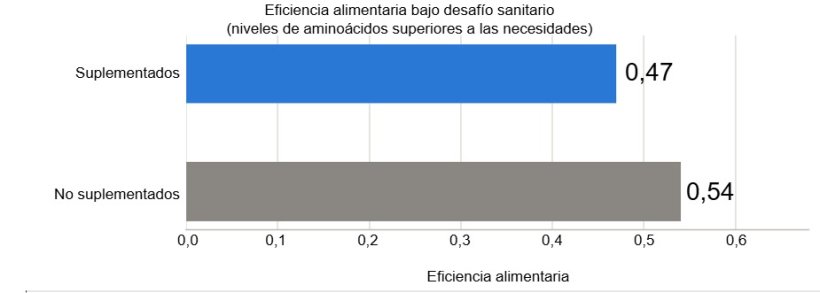
Figure 3. Feed efficiency under a health challenge in animals supplemented with amino acid levels above the requirements for tryptophan, methionine, and threonine, and in unsupplemented animals. Source: Valini et al., 2024.
In this context, precision feeding makes it possible to adjust nutrient intake continuously and individually to the different physiological conditions of animals (Hauschild et al., 2010), making feed supply more precise and economically viable, although applying this concept to animals facing challenges still requires further study.
The association between animals’ biological and physiological mechanisms and precision feeding systems enables more timely nutritional adjustments that are better aligned with individual variations, contributing to greater feed efficiency, better resource utilization, and greater sustainability of production systems.